Photography meets citizen science: June's wildlife in south-eastern Pennsylvania
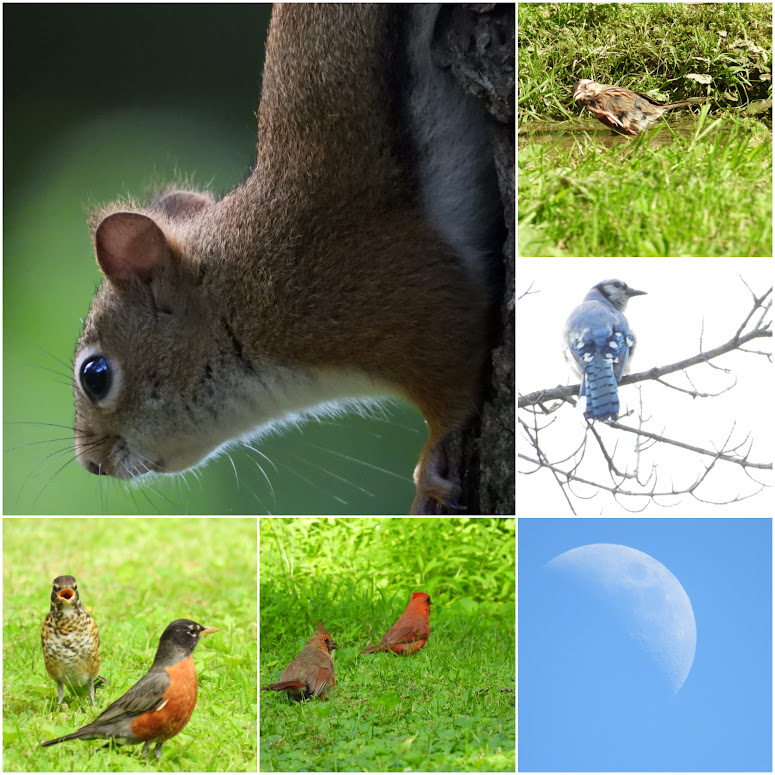
Now that June has reached a close and spring turned into summer, we can start reviewing the iNaturalist observations and the wildlife photos that I collected during my backyard "wildlife walks" for the month. My backyard photography and citizen science hobby has now progressed from winter's snow-covered ground to summer's 100 degree (F) temperatures.
Let's take a look at iNaturalist first - During June, I submitted 54 observations covering 19 species. All but two observations and two species were confirmed by iNaturalist identifiers and reached "research grade". This total down from previous months for two reasons:
First, the spring migration season ended, so the number and variety of real world observations declined. Second, I have started to curb my submissions of repeated species on consecutive days. In general, I wait a week now to resubmit the same species - unless there's something interesting about the sighting.
Overall, I have now submitted a total of 227 observations with 44 unique species.
As far as new species during June, there were only 2:
Here is a summary table:
| Common Name | First Observation Date | Most Recent Observation (as of July 4) | Observation Count | June Observation Count | June Observations (Links) |
|---|---|---|---|---|---|
| Northern Cardinal | 2026-03-30 | 2026-06-19 | 16 | 6 | 2026-06-06 2026-06-09 2026-06-09 2026-06-13 2026-06-19 2026-06-19 |
| Turkey Vulture | 2026-03-24 | 2026-06-28 | 30 | 6 | 2026-06-05 2026-06-08 2026-06-09 2026-06-14 2026-06-16 2026-06-28 |
| American Robin | 2026-04-10 | 2026-06-28 | 10 | 5 | 2026-06-09 2026-06-19 2026-06-20 2026-06-12 2026-06-28 |
| House Finch | 2026-04-26 | 2026-06-23 | 12 | 5 | 2026-06-06 2026-06-09 2026-06-10 2026-06-23 2026-06-23 |
| American Red Squirrel | 2026-03-22 | 2026-06-14 | 12 | 4 | 2026-06-01 2026-06-06 2026-06-09 2026-06-14 |
| Blue Jay | 2026-03-21 | 2026-06-28 | 14 | 4 | 2026-06-06 2026-06-08 2026-06-09 2026-06-28 |
| Eastern Cottontail | 2026-05-26 | 2026-07-01 | 6 | 3 | 2026-06-09 2026-06-14 2026-06-23 |
| Red-tailed Hawk | 2026-03-19 | 2026-07-01 | 28 | 3 | 2026-06-06 2026-06-18 2026-06-25 |
| Song Sparrow | 2026-05-22 | 2026-07-02 | 7 | 3 | 2026-06-02 2026-06-08 2026-06-17 |
| Downy Woodpecker | 2026-04-03 | 2026-06-24 | 3 | 2 | 2026-06-06 2026-06-24 |
| Eastern Kingbird | 2026-05-15 | 2026-06-26 | 3 | 2 | 2026-06-14 2026-06-26 |
| Gray Catbird | 2026-05-01 | 2026-07-02 | 10 | 2 | 2026-06-14 2026-06-23 |
| Mourning Dove | 2026-03-21 | 2026-07-03 | 11 | 2 | 2026-06-08 2026-06-19 |
| Northern Flicker | 2026-03-25 | 2026-07-01 | 10 | 2 | 2026-06-10 2026-06-20 |
| Black Vulture | 2026-05-03 | 2026-06-05 | 5 | 1 | 2026-06-05 |
| Cooper's Hawk | 2026-04-26 | 2026-06-20 | 2 | 1 | 2026-06-20 |
| Great Crested Flycatcher | 2026-06-09 | 2026-06-09 | 1 | 1 | 2026-06-09 |
| House Sparrow | 2026-06-26 | 2026-06-26 | 1 | 1 | 2026-06-26 |
| White-tailed Deer | 2026-05-29 | 2026-06-06 | 2 | 1 | 2026-06-06 |
And here is a visual from Meta AI:
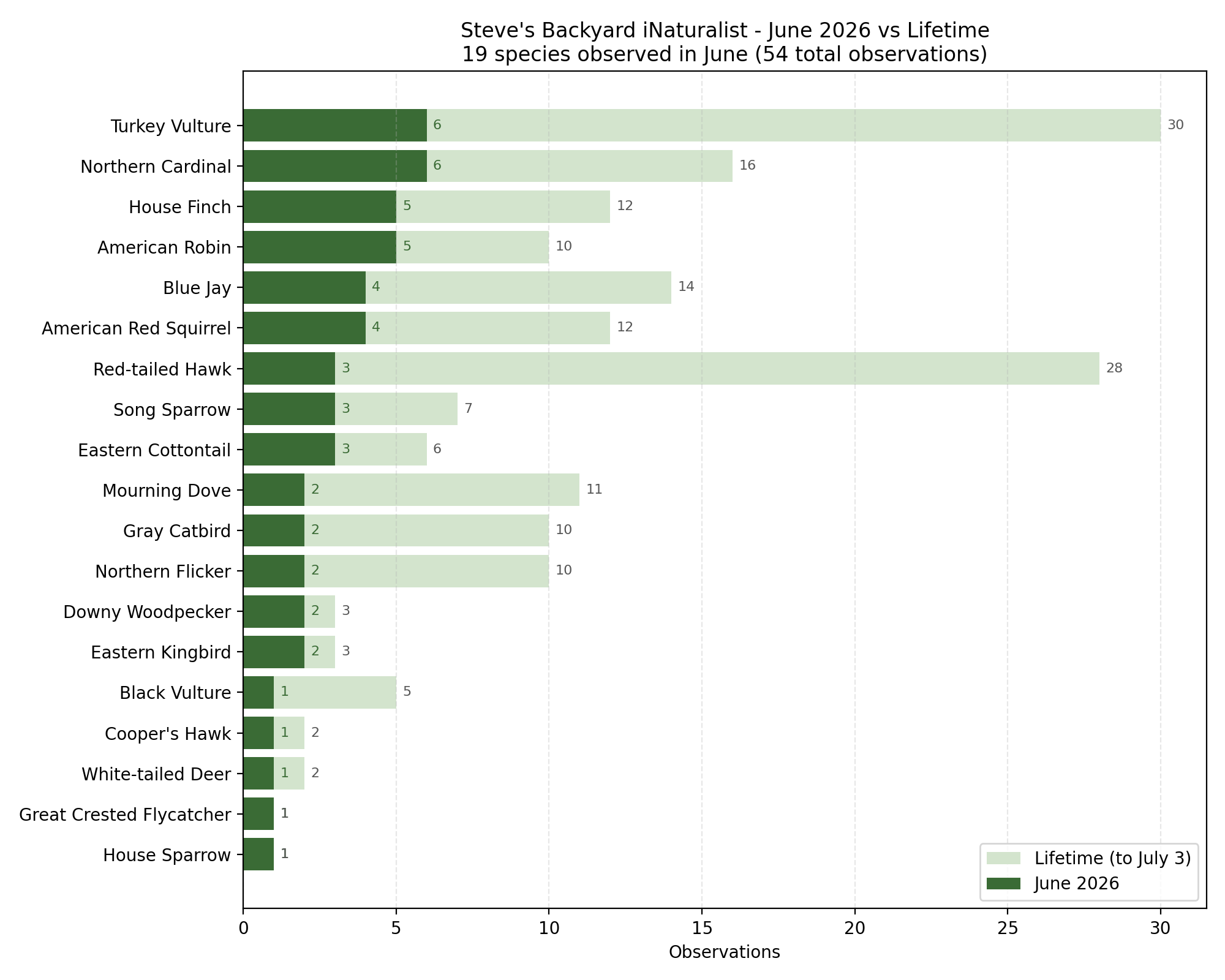
Impressions and observations for the month are as follows:
- Rabbits and squirrels were a lot more common. I saw them almost daily, and saw white tailed deer a few times beyond what I was able to capture with the camera.
- Juvenile small birds were a lot more common;
- The variety of birds was much lower;
- Bird photography became more challenging. It feels like there are two reasons for this one.
- First, the trees are now fully covered with leaves, so it's harder to get a good view of animals in the trees or in the sky. For the small birds, I'll hear a bird singing, but it will be totally invisible behind the leaves. For large birds, the gaps where I can see open sky have gotten smaller, so if I don't manage to focus and zoom quickly enough I am more likely to miss the shot.
- Second, it seems like the birds have started moving around more quickly - It feels much more frequent that I see a bird, but it leaves again before I have time to get focus and zoom adjusted. This applies to both the small birds and the vultures & hawks.
- June was the first month where I did not manage to get a shot of a Bald Eagle (so far, July is on track to be the second).
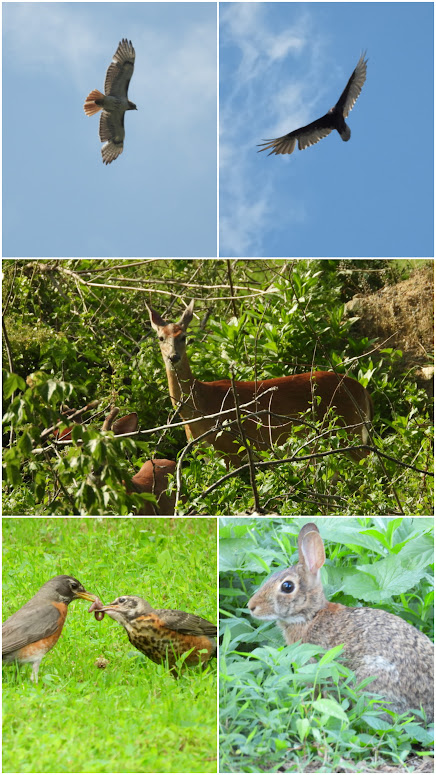 | 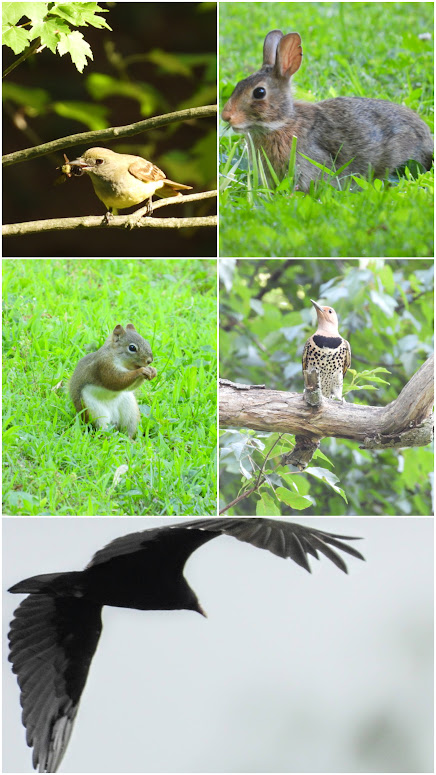 |
As far as photography, I saved 1382 photographs and probably (as usual) threw away just as many because they were bad photos or duplicates. The collages from this post actually cover most of the species that were encountered. The individual species names and relevant information from the scene will be included in upcoming posts.
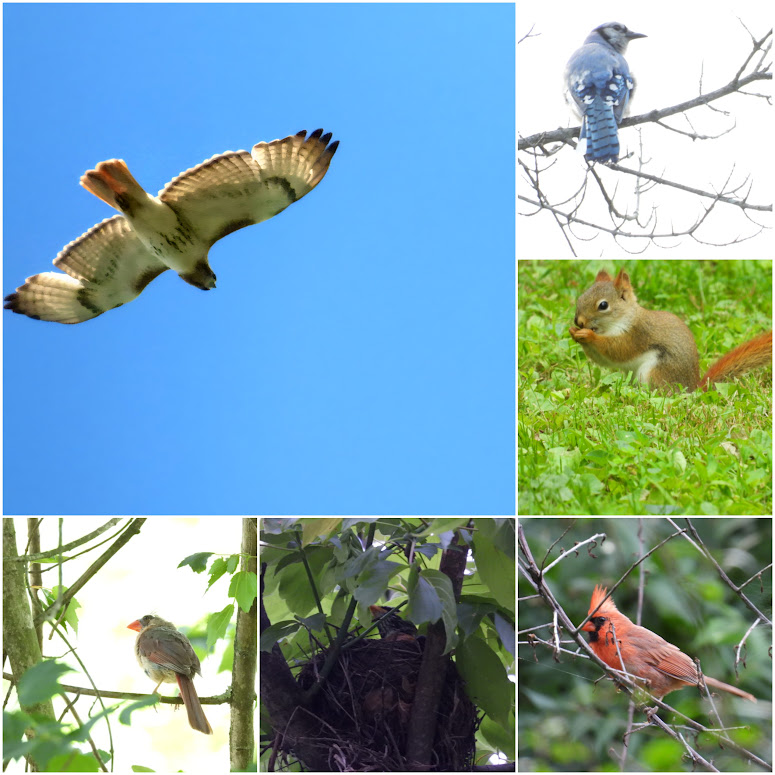
A surprise and disappointment in June was the absence of Red-tailed hawks during much of the month. They are actually fun targets for photography, so I'm always on the lookout for them. In May, I had established that we probably have a nesting pair living nearby, so I was expecting to continue seeing them during June.
Surprisingly, though, I think I only saw the Red-tailed hawks on about 5 or 6 days of the month.
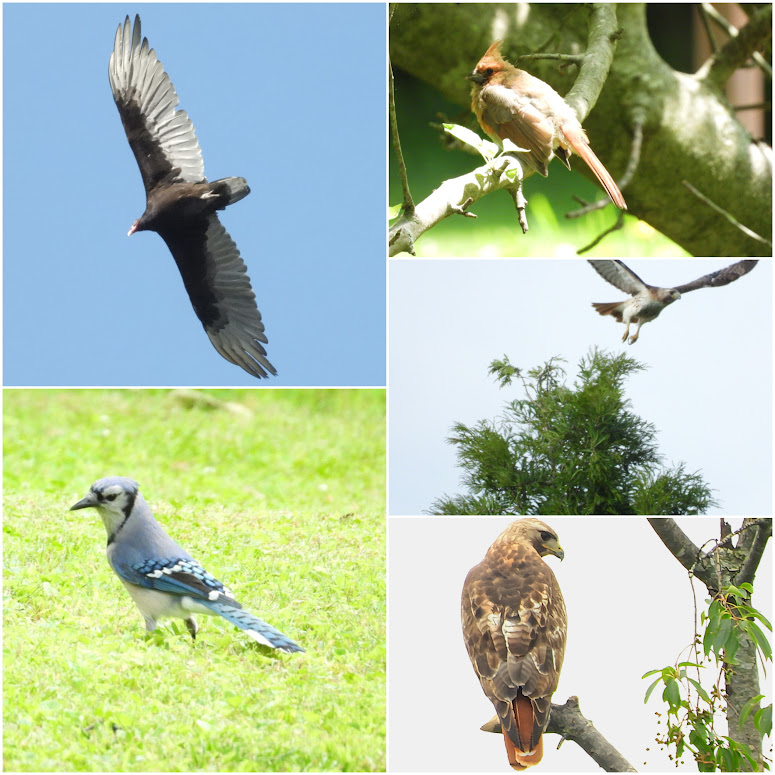
Despite that, I did manage to get some decent photos of them - in flight and on the ground, including at least one mobbing event and one whose presence I was tipped off to by the rabbit that I had in my view-finder at the moment it spotted the bird. The rabbit saw the hawk and bolted like lightning.
The decline in variety during June was offset a little bit by the appearance of mating pairs and juveniles of both birds and mammals, so I was able to get a few interesting photos of otherwise commonplace subjects. I'm not sure, since this is my first year paying attention to this stuff, but I guess the seasonal activities will also become more commonplace in July and August, so I'm already looking forward to the fall migration season. But, maybe the remaining summer months will bring some surprises.
Finally, an open question from previous months was, "what will happen to the adjacent property"? As you may recall, the property owner had taken down a bunch of trees in April and it seemed that the last remaining section of woods & brush would be completely removed. But, that activity stopped before it reached completion.
The rumor in the neighborhood was that the township had stopped them - presumably due to a zoning or permitting issue.
Well, the news for today is that there's no update. The work hasn't resumed, and I have no idea whether it's going to or not. There's no residence there, and I don't know the property owner, so I'm still in wait and see mode to see if this last little bit of wildlife habitat is going to be removed. Time will tell.
Thank you for your attention!
All photos above were taken by me with a Nikon P1000 camera. I'm sharing them under the CC BY 4.0 license (share & adapt freely with attribution to the original source).
Some cool shots in there. I like the back view of the Red-Tailed Hawk.
And the Great Crested Flycatcher is a great new species to identify! That's not one I would have been able to get without a guide or an assist.
Thanks. When I sat down to start looking through the photos, I was afraid I wouldn't have enough decent shots for the month, but fortunately there were more than I had remembered.
I had help for both of those two photos. The AI helped with identifying the flycatcher. I would've never gotten it on my own. Also, I adjusted the lighting and shadows on the hawk in Google Photos to try to bring out the color. It was shot on a pretty dreary day.
I hear dreary day light can be excellent for photographs!
That's the big drawback of my camera. It doesn't do well in low light. The zoom is apparently accomplished by using a really small sensor, so bad light & high zoom usually means bad pictures for me.
The one exception is the black & white turkey vulture in one of the collages above. It was totally by accident, but I like the way that turned out.
It looks like somebody's hairline. You could draw a face in the empty space down and to the left, and it would look great! 😃
lol. A receding hairline with a long comb-forward in the front. ;-)