Learning photography with wildlife in south-eastern Pennsylvania: First encounters in the month of April
Introduction
Here's the next post in my evolving series of posts covering the journey from learning photography to learning about wildlife to participating in citizen science and blogging about it on Steem. I began photography practice on local wildlife in March, and continued in April and into May.
Last week brought my first post covering my wildlife photography practice during the month of April, Photography meets citizen science: April's wildlife in south-eastern Pennsylvania. In that post, I mentioned that I submitted 64 observations covering 23 species to the iNaturalist web site.
For the next posts, I thought I'd show some more details on the "first encounter" species - i.e. species that I hadn't photographed before. It turns out that there were 10 of them:
| Common Name | First Observed | Common Name | First Observed |
|---|---|---|---|
| Downy Woodpecker | 04/03/26 | Cooper's Hawk | 04/26/26 |
| Painted Turtle | 04/04/26 | House Finch | 04/26/26 |
| White-throated Sparrow | 04/04/26 | Carolina Wren | 04/27/26 |
| Red-winged Blackbird | 04/09/26 | American Crow | 04/28/26 |
| Osprey | 04/20/26 | Eastern Bluebird | 04/28/26 |
There are enough photos of these animals that I'll need to split the set in two. All photos below were taken with a Nikon P1000 bridge camera. It has a physical 539mm focal length, which is reported as having an equivalent field of view to a 3000mm focal length for a 35mm.
Let's get on to the encounters.
Downy Woodpecker
First seen on April 3, and only reported to iNaturalist once during the month, we have the Downy Woodpecker. The weather was dreary, and the bird was high at the top of a tree, so it's not a great photo, but here it is - after lighting enhancements in Google Photos, and cropping & sharpening in LibreOffice. Before postprocessing, the original photo was taken with the following settings: ƒ/8; 1/1000; 503mm (2800 equiv , 116X); ISO250
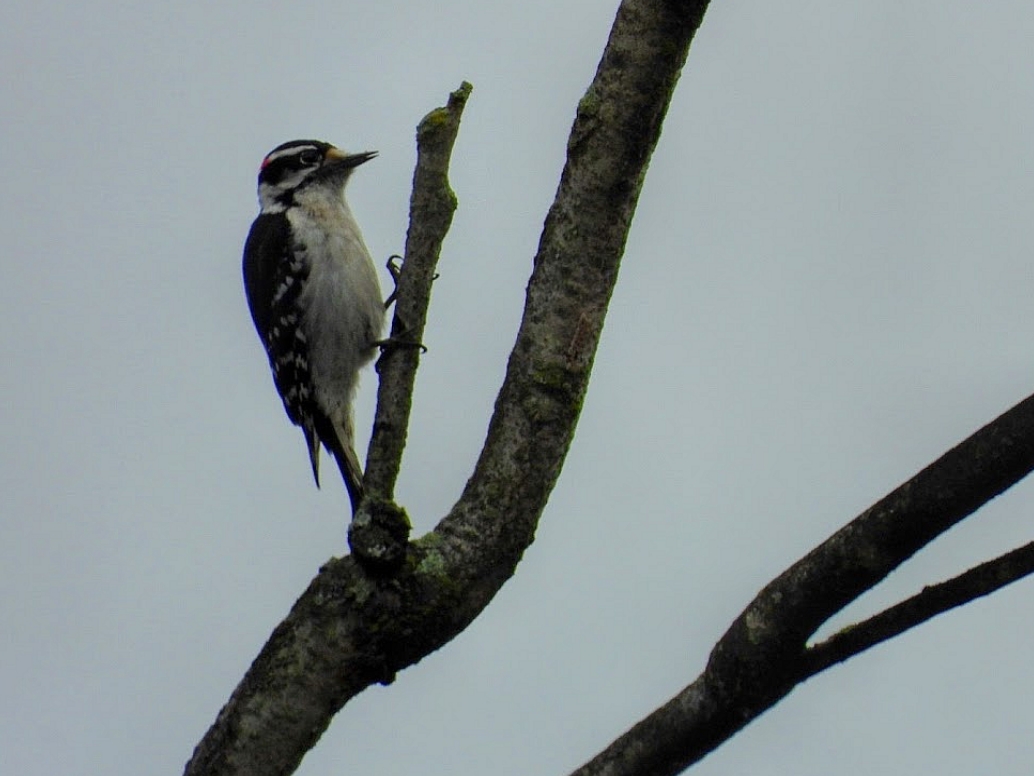
The Downy Woodpecker is the smallest woodpecker in North America, and it ranges across most of the United states and Canada, avoiding only the arid southwest states.
Painted Turtle
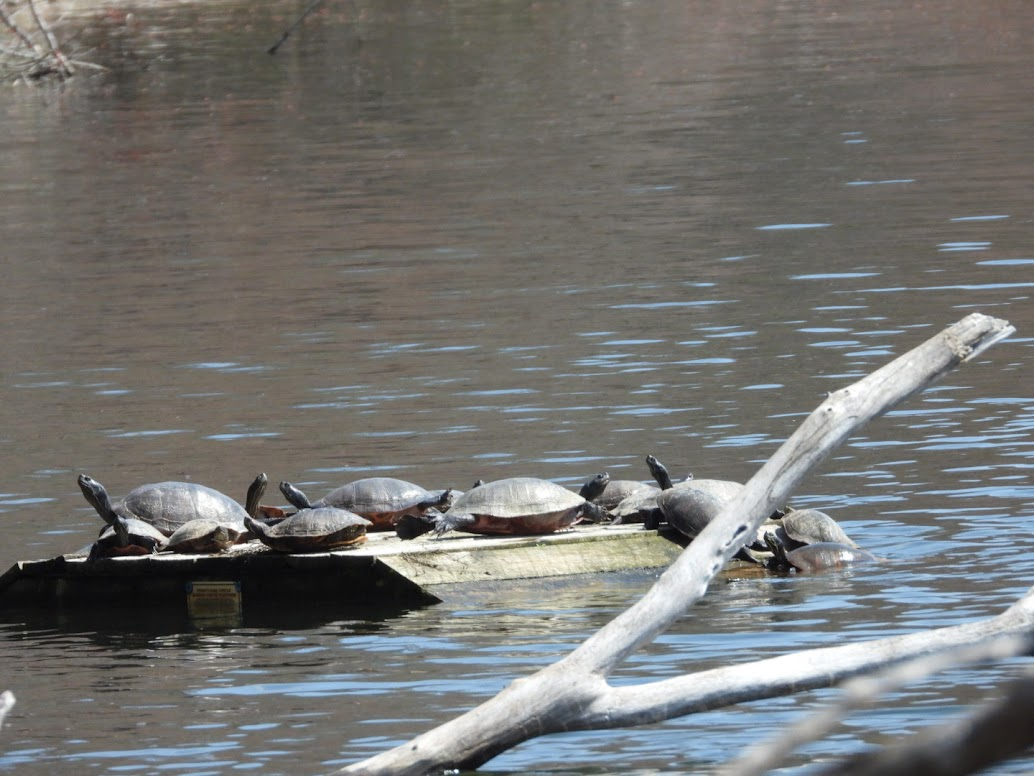
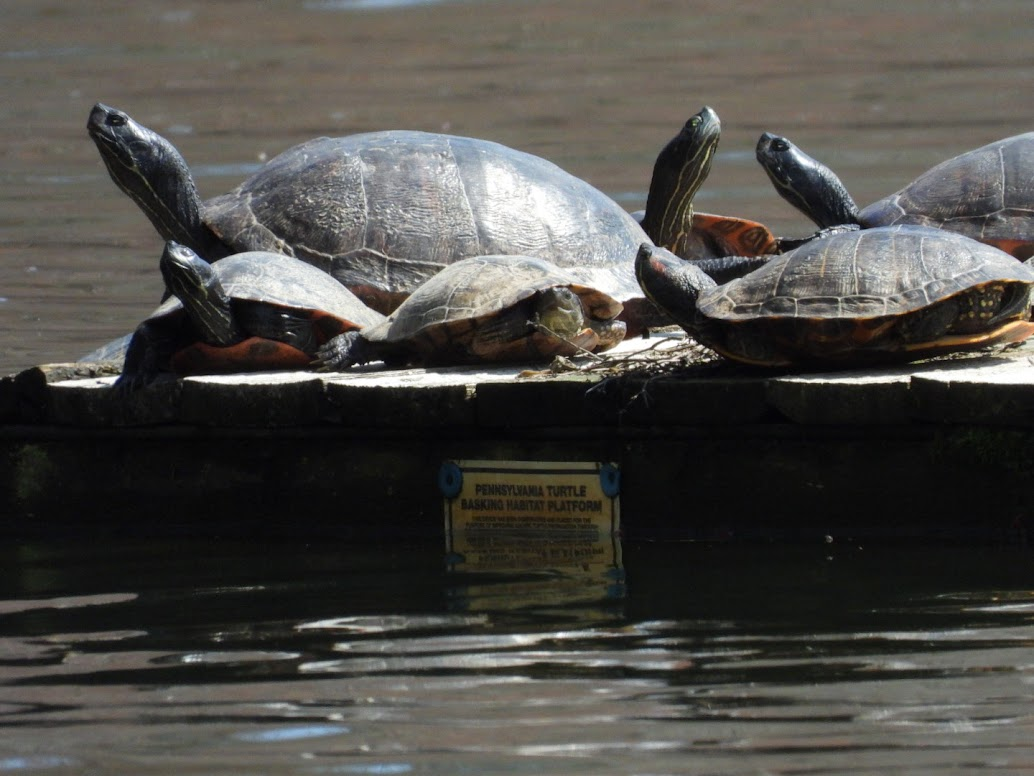
The painted turtles were observed on April 4 at Marsh Creek State Park. They were taking advantage of a basking platform that is provided to them by the Pennsylvania Fish and Boat Commission. I suspect there are multiple species of turtles in this photo, but I'm not able to identify them (If only @natator88 and @herpetologyguy were still here). I'm pretty sure that a couple are painted turtles. As with the Downy Woodpecker, this was the only day that I photographed this species.
| ƒ/5.6; 1/1250; 135mm ( 751 equiv, 31X); ISO450 | ƒ/7.1; 1/1250; 467mm (2600 equiv, 108X); ISO800 |
|---|---|
 |  |
Bonus photo - Canada Geese
It's worth noting that we also saw some Canada Geese that day, although I did not report the observations to iNaturalist because they're so common as to be regarded as pests. This is ironic, because the species was nearly extinct in the 20th century.
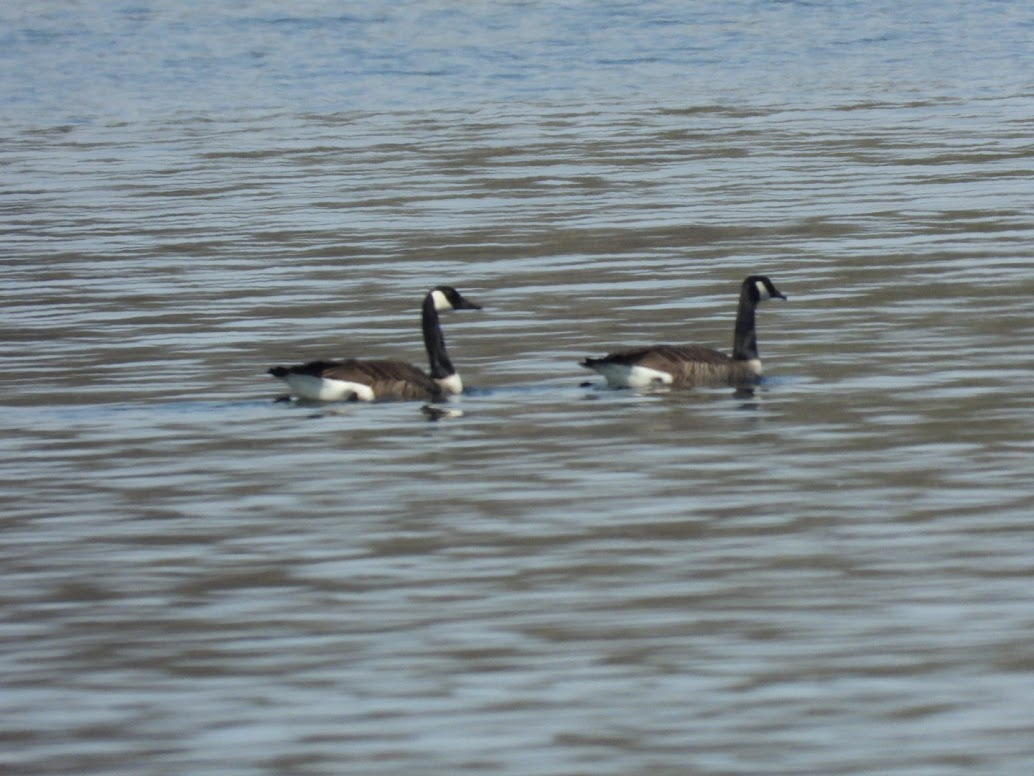
ƒ/8; 1/1600; 539mm (3000mm equiv, 125X); ISO640
White-throated Sparrow
Another first and only observation at Marsh Creek on April 4 was the White-throated sparrow. These guys also range across the US and Canada. The one in the photo was quite active, so it was challenging to keep the lens on him for long enough to target the autofocus.
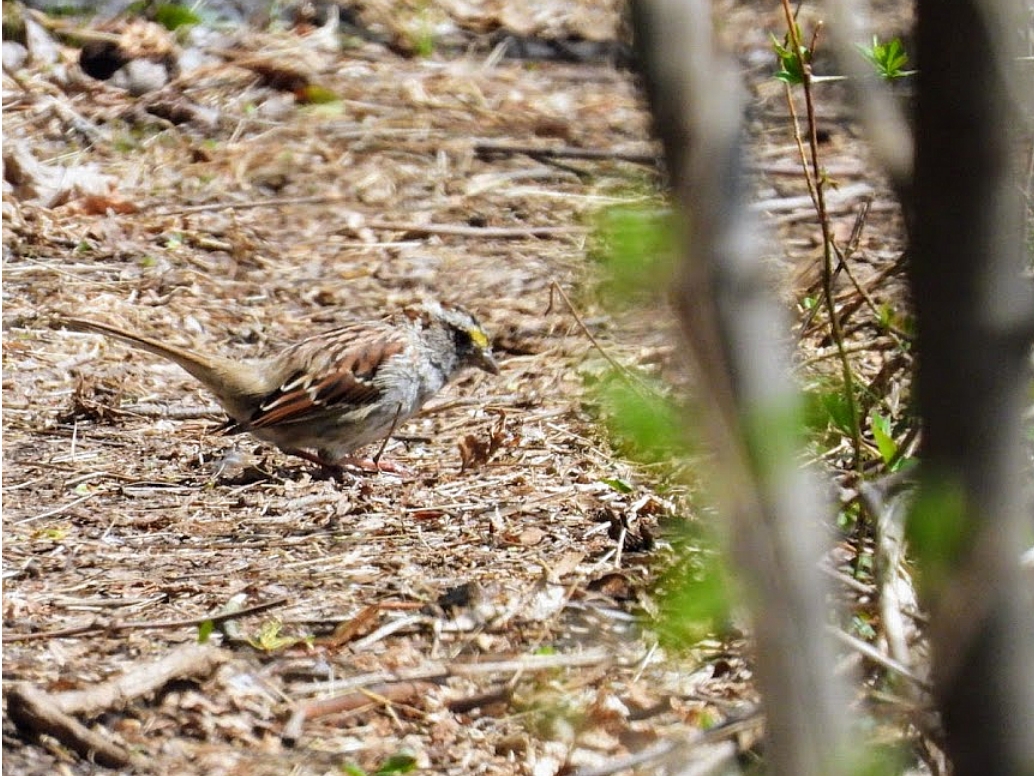
ƒ/7.1; 1/1600; 395mm (2198 equiv, 91X); ISO800 with lighting adjustments in Google Photos and cropping/sharpening in LibreOffice.
Red-winged blackbird
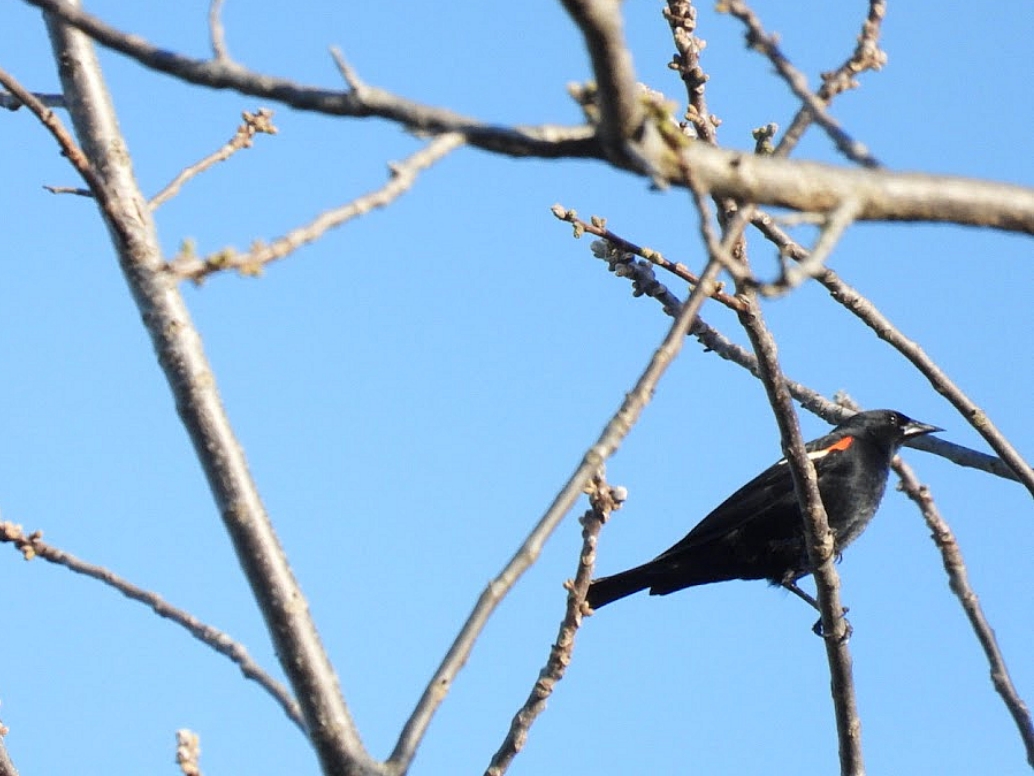
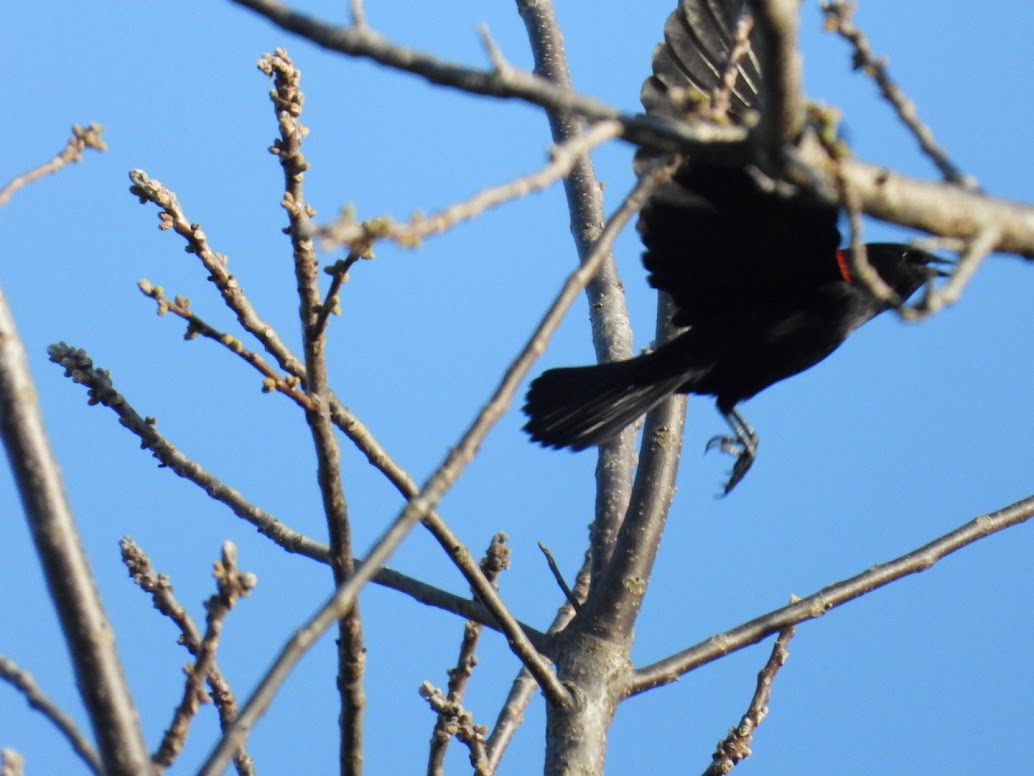
The first and only observation of the Red-winged Blackbird during April was on April 9 at the Sandy Hollow Heritage Park. I had no idea what it was, at first, but it turns out that these are easily recognized by the red and yellow bands on their shoulders. These birds can be found throughout the US, Mexico, and Canada, and they have no conservation concerns.
| ƒ/7.1; 1/800; 467mm (2600 equiv, 108X) Cropped and sharpened in LibreOffice; ISO800 | ƒ/8; 1/800; 539mm (3000 equiv, 125X); ISO800 |
|---|---|
 |  |
Osprey
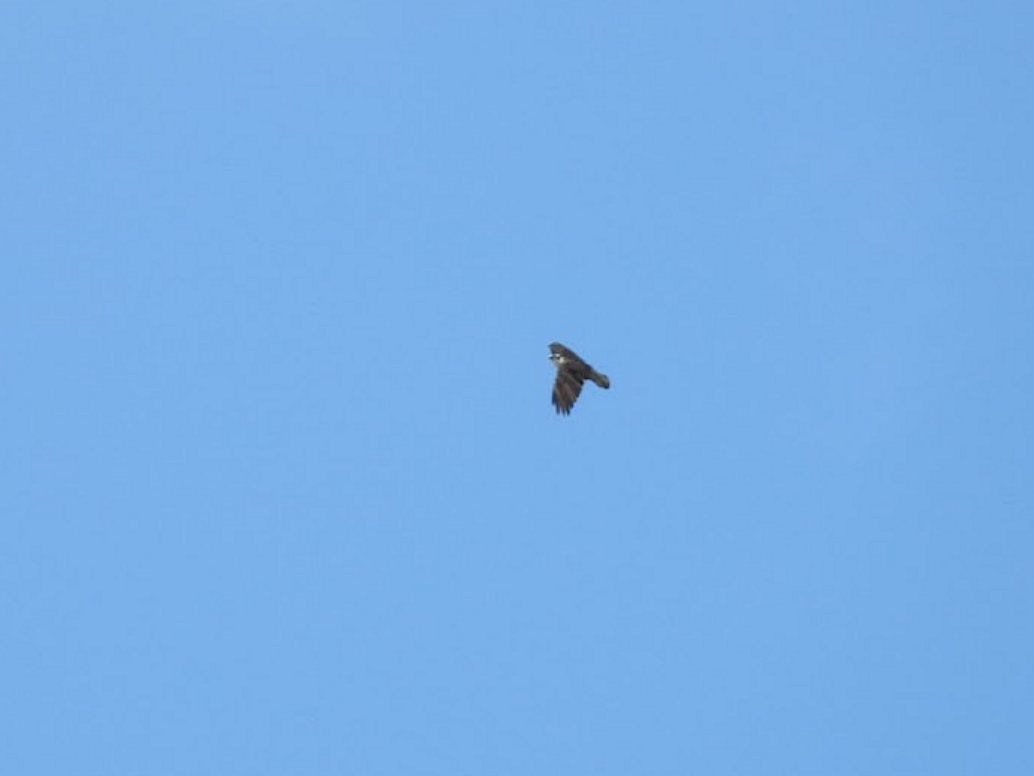
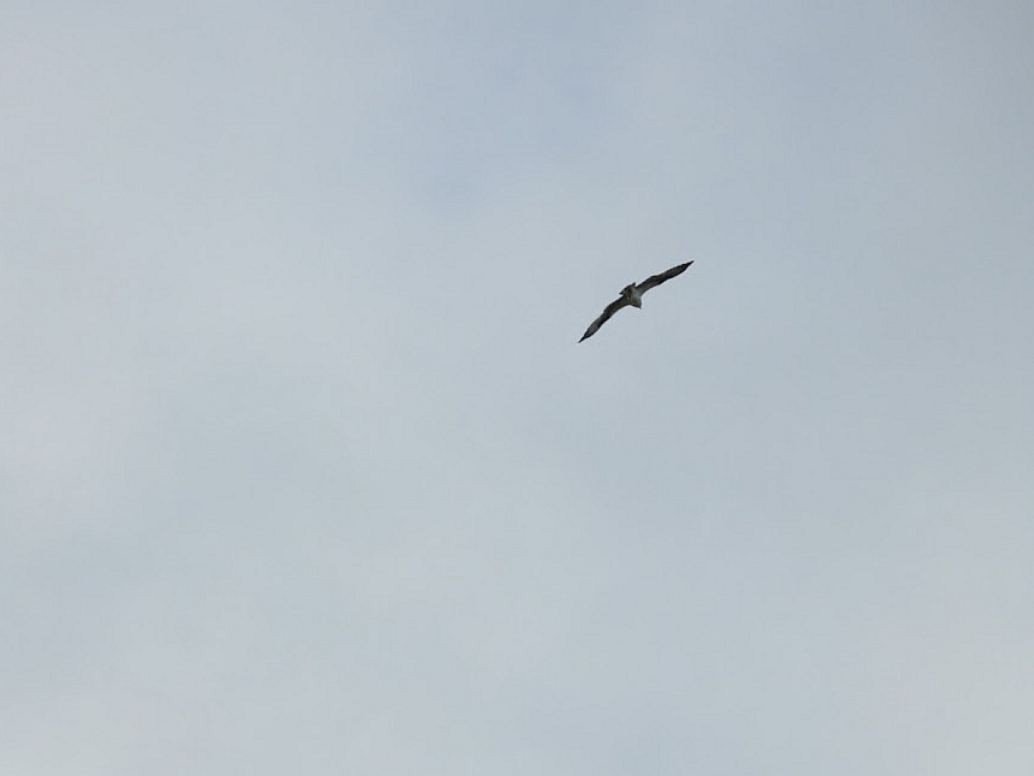
Not great pictures, but you take what you can get. The bird came and went very quickly. The only time I've seen or photographed a wild osprey (in my life, not just April) was on April 20, and it was flying above my yard. It's interesting to notice how dramatically the background changed when it flew in front of a cloud. That dramatic change in background makes autofocus targeting quite challenging.
At first, the white head fooled me, and I thought I had another Bald Eagle, but I was confused by the dark tail. Eventually, the bird was identified as an Osprey.
| ƒ/5.6; 1/500; 270mm (1500mm equiv, 63X); ISO160 Cropped and sharpened in LibreOffice | ƒ/5.6; 1/500; 198mm (1102 equiv; 46X); ISO100 Cropped and sharpened in LibreOffice |
|---|---|
 |  |
Although the Osprey has never been endangered on the global scale, I also learned that the bird had been considered extirpated - or "locally extinct" - in the state of Pennsylvania, up until the 1980s. The species was recovered here using a method known as bird hacking that was first developed by falconers, centuries ago, and adapted for conservation purposes by Larry M. Rymon at East Stroudsburg University, here in Pennsylvania.
In this technique, young birds are placed in so-called "hack boxes" at 15-30 days of age, before they're capable of flying. They are fed and protected with as little human contact as possible until they are ready to learn to fly and venture out on their own.
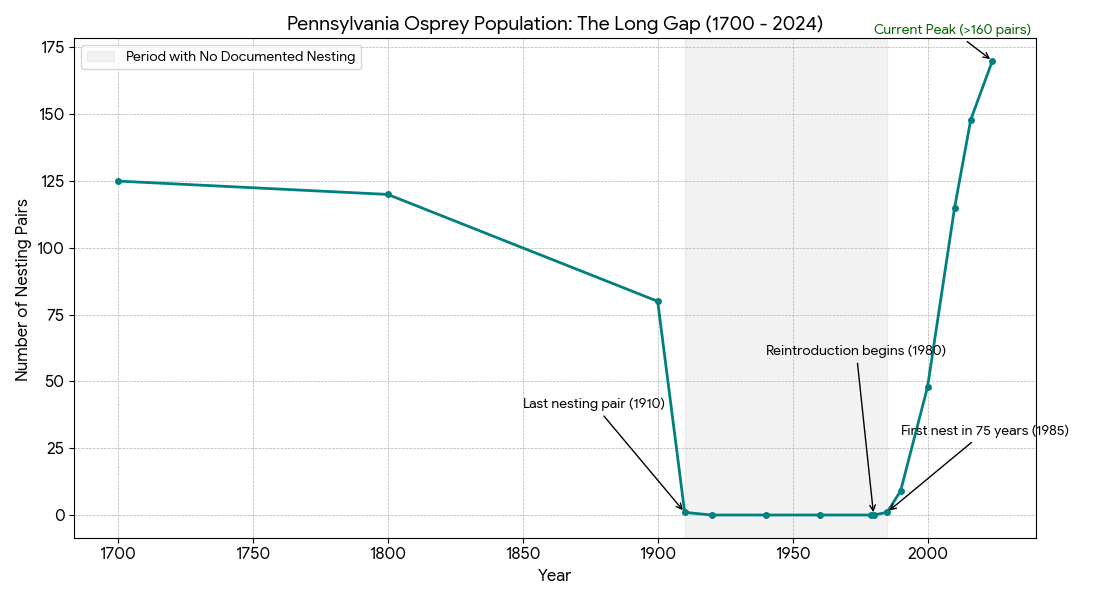
Google Gemini made this graph for me showing the estimated Osprey population in Pennsylvania from 1700 until today. Before their reintroduction in the 1980s, the last resident nesting pair was observed in 1910.
As I understand, the birds could still be found here during their annual migrations, but none lived here on a permanent basis for about 70 years. An interesting fact is that part of the reason that they were threatened was that they are very picky about nesting sites, always seeking a tall, dead, tree near a body of water where they can hunt for fish. Tall dead trees, however, are hard to find. They thrive today, in part because modern human cell phone towers, light posts, and other tall structures have given them a new habitat for nesting.
Conclusion
I'm just about out of time, so that's it for today. It's funny how simple practice at photography has turned into an unexpectedly vast web of interconnected information. Learning about photography, learning about wildlife, learning about history, participating in citizen science, and blogging about it.
If you're ever on the hunt for blogging topics, I can't recommend this enough. It's almost like a real-world video game, where just stepping out your door and looking at the trees and sky turns into a series of moments of excitement and anticipation.
If anyone wants to take a run at identifying those other turtles, please do!
Stay tuned for part 2 in the series, which will cover the last 5 first-encounter species.
Thank you for your attention!
All photos above were taken by me with a Nikon P1000 camera. I'm sharing them under the CC BY 4.0 license (share & adapt freely with attribution to the original source).