Chrome’s Agentic AI Era: Auto Browse, Gemini Sidebar, and the End of Manual Browsing
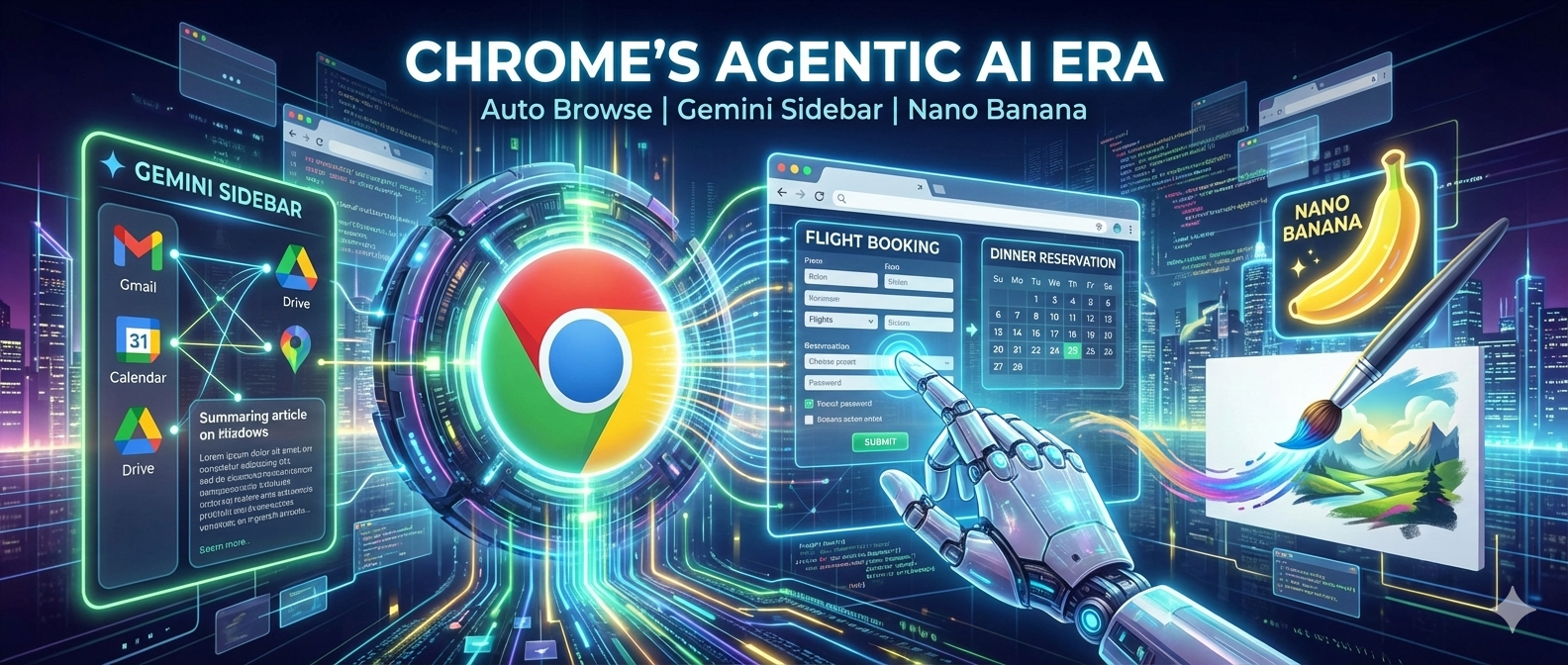
For decades, web browsers have been passive windows to the internet—you click, you type, you scroll. On January 28, 2026, Google officially flipped that script. With a massive update to Chrome, the company introduced a suite of AI features headlined by "Auto Browse," an agentic AI that doesn't just help you find information but actively performs tasks on your behalf.
Alongside deep Gemini integrations and a new creative tool dubbed "Nano Banana," this update signals Google’s aggressive move to transform Chrome from a simple browser into an autonomous digital companion. Here is everything you need to know about Chrome’s new brain.
The Headliner: Auto Browse
The most significant addition is Auto Browse, an "agentic" AI designed to handle the tedious parts of the web. Powered by Gemini 3, this feature allows users to delegate complex, multi-step workflows to Chrome.
Instead of opening five tabs to compare flight prices or manually filling out a license renewal form, paid subscribers (AI Premium/Ultra, $20–$60/mo) can simply type or speak a prompt like, "Find a dinner reservation for two in downtown Chicago this Friday under $100."
Auto Browse spins up a dedicated tab and begins navigating websites independently. It clicks menus, fills out forms, and filters results in real-time. Critically, Google has built in "human-in-the-loop" safeguards: the agent will pause and request user confirmation for sensitive actions, such as finalizing a payment or submitting personal credentials.
The Gemini Sidebar: Your Personal Context Engine
While Auto Browse is reserved for power users, the Gemini Sidebar has been rolled out to everyone. This isn't just a chatbot stuck to the side of your window; it is now deeply integrated with your personal data ecosystem.
By pulling context from Gmail, Google Calendar, and Drive, the sidebar can answer queries that require knowledge of your life. You can ask, "Summarize this article and tell me if it conflicts with my meeting at 3 PM," and Gemini will cross-reference the webpage content with your calendar instantly.
Google has preemptively addressed privacy concerns by launching a dedicated privacy hub, assuring users that personal data accessed by the sidebar is not sold to advertisers and offering robust opt-out controls.
Nano Banana: Creative Power (and Controversy)
Perhaps the most unexpectedly named feature is Nano Banana, a new built-in engine for image generation and editing.
Integrated directly into the browser, Nano Banana allows users to generate assets or edit web images on the fly. Need to remove a background from a product photo or generate a slide background? You can do it without leaving the tab. However, this ease of use has sparked immediate debate regarding copyright, particularly concerning the ethics of editing web-sourced images and the legal status of derivative works created instantly in-browser.
The Verdict
With these updates, Chrome is playing catch-up to competitors like Perplexity and OpenAI’s "Operator," but it has one massive advantage: distribution. By baking agentic capabilities directly into the world's most popular browser, Google is betting that users will prefer an AI that lives where they already work.
The era of "surfing" the web is ending. The era of automating it has just begun.