Decentralized Exchanges (DEXs) and the Future of Peer-to-Peer Asset Trading
Blockchain technology has revolutionized the financial landscape and how people think about money, investment, and financial transactions. The advent of Decentralized Exchanges (DEXs) is one of the most significant advancements resulting from blockchain. These exchanges facilitate direct transactions between users, without relying on a central company or organization, for the purchase, sale, and exchange of digital assets. Many people now think that DEXs will be a key part of the future of peer-to-peer asset trading due to their enhanced freedom, transparency and control over personal assets. I think decentralized exchanges are a significant step towards a more open financial system with people being in control of their own money.
A decentralized exchange is a trading platform where traders can exchange cryptocurrencies directly from their wallets. In contrast to the conventional exchanges, there is no central authority over which users' funds or every transaction can be controlled. Rather, those transactions take place on a blockchain network via smart contracts. A smart contract is a computer program that is designed to execute an agreement automatically when specific conditions are fulfilled. This allows users to trade freely with one another without the use of a middleman. I'm very interested in this concept because it eliminates the need for the third party and increases the trust of users that their assets are no longer under the control of the third party.
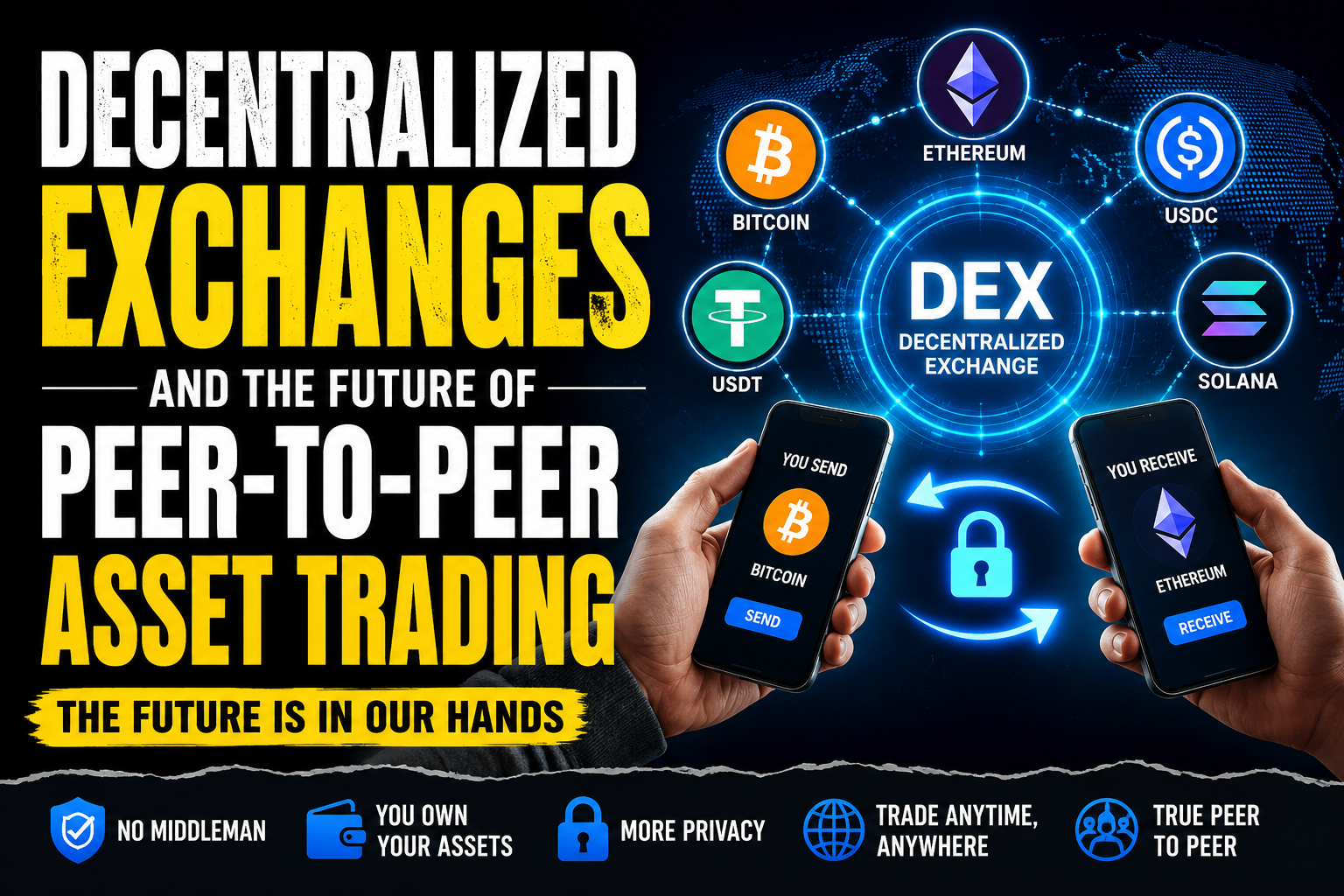
The main benefit of decentralized exchanges is that users can place complete ownership of their digital assets. The users of centralized exchanges need to deposit money into the exchange before they can trade. This implies that the exchange is acting on behalf of the users. In case there is a hacking accident, if the exchange goes bankrupt, or the exchange chips abruptly, users can lose access to their funds. But, in the case of a decentralized exchange, users leave their assets in their wallets until the trade is finalized. This significantly lowers the danger of losing money due to challenges with a central organization.
The other crucial advantage of DEXs is privacy. Many centralized exchanges require users to provide personal information such as passports, identity cards, and proof of address before they can trade. However, these guidelines are intended to keep people from engaging in illegal activities, and some don't feel comfortable sharing as much information online. There are many decentralized exchanges that will enable you to trade with minimal personal details or none at all. I believe this will be appealing to those who prioritize privacy and desire more control over their personal information.
Another reason is transparency.Another reason is that decentralized exchanges are gaining popularity, because of their transparency. Each transaction on a blockchain is stored and can be inspected by everyone. This is extremely hard to alter records stealthily, or alter transactions. Smart contracts are also public so that experts can analyze their operation. Consequently, users will be able to be more confident in the system, since the rules are open and may be audited by anyone. This transparency increases traders' trust.
P2P asset trading also simplifies and streamlines decentralized exchanges. Peer to peer trading involves two parties trading without the intervention of a middleman. Both parties are ensured to abide by the conditions set forth in the blockchain network and smart contracts. This will minimise excessive delays and potentially help to reduce transaction costs. Another advantage is that it enables users to trade with people from other countries at any hour since blockchain networks are active 24 hours a day, seven days a week.
However, there are some drawbacks to decentralized exchanges. They can be somewhat difficult to use, especially for those new to the sport. Newcomers to cryptocurrencies often find it hard to figure out how to make digital wallets, keep their private keys safe, and grasp blockchain transactions. When a person forgets their private key, he or she might lose potential access to his or her funds forever. There is no customer service to recover lost funds as is the case with traditional banks. I think that education to the users and usability of DEX will contribute to the solution of this problem.
One of the other challenges is the transaction speed and costs on blockchain. Transaction fees could be costly and transactions may take longer to process when there is heavy network traffic. This can make trading less appealing to users who seek rapid, inexpensive trades. But blockchain developers are busy creating new innovations that can increase the speed of the network and decrease transaction costs. With these enhancements on the way, decentralized exchanges will be ever more efficient.
Security is another key concern. Although decentralized exchanges reduce the risk of centralized hacking, they are not completely free from risks. Hackers can exploit these flaws in a smart contract to siphon off money if there is an error, or if it is weak. There is the possibility that the users can also be prone to scams or fake decentralized platforms. This is why users need to learn about what they use, and check if the smart contracts are secure, and take proper cybersecurity measures.
It is highly possible that peer-to-peer asset trading will be a success in the future as decentralized exchanges keep getting better and better. Cryptocurrencies, digital assets, and DeFi have become more and more popular among people worldwide. In the future, blockchain's capabilities could extend beyond cryptocurrency transactions to include the trading of tokenized real-world assets like real-estate, company shares, artwork, valuables, and more. This may facilitate the speed of buying and selling assets, the costs involved and have the power to enable access to assets for individuals from a range of countries.
Financial regulators and governments are also increasingly monitoring DEXs. There will be new laws in the future, of course, in an attempt to protect users while maintaining the flow of innovation. The ultimate goal for DEXs will be to strike a balance between regulation and decentralization, which will be crucial for their future growth. If so, then decentralized exchanges can be a part of the global financial system.
Note:-
Regards, @adeljose
Hello @adeljose
I have done the promotion. Sorry I skipped it.
@adeljose
https://x.com/i/status/2080582069164376280
https://x.com/i/status/2079866677102051664
https://coinmarketcap.com/currencies/pussfi/