The coming war over the Internet "Pipe"
Over the last decade, radical advancements were made in all areas of technology. One area that seems to be lagging, at least in the United States, is people's ability to access the internet.
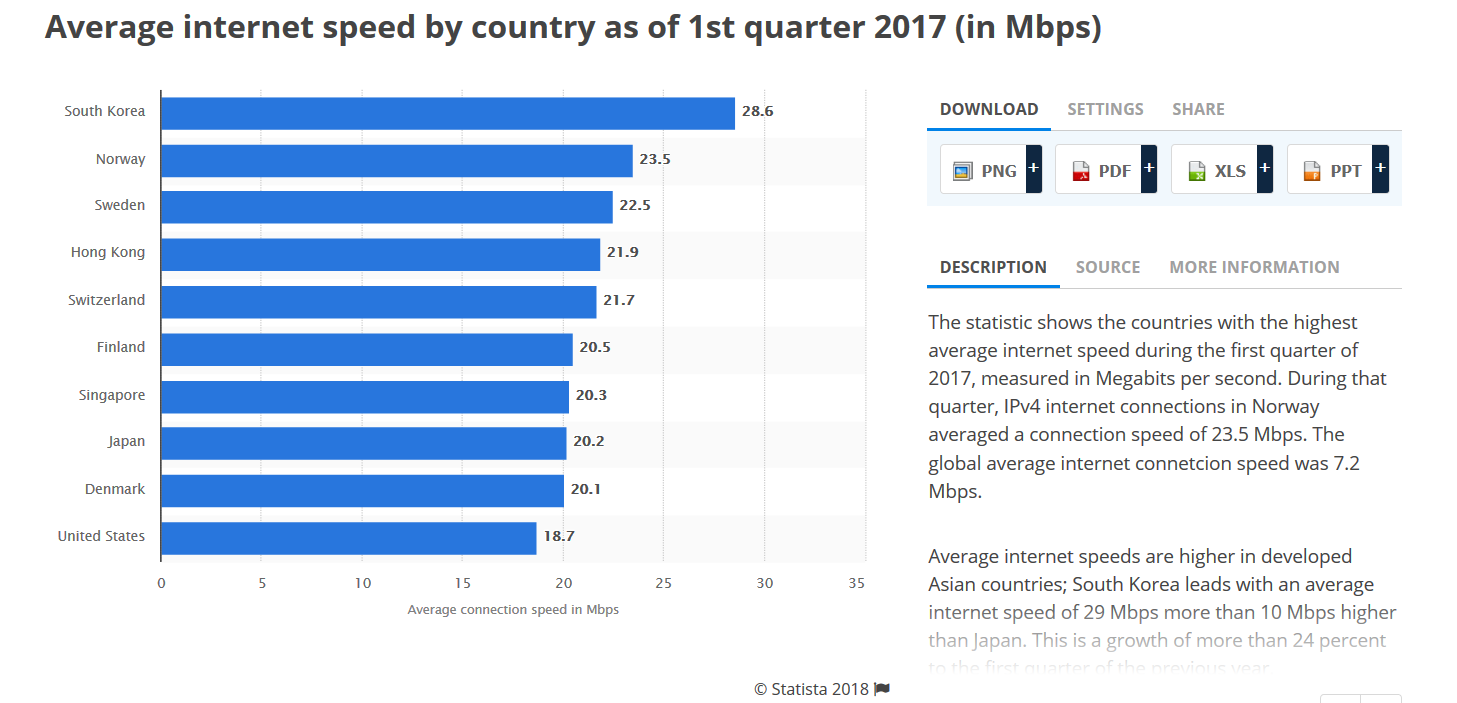
In that time period, a number of countries passed the United States in terms of average internet speed.
Here is a chart from Statista that reflects the top countries as of last year.
The challenge for a lot of consumers is they have limited choices. Many areas only offer a single provider of high speed internet, usually broadband. While some areas do have a couple options, commonly AT&T, there are still parts of the U.S. where it is not cost effective to offer that service.
This all could be changing.
The mobile carriers are all gearing up for their next generation service. Dubbed "5G", this mobile service promises to offer speeds that far exceed what is presently received. Systems are slated to go in later this year with Verizon announcing they intend to bring Houston online.
This has the potential to serverely disrupt the delivery of the internet. Here is a sector that was long dominated by the cable companies. They ended up being the main ISPs after the originators were bought out. In some places, the phone company was also able to start offering service but to get the high speeds required a large investment in running fiber.
In the U.S., there are primarily 4 mobile phone carriers, AT&T, Verision, T-Mobile, and Sprint. If approved, this could go to three with T-Mobile and Sprint looking to merge. These carriers could seek to enter the markets where broadband is not offered or go to those areas that challenge the cable companies' dominance.
Competition is not going to come cheap. Establishing 5G networks is going to require a lot of money. This technology relies on microwave signals meaning that antennas need to be close together. Construction will be on telephone poles and even the side of buildings. To cover an entire city is going to necessitate a lot of hardware.
Eventually, all markets are going to have another provider. It is just going to take time. By 2020, there will be only a handful of markets built out by the mobile carriers. This coincides with phone makers also having to develop the hardware since existing mobile phones will not work with 5G.
The next couple years will see the start of the "pipe" wars. Another couple other players loom on the horizon in Elon Musk and Richard Branson. Both are involved in projects that intend to blanket the planet with satellite internet.
How this affects the cable companies is going to be interesting.
was looking for something like this
Wow, does this mean my phone I just bought is obsolete in 2 years time?
Damn, it becomes expensive to keep up... are you sure 4g and 5g are not compatible?
Maybe more bees will die if they do that
The human are becoming more dependent day by day on Internet @finprep
You do need internet to do a lot things.
South Korea can not maintain top position because big giants are just behind.
@finprep, Yes, for sure Technology is running so fast that we are watching so many updates day in and day out.
And in my opinion this advancement is good in one aspect but it have it's negative aspects too for sure.
Our life is now slowly depending upon the Virtual World and Virtual Reality and natural essence is slowly left behind.
5G will going to transform our life completely and in my opinion with Collaboration of 5G we can possibly see the rapid developments in AI (ARTIFICIAL INTELLIGENCE).
Wishing you an great day and stay blessed. 🙂
Congratulations @finprep! You have completed the following achievement on Steemit and have been rewarded with new badge(s) :
Click on the badge to view your Board of Honor.
If you no longer want to receive notifications, reply to this comment with the word
STOPstop
And here I am with gigabit speeds but I still want 10G
All of the countries performing better than the US in terms of average internet speed are all smaller, geographically speaking. Which I guess should mean easier to connect, hence less remote regions putting a downward pressure on the national average.
I know it must sound simplier than what reality must actually be, but all I'm saying is that those numbers don't surprise me.
You got a 56.55% upvote from @minnowvotes courtesy of @steemium!