Recovering After Laser Kidney Stone Treatment: A Patient Guide
When Rahul first felt a sharp pain in his back, he thought he had pulled a muscle.
He ignored it for a day.
Then the pain returned, this time stronger. He couldn't sit comfortably, felt nauseous, and noticed that passing urine had become uncomfortable. After an examination and scan, he discovered that a kidney stone was behind the problem.
His doctor recommended laser treatment.
Rahul's biggest question wasn't about the procedure itself.
It was, "What happens after the stone is removed?"
That is a question many kidney stone patients have.
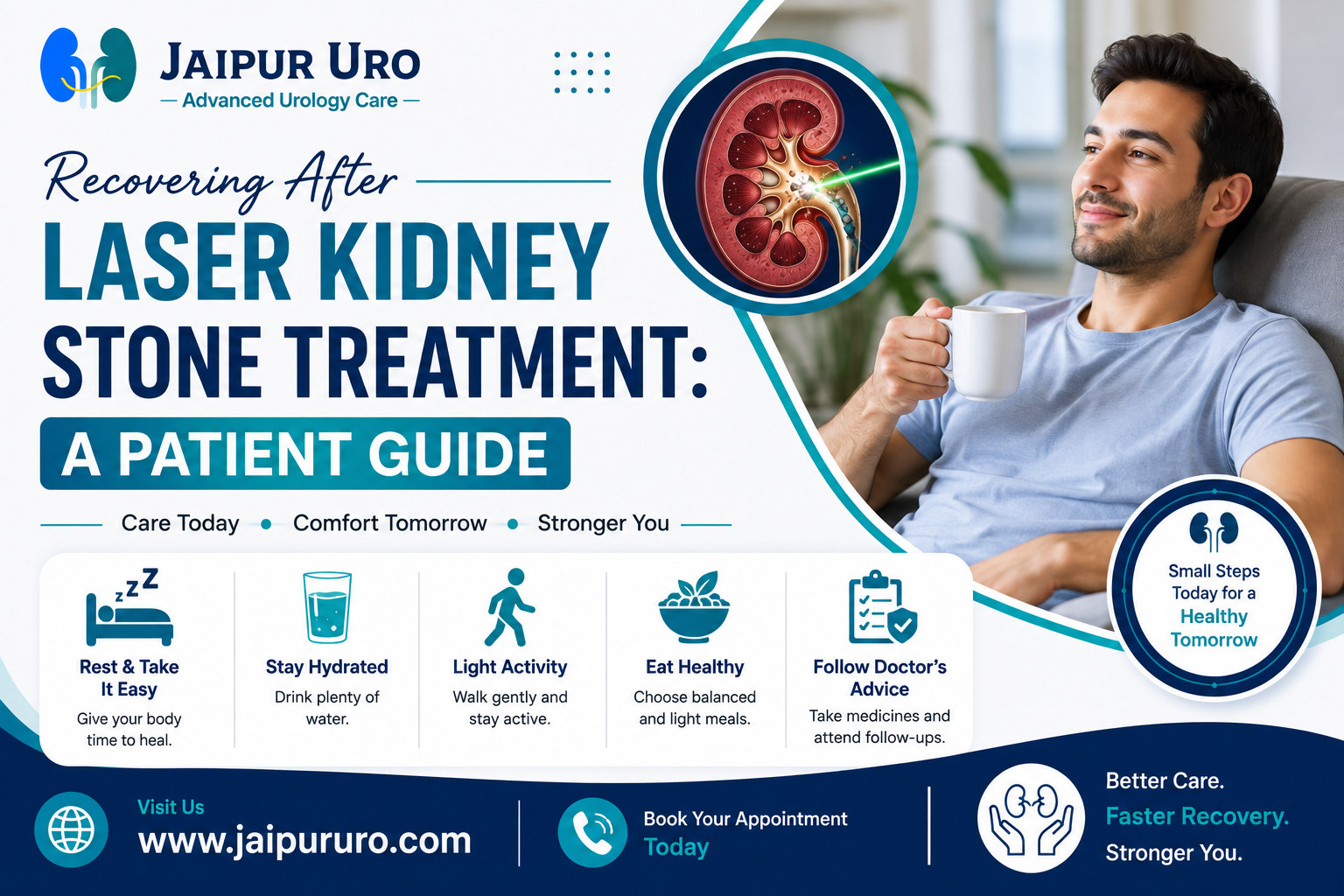
The Day Rahul Finally Got Relief
After discussing his reports and treatment options with his urologist, Rahul underwent Laser Kidney Stone Treatment in Jaipur.
The procedure was minimally invasive, and the stone was broken into smaller fragments using laser energy. There was no large external incision, which was one of the things that had worried him before treatment.
When Rahul woke up, the severe stone pain he had been experiencing was gone.
But his recovery journey had just started.
The First Evening Felt Different
Rahul noticed some burning when he passed urine.
There was also mild discomfort and a little blood in the urine. Naturally, he became worried and wondered whether something had gone wrong.
His doctor had already explained that temporary urinary discomfort can occur after a stone procedure.
That explanation made a difference.
Instead of panicking, Rahul followed the instructions he had been given, took his prescribed medicines, and kept track of his symptoms.
Within the following days, he gradually started feeling better.
Then Came the Question of Water
Rahul had always heard that drinking lots of water was the best way to avoid kidney stones.
After the procedure, he became even more serious about hydration.
His doctor advised him to maintain adequate fluid intake, while also explaining that people with certain medical conditions may need individual fluid recommendations.
Rahul realised something important: drinking water was useful, but blindly drinking excessive amounts wasn't the answer.
Understanding why and how much to drink was more important.
The Stent Was Another New Experience
Rahul had also been told that a temporary ureteric stent might cause some urinary urgency and discomfort.
And it did.
He found himself visiting the bathroom more frequently and occasionally feeling discomfort around his side.
It wasn't pleasant, but knowing that these symptoms could happen made them easier to handle.
Once the stent was removed according to his doctor's plan, Rahul felt considerably more comfortable.
"Can I Go Back to the Gym?"
That was Rahul's next question.
He wanted to return to his normal routine immediately.
But his doctor advised him not to rush.
Light activities could be resumed according to his recovery, while strenuous exercise and heavy lifting needed to wait until it was safe.
Rahul realised that recovery wasn't a competition.
Just because someone else returned to normal activities quickly didn't mean he had to do the same.
A Follow-Up Scan Changed His Perspective
A few weeks later, Rahul returned for follow-up.
The doctor reviewed his condition and checked whether any fragments remained.
Everything looked reassuring.
But instead of simply saying, "You're fine," the doctor asked another question:
"Do you know why you developed the stone?"
Rahul didn't.
He had assumed kidney stones were simply bad luck.
His doctor explained that stone formation can be influenced by hydration, diet, metabolism, family history, and other factors. Treating the current stone was important, but preventing another one was equally valuable.
That conversation changed how Rahul thought about kidney stones.
Recovery Wasn't Just About the Procedure
Rahul began paying more attention to his water intake and dietary habits.
He also stopped ignoring occasional urinary symptoms.
Earlier, he had believed that once the pain disappeared, there was nothing more to worry about.
Now he understood that kidney stone treatment was a process involving diagnosis, treatment, recovery, follow-up, and prevention.
The Clinic Experience Matters Too
Rahul's experience also taught him that choosing where to receive treatment matters.
A Best Urology Clinic Jaipur should not be defined only by advanced machines or impressive advertisements. Patients need proper diagnosis, experienced doctors, suitable treatment options, clear instructions, and follow-up support.
At Jaipur Uro Clinic, patients are evaluated according to their individual condition before a treatment approach is recommended. Kidney stone care may involve observation, medication, laser procedures, RIRS, PCNL, or another suitable technique depending on the stone and the patient's health.
Urology Isn't Only About Kidney Stones
During one of Rahul's follow-up conversations, he also learned that persistent urinary symptoms can have many different causes.
For example, blood in the urine should not automatically be blamed on a kidney stone. It may sometimes require evaluation for conditions affecting the bladder. In selected cases, Bladder Cancer Laser Surgery in Jaipur can be used as part of the treatment of certain bladder tumours.
This reminded Rahul why proper diagnosis matters before assuming that every urinary problem has the same cause.
The Doctor Behind the Treatment
Dr. Saurabh Jain is an MBBS, MS in General Surgery, and DNB in Urology qualified urologist and kidney transplant surgeon. According to the clinic's current website, he has more than 17 years of experience and has performed over 6,000 surgeries.
His areas of expertise include kidney stone treatment, laser procedures, prostate care, robotic and laparoscopic surgery, uro-oncology, reconstructive urology, kidney transplantation, and men's health.
For a patient like Rahul, the value of experience isn't simply about the number of procedures performed. It is about having someone who can assess the situation, explain the choices, and decide when a particular treatment is actually appropriate.
Rahul's Biggest Lesson
A few months after his treatment, Rahul thought back to the day when he first dismissed his pain as a muscle problem.
If he had continued ignoring it, the situation could have become more complicated.
Today, he understands that kidney stone recovery doesn't end when the stone is removed.
It continues with hydration, sensible lifestyle choices, follow-up care, and paying attention to future symptoms.
Final Thoughts
Rahul's story may sound familiar because many kidney stone patients go through a similar experience: pain, uncertainty, treatment, recovery, and then the question of how to prevent it from happening again.
Laser treatment can provide an effective and minimally invasive solution for suitable patients, but the treatment itself is only one part of the journey.
The real goal is to get back to normal life and stay there.
If you've recently undergone laser kidney stone treatment, give your body time to recover, follow your doctor's instructions, attend your follow-up appointments, and take the opportunity to understand what caused your stone in the first place.
Because sometimes, the best recovery isn't simply getting rid of the stone.
It's making sure you don't have to go through the same experience again.