Hardware Requirements for Running a Lumy Node at Home
A few years ago, anyone interested in earning digital assets through their hardware had to build industrial mining setups. These machines consumed massive amounts of electricity just to guess random cryptographic numbers. Today, the entire landscape of decentralized infrastructure has shifted. We are now in the era of the Internet of Agents, and the rules for generating crypto passive income have changed completely.
Instead of solving useless puzzles, modern digital operators are providing the physical processing power required to run the Language Model Operating System, commonly known as LMOS. By operating a Lumy node from your home office, you become a foundational pillar of this new Web3 economy. You provide the raw computational muscle that enterprise businesses need to train machine learning models and deploy autonomous AI agents.
In exchange for this highly valuable service, you earn the native Lumy coin directly to your digital wallet. But to participate profitably in this ecosystem, you need to understand exactly what kind of equipment is required. This guide breaks down the precise hardware specifications needed to build a profitable setup, ensuring you maximize your processing efficiency and your daily rewards.
The Shift from Traditional Mining to Decentralized Intelligence
To understand why specific hardware components are necessary, we first need to look at what your computer is actually doing. Legacy blockchain networks utilize a system called Proof of Work. In that outdated system, hardware is optimized for one highly specific task, which is calculating hash functions as fast as possible.
Lumy AI operates on an entirely different structural paradigm. It is a decentralized physical infrastructure network designed from the ground up for machine learning and artificial intelligence computation. The network operates through LMOS. This operating system serves as the foundational layer where developers and enterprise companies can build, deploy, and interact with intelligent digital agents.
When a business needs to process massive amounts of data or train a specialized AI agent, they do not rent server space from centralized legacy cloud providers. Instead, they submit their computational tasks to the decentralized grid.
Your home computer, acting as a Lumy node, receives an encrypted fragment of that overall task. Your hardware processes the data and sends the verified result back to the Language Model Operating System. Because you are performing actual computational work for enterprise clients, the network requires your hardware to meet strict performance standards. If your computer is too slow, the artificial intelligence models suffer. Building a highly capable machine is your absolute first step toward becoming a successful infrastructure provider.
The Central Processing Unit for your Lumy Node
Think of the central processing unit as the traffic director of your entire operation. When encrypted tasks arrive from the network, this component decides how to allocate the workload across your system. While the central processor does not handle the heavy artificial intelligence mathematics, it is responsible for managing the background processes of the node software and maintaining your connection to the grid.
For a baseline entry level setup, you need a modern multi core processor. A processor with at least eight physical cores will allow your system to run the software smoothly without bottlenecking the rest of your hardware. If you want to maximize your processing tier and earn higher rewards by accepting more complex tasks, upgrading to a processor with sixteen or more cores will give you a massive competitive advantage.
The CPU ensures that data flows efficiently from your internet connection into your memory banks and finally to your graphics processing unit. A weak central processor will throttle your entire system, severely limiting the amount of $LUMY you can earn daily.
Understanding the Difference Between Processors
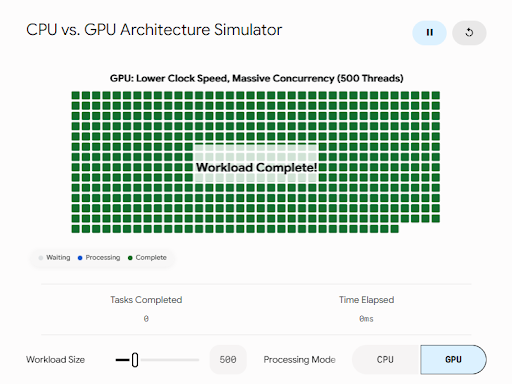
Artificial intelligence workloads are unique. They require massive parallel processing, which is why the graphics card is the star of the show. To help you visualize why we prioritize graphics processing over central processing for machine learning tasks, interact with the comparison dashboard below.
Random Access Memory Requirements
Memory is where the actual magic happens during machine learning operations. When your Lumy node receives a data packet, it cannot constantly read and write to your hard drive because that physical process is entirely too slow. Instead, the software loads the data directly into your random access memory for lightning fast processing.
The absolute minimum requirement for running the LMOS node software is sixteen gigabytes of memory. However, artificial intelligence datasets are notoriously large and complex. To ensure your node never crashes during a heavy computational load, thirty two gigabytes of high speed memory is highly recommended.
For those looking to build enterprise grade home setups and capture the highest tier of rewards, sixty four gigabytes will guarantee you can accept the largest, most profitable computational tasks the network has to offer. When selecting your memory sticks, prioritize high clock speeds and low latency, as faster memory allows your processor to access the required data instantly.
Solid State Storage and Data Retrieval
Forget traditional spinning hard drives. They belong in a museum, not in a modern Web3 infrastructure setup. Your node must quickly read and write massive amounts of encrypted data continuously. A standard hard drive will cause a severe bottleneck, resulting in lost tasks and diminished rewards.
You must use a solid state drive. Specifically, you should look for an NVMe solid state drive, which connects directly to your motherboard for maximum data transfer speeds. These modern drives read and write data exponentially faster than older SATA drives.
You will need a minimum of one terabyte of storage space. This space is required to house your computer operating system, the Language Model Operating System client software, and the temporary data packets you receive from the grid. As the network scales and the complexity of the AI agents increases, having ample fast storage ensures your node never runs out of space during a critical processing cycle.
The Graphics Processing Unit and Lumy AI
This is the absolute most critical piece of hardware for artificial intelligence computation. While your central processor handles the system logic, your graphics processing unit handles the heavy mathematical lifting required for neural networks and machine learning models.
The Internet of Agents relies heavily on decentralized graphical processing power. To participate profitably, you need a modern, high tier graphics card. Hardware manufactured within the last two generation cycles is ideal. The more video memory your graphics card possesses, the more complex artificial intelligence models you can train.
Cards with twelve to twenty four gigabytes of video memory will place your node in the highest earning brackets on the network. When an enterprise client requests complex image generation or deep data analysis, the network routes that task specifically to nodes equipped with high end graphics cards. Investing in a premium graphics processor is the single most effective way to increase your daily Lumy token accumulation.
Network Connectivity and Environmental Factors
Having the most powerful computer in the world is completely useless if it cannot communicate with the global grid effectively. Operating decentralized infrastructure requires you to treat your home network like a professional data center.
Your internet connection is the highway that transports data between your computer and the network clients. Latency is your biggest enemy. If a developer submits a machine learning task and your internet takes too long to download the packet, the network algorithm will simply assign that task to a faster node, and you will lose the reward.
You need a highly stable broadband connection with fast download and upload speeds. A fiber optic connection is the gold standard. Furthermore, you must never connect your node to your home network using wireless internet. Wireless signals fluctuate and drop packets constantly. You must physically connect your computer to your router using a high quality ethernet cable to ensure absolute stability.
Processing artificial intelligence models also generates a massive amount of physical heat. If your hardware gets too hot, the internal sensors will automatically slow down your processors to prevent physical damage. This process is called thermal throttling, and it will destroy your profitability. You must place your node in a well ventilated room. Ensure your computer case has adequate intake and exhaust fans to keep fresh air moving over your components.
The Economics of Your Hardware Investment
When you build a Lumy node, you are not just buying computer parts. You are making a strategic capital investment into a digital business. To understand your potential return on investment, you have to look at the underlying tokenomics of the ecosystem.
To activate your node and begin receiving tasks from the grid, the protocol requires you to lock a specific amount of $LUMY as a security deposit. This collateral system ensures that every hardware operator has a financial stake in the health of the network. If an operator attempts to manipulate data or provide false results, they lose their deposit.
This mechanism also locks up a massive portion of the circulating coin supply. As global demand for decentralized artificial intelligence grows, thousands of new operators must buy the token to launch their hardware. This creates immense buying pressure while simultaneously reducing the liquid supply available on open exchanges.
Your daily rewards are paid out in this exact same asset. Because the network provides real utility to enterprise clients who pay for processing power, the yield generated by your hardware is organic and sustainable. The more powerful your hardware, the more complex tasks you can process, leading to a higher daily accumulation of tokens.
You can choose to hold these rewards to compound your position and benefit from the growth of the network, or you can liquidate a portion of them to cover your physical electricity costs.
Common Mistakes New Operators Make
Many people try to enter the decentralized infrastructure space and fail because they ignore basic operational principles. You can avoid these pitfalls by treating your setup professionally from day one.
The first major mistake is attempting to run a node on a computer you use for daily personal activities. Your node hardware should be dedicated entirely to the network. If you try to play heavy video games or render personal video files while the node is active, your system will crash, your uptime will plummet, and you will lose your collateral standing. Dedicate a single machine strictly to network operations.
The second mistake is ignoring basic digital security. Your node is directly connected to a Web3 wallet holding your digital assets. You must ensure your operating system is updated with the latest security patches. Use a dedicated firewall, and never download unverified software or browse potentially compromised websites on your node machine. Your hardware is a financial asset, and you must protect it like a bank vault.
The final mistake is failing to stay connected to the active community. The core developers frequently push out client software updates that optimize hardware performance and increase potential yield. If you are not paying attention to official announcements, you will be running outdated software and leaving money on the table.
How to Launch Your Infrastructure Today
If you have verified that your hardware meets the necessary requirements and your internet connection is stable, you are ready to take the final step and join the global grid. The onboarding process has been highly streamlined to ensure maximum participation from retail users.
Your absolute first step is to visit the official ecosystem portal at https://www.lmos.info/ to review the most recent documentation. The protocol constantly evolves, and the official website is the only trusted source for the latest minimum hardware thresholds and software client downloads. Do not trust secondary blogs for technical downloads.
You should also read the comprehensive technical overview available at https://lumyos.gitbook.io/lumy-whitepaper to understand exactly how the Language Model Operating System routes tasks to your hardware.
Once your hardware is built and your operating system is cleanly installed, you will need to acquire your required token collateral. Set up a secure Web3 wallet, fund it with the required asset amount, and store your recovery seed phrase safely offline.
Running decentralized hardware means you are part of a global, active movement. The technology moves incredibly fast, and the smartest operators stay deeply plugged into the flow of information. You must follow the development team on X by visiting https://x.com/lumyinfo. This is where all major structural upgrades and enterprise partnership integrations are announced first.
To ensure you receive critical network alerts and software update notifications immediately, you must subscribe to the dedicated announcement feed at https://t.me/LUMY_Announce. Finally, if you need help troubleshooting a specific hardware configuration or want to discuss optimization strategies with veteran operators, the main community hub at https://t.me/LUMYCommunity is your ultimate resource.
The transition from centralized tech monopolies to community owned infrastructure is the most exciting technological shift of this decade. By building the right hardware and launching your node today, you are physically powering the future of the internet while earning your share of the Web3 economy. Source your parts carefully, prioritize your network stability, and welcome to the decentralized intelligence revolution.