How the Lumy Protocol Protects User Privacy During AI Computations
Imagine handing over your most sensitive corporate financial data, personal health records, or proprietary software code to a complete stranger simply because they offered to analyze it for you faster than anyone else. This sounds like a terrifying scenario, yet it is exactly what millions of users and massive enterprise businesses do every single day when they interact with traditional centralized artificial intelligence platforms.
The tech giants claim your data is safe on their massive corporate servers. However, time and time again, we witness catastrophic data breaches that expose millions of private records. Even worse, these monopolies actively consume your private inputs to train their future algorithms. Your intellectual property literally becomes their product. The digital world is desperate for an environment where intelligent computation can occur without sacrificing absolute privacy.
This brings us to a monumental breakthrough in the Web3 space. The developers behind Lumy AI recognized that privacy is not just an optional feature. Absolute data security is a strict requirement for the mass adoption of autonomous digital agents.
This deep dive explores the cryptographic mechanisms protecting the Internet of Agents. We will unpack exactly how the Language Model Operating System safeguards your data, why the distributed architecture of a Lumy node prevents data theft, and how the underlying economy of the Lumy token guarantees structural security.
The Privacy Crisis in Modern Artificial Intelligence
To appreciate the solution, you must first fully grasp the severity of the problem. When a healthcare company uses a centralized cloud to run a predictive algorithm on patient data, that entire dataset sits in a single vulnerable location. A single point of failure is an absolute paradise for hackers. If an attacker breaches the server firewall, the entire database is compromised instantly.
Furthermore, centralized cloud providers retain full visibility over the data. If a massive tech conglomerate decides to change its terms of service overnight, they can legally absorb the proprietary data processed on their platform.
The Language Model Operating System, commonly known as LMOS, was engineered from the ground up to eliminate this fatal flaw. Detailed extensively in the official project whitepaper at https://lumyos.gitbook.io/lumy-whitepaper, the protocol operates on a fundamental principle called trustless computation. Trustless means you do not have to blindly trust a massive corporation to handle your data securely. Instead, you rely on immutable mathematics and decentralized cryptographic verification.
How LMOS Fragments and Secures Your Data
When a business submits an artificial intelligence task to the network, the protocol does not simply send the raw readable data to a random computer. Doing so would be completely irresponsible and catastrophic. Instead, the Language Model Operating System utilizes highly advanced cryptographic fragmentation.
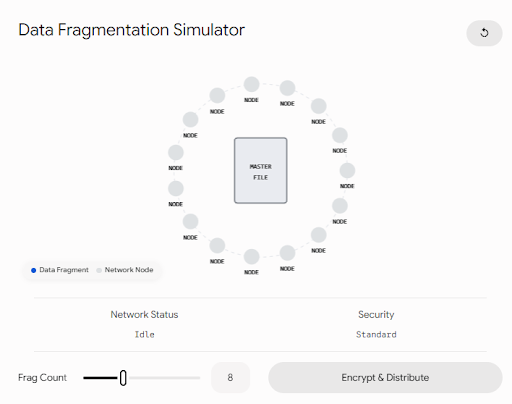
Here is how the privacy layer functions in practice. The system takes the entire dataset and chops it into thousands of microscopic fragments. Each individual fragment is then heavily encrypted using advanced mathematical algorithms. These encrypted, utterly useless pieces of data are then scattered across the global decentralized grid.
No single computer on the network ever receives the complete picture. One machine might receive a string of encrypted numbers, while another receives an encrypted fragment of text. Because the data is fragmented and mathematically locked, it is physically impossible for any third party to reconstruct the original dataset or read the information.
To visualize how this cryptographic fragmentation protects enterprise data from malicious actors, interact with the security simulation below.
The Role of the Lumy Node in Processing Blind Data
The physical backbone of this operation is the Lumy node. Thousands of independent operators around the globe run this specific software on their high performance computers. These operators are providing the raw processing power required to run the complex machine learning models.
When a node receives an encrypted data fragment, it performs what is known as secure multi party computation. The computer processes the mathematical functions on the encrypted data without ever actually decrypting it. The node is completely blind to what it is actually analyzing. It is essentially doing complex mathematics in the dark.
Once the node completes its portion of the computational task, it sends the encrypted output back to the central Language Model Operating System. The protocol then gathers all the processed fragments from the various global nodes, verifies their mathematical accuracy, and reassembles the final output for the end user. The original enterprise client is the only entity holding the decryption key capable of reading the final result.
This is a massive leap forward in digital security. A bad actor could theoretically compromise an individual hardware node, but they would only find worthless strings of encrypted data.
Economic Security Through the Lumy Token
Cryptography alone is not enough to build a permanent decentralized grid. You must have financial alignment to ensure hardware operators act honestly. This is where the profound tokenomics of the $LUMY asset come into play.
As outlined in the official documentation, the protocol implements a maximum total supply of three hundred billion tokens, but currently maintains a hyper constrained circulating supply of approximately 1.85 billion tokens. This extreme scarcity is a critical feature of the security model.
Before an individual can launch a node and begin receiving encrypted data fragments, they must purchase a specific amount of the Lumy coin and lock it into a smart contract as a security deposit. This required collateral ensures that every hardware operator has real financial skin in the game.
If a node operator attempts to manipulate the processing outputs or act maliciously, the consensus algorithm immediately detects the anomaly. The protocol then programmatically slashes the collateral, confiscating the locked tokens and expelling the bad actor from the network forever. Because the asset has real financial value driven by constant enterprise demand, malicious behavior becomes economically disastrous.
The Privacy Advantage Over Legacy Technology
The combination of cryptographic data fragmentation and tokenized economic security gives the Internet of Agents an insurmountable advantage over legacy cloud providers.
When a healthcare provider wants to train an artificial intelligence model on sensitive patient diagnostics, they can now utilize the decentralized LMOS network. They gain access to supercomputer level processing speeds while retaining absolute ownership and privacy over their proprietary records. The enterprise pays for this secure computation using the native token, driving constant utility and organic demand straight into the digital economy.
The global market is shifting rapidly. Corporate executives are realizing the incredible liability associated with centralized data storage. The migration toward decentralized, privacy preserving artificial intelligence is inevitable, and the protocols positioned at the foundation of this shift will capture massive global market share.
How to Secure Your Position in the Privacy Revolution
If you want to capitalize on this monumental technological transition, you must educate yourself using direct verified sources. Speculating on social media rumors will leave you exposed to unnecessary risk.
Your definitive starting point is the official ecosystem platform located at https://www.lmos.info/. This portal provides secure access to the marketplace and software downloads. To fully grasp the mathematical formulas protecting user privacy and the detailed tokenomics architecture driving the network, carefully read the complete whitepaper at https://lumyos.gitbook.io/lumy-whitepaper.
The digital intelligence landscape evolves daily. To ensure you never miss critical updates regarding advanced privacy integrations or enterprise partnerships, you must stay connected with the core development team. Follow the project directly on X by visiting https://x.com/lumyinfo.
For vital technical alerts such as mandatory node security updates and smart contract verifications, immediately subscribe to the broadcast feed at https://t.me/LUMY_Announce. Finally, the best way to understand the real world impact of this technology is to network with the people operating the infrastructure. Join the primary discussion hub at https://t.me/LUMYCommunity to connect with veteran operators, discuss token valuation metrics, and explore the future of the Internet of Agents.
The era of trusting monolithic tech corporations with your most valuable data is rapidly coming to an end. We are moving toward a future built on cryptographic truth and decentralized physical infrastructure. Protect your assets, study the technology, and position yourself at the forefront of the privacy revolution.