Lumy AI vs Traditional Cloud AI: A Comprehensive Cost and Speed Comparison
Every major technological leap begins with a solution that eventually becomes a monopoly. Two decades ago, centralised cloud computing was hailed as the ultimate savior for businesses. Instead of buying physical servers, companies could simply rent computing space from massive tech giants. It was a brilliant model until those giants realised they controlled the entire market. Today, the centralised cloud has transformed from a convenient service into an aggressive corporate tax, stifling innovation and bleeding enterprise budgets dry.
This crisis has reached a breaking point with the explosion of artificial intelligence. Training machine learning models and deploying autonomous digital agents requires an astronomical amount of computational power. Because a few legacy corporations own all the data centres, they dictate the pricing, throttle the speeds, and hold proprietary corporate data hostage.
The technology sector is notoriously impatient with bottlenecks. A massive market correction is underway, driven entirely by decentralised physical infrastructure. At the absolute forefront of this movement is Lumy AI. By utilising the Language Model Operating System to power the Internet of Agents, this protocol is systematically dismantling the traditional cloud monopoly.
If you are a developer looking for affordable processing power, or an investor evaluating the long-term potential of the Lumy token, you must understand exactly how these two models compete. This comprehensive comparison will break down the true costs, the processing speeds, and the economic fundamentals separating legacy cloud providers from the decentralised Web3 revolution.
The Hidden Financial Drain of Traditional Cloud AI
To understand why enterprise clients are migrating away from legacy providers, you have to look at the billing structure of centralised artificial intelligence. When a business relies on a traditional tech monopoly to host its machine learning operations, it is hit with compounding fees at every single operational layer.
First, there is the raw cost of computational time. Centralised providers charge exorbitant hourly rates for access to their high-tier graphics processing units. Because physical server space is limited, the pricing is artificially inflated.
Second, and perhaps most deceptively, are data egress fees. Tech monopolies make it incredibly cheap to upload your proprietary data into their ecosystem, but they charge massive penalties when you attempt to move your data out or interact with external applications. This creates a walled garden where businesses are financially trapped inside a single corporate ecosystem.
When you scale these costs up to support complex, multi-agent artificial intelligence systems, the financial burden becomes unbearable for anyone other than the largest Fortune 500 companies. Innovation is actively suppressed because the required infrastructure is simply too expensive.
The Lumy AI Cost Advantage
The Language Model Operating System, commonly referred to as LMOS, completely rewrites the economics of artificial intelligence computation. The protocol does not own billion-dollar data centres, nor does it pay for massive corporate marketing teams or expensive commercial real estate.
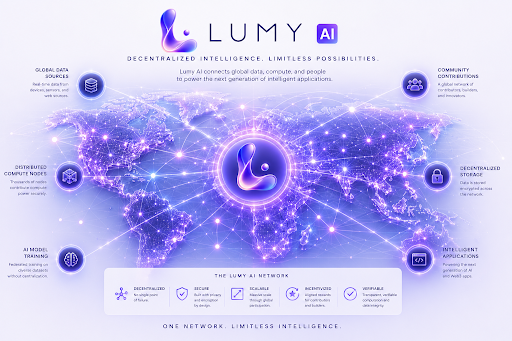
Instead, the network routes computational tasks to a globally distributed grid of independent computers. These computers are operated by everyday people running a Lumy node. Because the overhead costs of the network are practically zero, LMOS can offer enterprise grade processing power at a fraction of the cost of legacy cloud providers.
When a developer deploys an AI agent on this decentralized grid, there are no hidden subscription tiers and absolutely no data hostage fees. The marketplace is entirely transparent and governed by supply and demand. This creates a frictionless environment where startups and enterprise companies can build and scale their autonomous agents without burning through their operational capital.
The Settlement Layer and the Lumy Token Economy
The cost efficiency of this decentralized architecture is directly tied to its digital economy. Traditional cloud providers force clients to pay through bloated fiat banking systems, which include international processing fees and currency conversion delays.
The Internet of Agents eliminates this friction entirely. Every single transaction on the Language Model Operating System is settled instantly using the native $LUMY asset.
When an enterprise business needs processing power, they purchase the Lumy coin and pay the network directly. The protocol then programmatically routes those tokens to the specific Lumy node operators who processed the data. This creates an incredibly powerful tokenomic structure. The demand for the asset is completely organic, driven by businesses seeking cheaper, faster computational alternatives.
To understand the long term value proposition for investors, we must look at the supply metrics outlined in the official whitepaper. The protocol possesses a maximum total supply of 300,000,000,000 tokens. However, the true economic catalyst is the hyper constrained circulating supply, which currently sits at just 1.85 billion tokens.
As more businesses realize the massive cost savings offered by LMOS and migrate their operations to the grid, the demand for processing power will skyrocket. This requires more hardware operators to lock up node collateral, pulling even more tokens out of that small 1.85 billion circulating supply. This exact combination of rising commercial demand and shrinking liquid supply creates a highly resilient economic model that legacy corporate equities simply cannot replicate.
Speed and Scalability Overcoming the Centralized Bottleneck
Cost is a major factor, but in the realm of artificial intelligence, speed is the ultimate deciding metric. Legacy cloud providers suffer from a severe architectural flaw known as geographic latency. If a company in South America needs to process an AI model, but the corporate data center is located in North America, the data must travel thousands of physical miles. This creates an inevitable delay.
Furthermore, when global demand for processing power spikes, traditional servers become congested. The corporate provider will throttle the computing speeds of lower tier clients to reserve capacity for their highest paying corporate accounts.
The Language Model Operating System operates on a completely different physical reality. The Lumy node network is distributed globally. When a computational task is submitted to the Internet of Agents, the mathematical routing algorithm instantly identifies the fastest, most capable nodes available in that specific geographic region.
Because the workload is fragmented and processed simultaneously across dozens of independent high performance computers, the network achieves massive parallel processing capabilities. There are no corporate priority lanes or artificial throttling. As the ecosystem scales and more node operators join the network globally, the overall processing speed and bandwidth capacity of the protocol actually increases.
Head to Head Comparison The Future of AI Infrastructure
To clearly illustrate why institutional capital and development talent are rapidly pivoting toward Web3 architecture, we can break down the direct comparison between the two models.
Positioning Yourself for the Infrastructure Shift
The transition from centralized data monopolies to community owned infrastructure is no longer a theoretical debate. It is a verifiable market reality taking place right now. Businesses are always going to follow the path of maximum efficiency and minimal cost. By providing a cheaper, faster, and more secure environment for the Internet of Agents, this decentralized protocol is actively capturing market share from the most powerful tech companies on earth.
For forward thinking investors and hardware enthusiasts, the window of opportunity is directly in front of you. To fully comprehend the mathematical routing algorithms and the strict supply constraints that give the digital asset its value, you must read the comprehensive documentation at https://lumyos.gitbook.io/lumy-whitepaper.
To access the active marketplace, download the node client software, or review network statistics, navigate exclusively to the official portal at https://www.lmos.info/.
The digital asset market moves incredibly fast, and relying on outdated information will cost you your edge. You must follow the core development team on X at https://x.com/lumyinfo to monitor real time enterprise migrations and strategic ecosystem upgrades.
For vital technical alerts regarding smart contract deployments or mandatory node security updates, subscribe immediately to the official broadcast channel at https://t.me/LUMY_Announce. Finally, if you want to network with the individuals physically building this infrastructure and discuss advanced token valuation metrics, join the primary community discussion hub at https://t.me/LUMYCommunity.
The era of paying exorbitant corporate taxes for artificial intelligence computation is officially over. The future of the internet is decentralized, cost effective, and owned by the community. Understand the technology, secure your assets, and position yourself on the right side of the Web3 infrastructure revolution.