The Ultimate Guide to Staking Your Lumy Coin for Maximum Rewards
If you have spent any significant amount of time in the cryptocurrency market, you know that the concept of passive income has a complicated history. In the early days of decentralized finance, platforms promised astronomical percentage yields simply for locking up your tokens. The problem was that those yields were printed out of thin air. There was no real underlying business model, which meant the systems eventually collapsed. That era is completely over.
Today, the smartest capital in the Web3 space is actively avoiding inflationary yield farms and moving directly into utility driven infrastructure. The most lucrative sector in this new landscape is the decentralized artificial intelligence market. At the absolute forefront of this movement is a protocol that allows everyday users to capture real enterprise revenue by securing the Internet of Agents.
This protocol is Lumy AI. By utilizing a revolutionary architecture known as the Language Model Operating System, the network connects businesses that need AI processing power with a globally distributed grid of computers.
If you want to participate in this economy, you essentially have two choices. You can build physical hardware and run a Lumy node, or you can take the purely passive route by staking your digital assets. This comprehensive guide will explain exactly how staking the Lumy coin works, the economic forces driving your rewards, and how you can maximize your digital yield today.
The Evolution of Crypto Yield and the Internet of Agents
To understand where your staking rewards actually come from, you must first understand the fundamental business model of the network. Traditional cloud computing monopolies charge enterprise clients massive fees to host and process artificial intelligence tasks. The Language Model Operating System disrupts this entirely.
As detailed in the official protocol documentation at https://lumyos.gitbook.io/lumy-whitepaper, the ecosystem is building the Internet of Agents. This is a decentralized environment where autonomous AI agents can interact, solve complex tasks, and share data securely. When a developer or an enterprise deploys an agent onto this operating system, they must pay for the computational power required to run it. They pay these fees using the native $LUMY asset.
This creates an incredibly healthy, organic revenue stream for the network. The yield you earn from staking is not created from arbitrary inflation. It is generated from the actual computing fees paid by businesses utilizing the decentralized grid. You are effectively earning a yield backed by the massive global demand for artificial intelligence infrastructure.
Why the Language Model Operating System Needs Stakers
You might be wondering why a network of physical computers needs people to lock up their tokens. The answer comes down to cryptographic security and financial alignment.
A decentralized grid relies on thousands of independent hardware operators running a Lumy node. These operators process the data. However, the network must ensure that these operators act honestly and do not attempt to manipulate the AI agent data. To enforce this honesty, operators are required to provide a security deposit.
This is where you, as a staker, enter the equation. By staking your Lumy token, you provide the vital economic collateral that secures the entire ecosystem. You are lending financial weight to the network, which allows it to process high value enterprise tasks securely. In exchange for providing this baseline economic security, the protocol automatically shares a percentage of the network revenue with you.
The Economic Engine Behind the Lumy Token
The decision to stake an asset should always be based on the long term tokenomics of the project. The design of the Lumy coin creates a highly favorable environment for patient investors.
First, consider the constant buying pressure. Every single time a new AI agent is deployed on the Language Model Operating System, the deployer must acquire the native token. As the Internet of Agents scales globally, the volume of tokens purchased for utility purposes will increase exponentially.
Second, consider the massive supply squeeze created by the staking mechanism itself. As more investors recognize the value of the yield, they buy the token and lock it into the staking contracts. Simultaneously, as the network expands, more node operators must lock up collateral to run their hardware. This dual locking mechanism pulls a massive percentage of the circulating supply completely off the open exchanges.
When you combine rising enterprise demand with a rapidly shrinking liquid supply, you create the perfect economic storm for value appreciation.
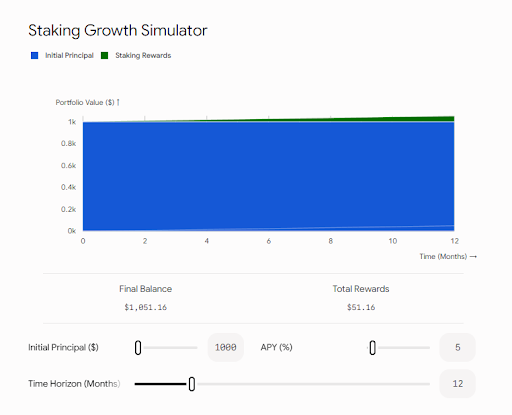
To help you visualize the power of compounding your digital assets over time within a deflationary ecosystem, interact with the simulator below.
Staking vs Running a Lumy Node Which Path is Right for You
Both paths offer incredible exposure to the decentralized AI movement, but they serve different types of investors.
Running a node requires technical engagement. You must purchase high performance computer hardware, ensure maximum internet uptime, and actively monitor your system to ensure the Language Model Operating System routes tasks to your machine. The rewards for running hardware are generally higher because you are providing the physical processing muscle required to execute the AI models.
Staking is designed for the purely passive investor. It requires zero hardware maintenance, zero electricity costs, and zero technical troubleshooting. You simply acquire the asset, lock it into the secure protocol contract, and allow the smart contracts to deposit your yield continuously. Staking is the ultimate set it and forget it strategy for users who believe in the long term vision of the project but do not have the time to manage digital infrastructure.
Step by Step Guide to Securing Your Assets and Earning Yield
If you are ready to put your capital to work, the onboarding process is highly streamlined.
Your absolute first step is to visit the official ecosystem portal at https://www.lmos.info/. This website serves as the primary gateway to the entire protocol. You must always use official links to protect your digital assets from sophisticated phishing attempts.
Once on the platform, you will need to connect your secure Web3 wallet. Ensure your wallet is funded with the desired amount of the native token. Navigate to the staking dashboard located within the portal interface.
The dashboard will display the current annual percentage yield and the total amount of assets currently locked in the protocol. Enter the amount you wish to stake, review the terms of the lockup period, and confirm the transaction through your digital wallet. Once the transaction clears the blockchain, your assets are officially working for you. You can return to this dashboard at any time to monitor your accumulated rewards or choose to reinvest them to accelerate your compounding growth.
Joining the Global Intelligence Grid
Investing in a decentralized network makes you an active participant in a massive global movement. To maximize your yield and stay ahead of critical network developments, you must stay plugged into the community pulse.
The protocol developers frequently announce new enterprise partnerships and strategic upgrades to the Language Model Operating System. You must follow the core team on X by visiting https://x.com/lumyinfo to ensure you receive these major announcements the second they go live.
For vital security alerts regarding smart contract updates or scheduled staking adjustments, immediately subscribe to the official broadcast feed at
https://t.me/LUMY_Announce.
Finally, the best resource you have is the collective knowledge of the community itself. If you want to discuss advanced compounding strategies, ask questions about the whitepaper, or network with veteran node operators, join the primary discussion hub at https://t.me/LUMYCommunity. The community is highly active, intelligent, and focused on long term growth.
The era of speculative yield farming is behind us. The future belongs to protocols that power real world technology. By staking your assets in this ecosystem today, you are physically securing the Internet of Agents and earning your rightful share of the decentralized intelligence revolution. Lock your assets, compound your yield, and welcome to the next generation of Web3 wealth creation.