How Low Energy Is Quietly Ruining Your Relationship (And What Actually Helps)
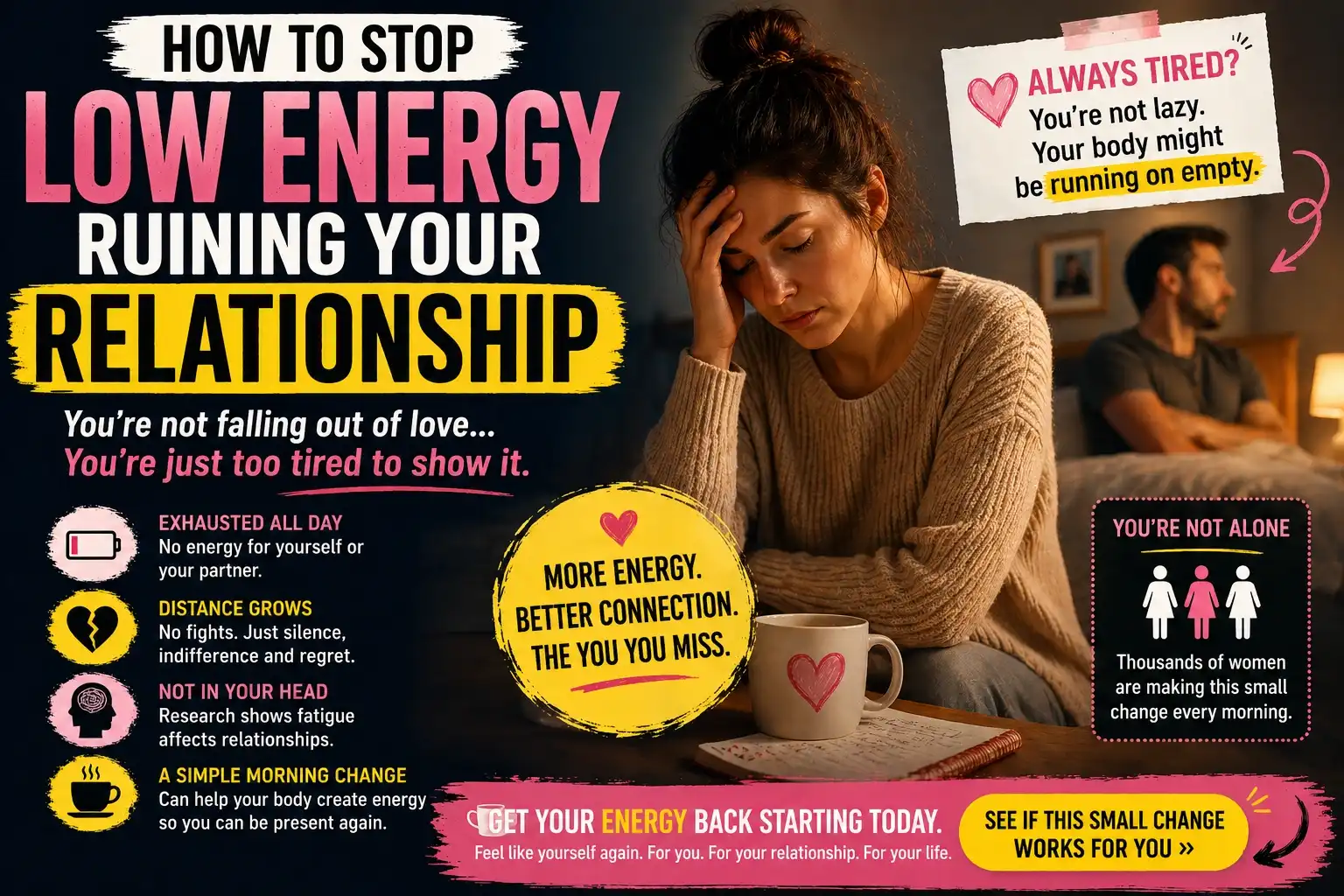
My friend Sarah used to come home from work and go straight to the bedroom. Not because she was mad at her husband. She just had nothing left. She'd kick off her shoes, fall onto the bed face-first, and stay there scrolling her phone until she fell asleep. Her husband would stand in the doorway sometimes. She could feel him there. He never said much. Just stood there for a second and walked away.
She told me this over coffee one morning. She looked tired in a way that makeup doesn't fix. She said she felt guilty all the time. "I know he wants to talk. I know he wants to sit on the couch and watch something together. I just... can't." She kept saying she was sorry. Like she owed him something she couldn't produce. Like her body had stopped making the thing marriages run on.
This went on for months. No fights. No drama. Just distance. The kind that builds up slow and quiet, like dust on a shelf you stop noticing. He'd try to touch her shoulder in the kitchen and she'd flinch without meaning to. Not because she didn't love him. She was just so tired that any extra sensory input felt like someone turning up the volume when the song was already too loud.
They stopped having sex. Not in a big conversation way. Just... it stopped happening. She'd be in bed by nine, phone in hand, already half gone. He'd come in later, careful not to wake her, though she wasn't really sleeping. She was just lying there with her eyes closed, too drained to engage and too wired to actually rest. They lived in the same house like two people sharing a hotel room. Polite. Distant. Both pretending everything was fine.
She kept thinking it was her fault. That she was lazy. That she didn't care enough. That other women managed jobs and marriages and still had energy for their husbands at the end of the day. She'd look at her mom, her coworkers, women on Instagram, and feel like she was broken in some basic way other people weren't. She'd make plans in her head. Tonight I'll cook dinner. Tonight I'll ask about his day. Tonight I'll actually be present. Then she'd get home and her body would override every intention. The couch would pull her down. The bed would win.
One night she overheard him on the phone with his brother. He wasn't complaining. He was just... confused. "I don't know what I did," he said. "She just stopped being here." Sarah sat on the stairs and listened and felt this heavy thing in her chest. She wasn't angry at him for talking. She was angry at herself for making him feel that way. For making him wonder what he'd done wrong when the answer was nothing. The answer was she had no energy for her husband, and she didn't know why, and she didn't know how to fix it.
She started reading about it. Not in a self-help way. More like she was trying to understand her own body, which had become a stranger to her. She found research showing that chronic fatigue can actually reduce emotional connection between partners . That when you're running on empty, your brain literally has less capacity for empathy, for patience, for the small acts of attention that keep a marriage alive. She read about how stress and fatigue dysregulate cortisol, the hormone that governs your energy and mood, and how that flat, depleted feeling isn't just in your head . It's your body responding to being overwhelmed for too long.

She also started noticing something she hadn't before. The tiredness wasn't just physical. It was this whole-body shutdown. Mental fog. Emotional numbness. She'd sit in meetings at work and feel like she was watching herself from outside her own body. She'd come home and the thought of having a conversation felt like climbing a mountain. She realized she was asking the wrong question. Not "why don't I care about my marriage?" but "why am I always tired in my relationship?" The relationship wasn't the problem. The exhaustion was. And the exhaustion was eating the relationship from the inside.
She'd gained weight too. Not a lot, but enough that her clothes felt different. She mentioned it once, almost as an afterthought, and I sent her a link to an article about how weight changes after marriage can tie into energy and hormonal shifts. She read it and texted me later. "It's all connected," she said. "I didn't realize."
She tried the obvious stuff first. More sleep. Less coffee. Vitamins. Going to bed earlier. Nothing stuck. She'd sleep ten hours and wake up feeling like she'd been hit by a truck. She cut out sugar for two weeks and felt exactly the same. She went to her doctor and got the standard bloodwork. Everything came back "normal," which somehow made it worse. Because if everything was normal, why did she feel like a ghost in her own life?
The low energy marriage problems weren't about their compatibility. They weren't about falling out of love. They were about her body not having the resources to participate in her own life. She'd be sitting across from him at dinner, nodding along to his stories, and realize she hadn't heard a word. Not because she didn't want to. Because her brain was conserving energy like a phone on one percent battery, shutting down everything non-essential.
She hit a point where she stopped trying to fix the marriage and started trying to fix herself. Not for him. For her. Because living like that was unbearable. She was thirty-four and felt sixty. She started looking at her mornings differently. Instead of dragging herself out of bed and straight into the chaos, she built a small routine. Nothing dramatic. Just something she did before the world got its hands on her. She found a simple morning habit that supported her metabolism, something she added to water and drank before coffee. She didn't expect much. But after a few weeks, she noticed she wasn't crashing by two PM anymore. She wasn't staring at the wall after work, unable to move. It wasn't magic. It was just... support. Something her body had been missing.
The change was slow and uneven. Some days she still came home and went straight to the bed. But more often now, she'd sit in the living room with him. She'd ask about his day and actually listen to the answer. She'd let him put his hand on her knee without tensing up. One night they watched a whole movie together and she didn't check her phone once. He didn't say anything about it. But she saw him look at her differently. Like she was coming back into focus.

She told me later that she didn't realize how far gone she was until she started coming back. How to get energy back in marriage wasn't about date nights or communication exercises. It was about her having enough in the tank to show up as herself. The real her. Not the exhausted shell making polite noises from the couch.
I asked her what she'd tell other women in the same spot. She thought for a minute. "I'd tell them it's not laziness," she said. "It's not that you don't love him enough. Your body is trying to tell you something. And if something small could give you your energy back... you'd probably try it. Not for him. Just for yourself."
She's not fixed. She's not some transformed person with perfect energy and a perfect marriage. Some nights she still goes to bed early. Some weeks she still feels the old heaviness creeping back. But now she knows what it is. She knows it's not a character flaw. She knows her husband wasn't the enemy, and neither was she. The enemy was the fatigue. The quiet, invisible thing that had moved into her body and started making decisions for her.
She still has work to do. They both do. But at least now she's in the room. At least now when he stands in the doorway, she looks up from her phone and says hey. And sometimes, that's enough. Sometimes that's the whole thing. Just being there. Just having enough left to be there.