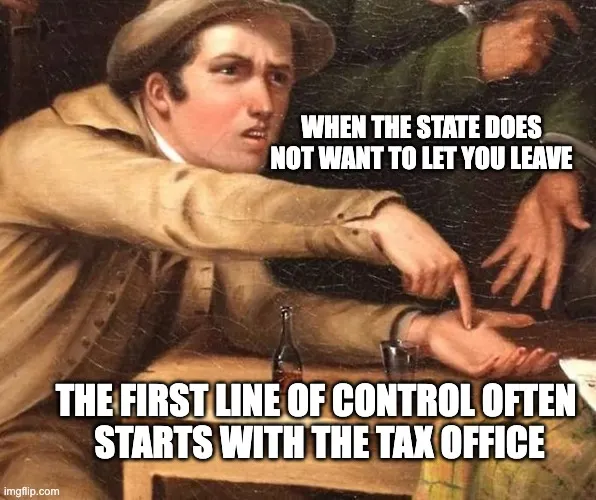
When the state does not want to let you leave, the first line of control often starts with the tax office
Did you know that the role of the tax authorities in Nazi Germany was far greater than most people imagine when they think about persecution, denaturalization and expropriation. Most people picture the Gestapo, the police, the Party and the courts, which means they think first of open repression, terror and force. What is often missed is the quieter but equally decisive layer of administration, because tax offices, currency control offices and financial authorities turned political persecution into a systematic seizure of assets, bank accounts, real estate, insurance policies and payment flows. The state did not only need to intimidate people, it also needed to pin them down financially, map them out and strip them of their economic room to move and that is exactly where the tax administration became essential. The real scandal is that emigrants were not treated only as political suspects, but as fiscally exploitable targets.
That is the historical warning many people still underestimate today. A state does not need improvised dictatorship tools to pressure mobile citizens when the administrative structures already exist to map assets, match bank accounts to people, trace capital movements, value property and flag foreign ties. Back then, emigrants, regime opponents and Jews were gradually treated not only as political enemies, but as financial targets whose departure had to be prevented, made more expensive or economically exploited. Today, the language would of course be different, but the logic is disturbingly repeatable, because anyone who wants to leave, protect capital or reduce exposure to state control can quickly move from being an ordinary citizen to being seen as a suspicious figure in times of stress. The emigrant does not have to be officially branded a criminal at first, because it is enough to become someone under pressure to explain, disclose, justify and submit to growing administrative scrutiny.
What makes this especially dangerous is the normal appearance of the machinery. Tax offices look technical, dry and apolitical at first glance and that is exactly what makes them so effective in tense periods. Open force attracts attention, while administration looks harmless, even though it can reach much deeper into a person’s life by freezing property, obstructing transfers, demanding documentation, imposing deadlines, estimating values and turning every attempt at financial self-protection into a file for review. Anyone who looks only for open bans does not understand how modern states usually build pressure. The real intervention often begins much earlier, with registration, valuation, reporting duties, tax preemption and the political message that leaving the country or protecting one’s assets is no longer a private decision, but a problem for the collective.
For investors, entrepreneurs, potential emigrants and also conscientious objectors, that is the central lesson. In a serious economic, military or fiscal crisis, the state will always look more sharply at those who are mobile, who can move capital, who may be able to escape its reach or who are unwilling to comply with every new demand without resistance. Then a simple shift in mood can be enough for asset protection to be reframed as a lack of solidarity, for relocation to be treated as weak national commitment, for international diversification to be read as political distrust and for personal conscience to be reinterpreted as disloyalty. The structures needed to monitor and burden such groups do not need to be invented from scratch, because they are already there. That is why the mistake is to focus only on historical uniforms and fail to notice that modern control arrives in digital, fiscal, administrative and moral form.
The harshest insight is this: the state does not need to openly persecute you in order to practically pin you down. It is enough to make you financially visible, make your mobility more expensive, narrow your options through administration and prepare public opinion so that exceptional measures against people who want to leave or protect their capital start to look reasonable. That is why the role of the tax authorities was not merely supportive back then, but central and that is also why it would be naive today to think that such dynamics could return only through dramatic images of dictatorship. Anyone who takes history seriously understands that repression often begins where administration meets moral pressure and where the citizen with exit options becomes someone the state wants to bind more tightly, skim more aggressively, and, if necessary, mark out for special treatment. That is why the most important form of preparation is not outrage in hindsight, but practical freedom of action in advance.