Film Review: Kick-Ass (2010)
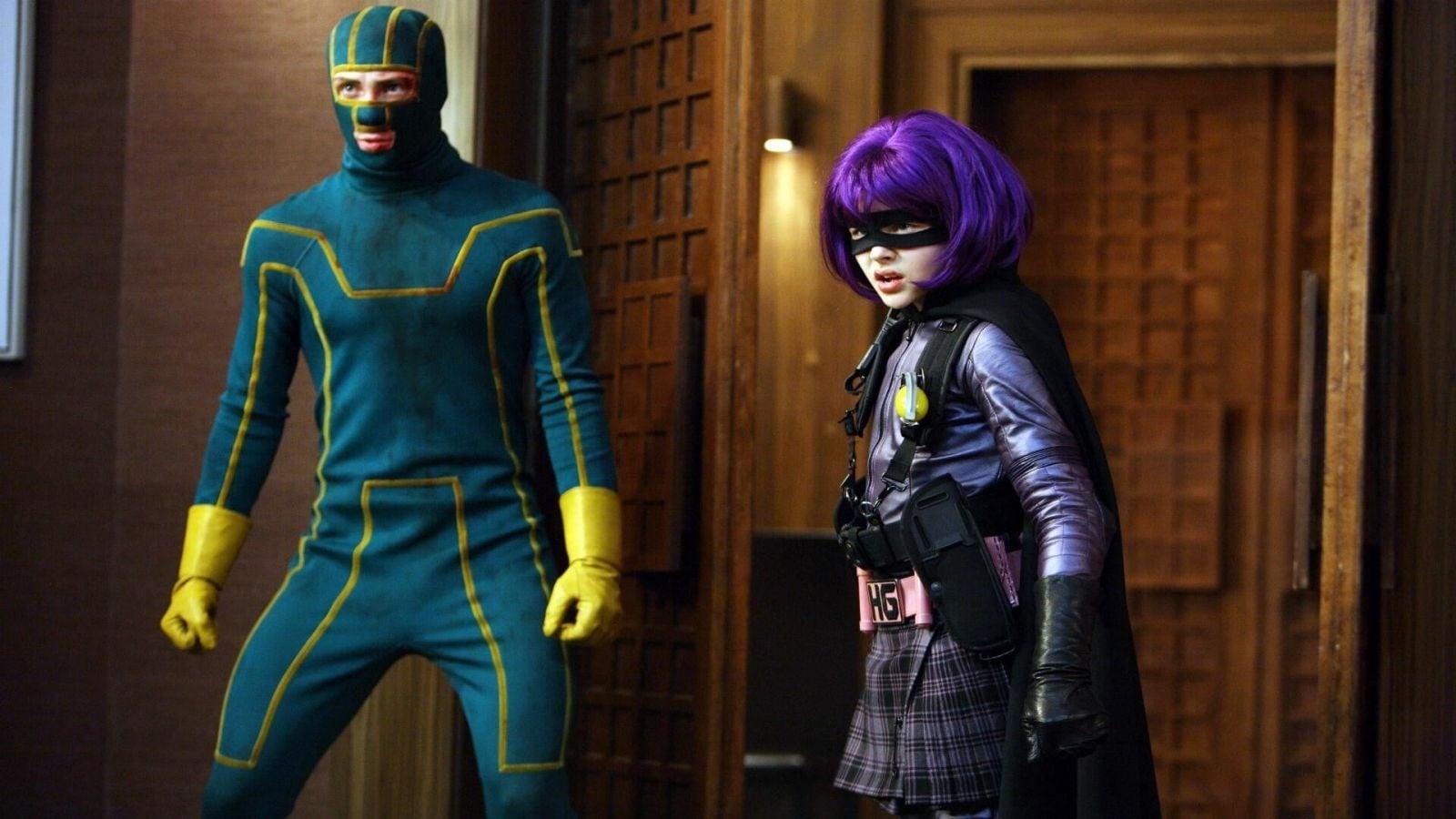
Matthew Vaughn’s Kick-Ass arrived in 2010 at a pivotal moment, just as superhero films were tightening their grip on global box offices. Adapted from Mark Millar and John Romita Jr.’s comic book, the film presents itself as a bracing antidote to the sanitised, PG-13 polish of the burgeoning Marvel Cinematic Universe. Yet beneath its surface-level transgressions lies a work that is ultimately more interested in provocation than in genuine deconstruction.
The narrative follows Dave Lizewski (Aaron Johnson), an unremarkable New York teenager who, armed with little more than a wetsuit and misguided idealism, elects to become a real-life masked vigilante. His misadventures soon entangle him with Hit Girl (Chloë Grace Moretz), an eleven-year-old assassin of startling proficiency, and her father Big Daddy (Nicolas Cage), whose mentorship consists of training his daughter in the lethal arts whilst feeding her a steady diet of profanities. Vaughn’s method of "realism" is blunt instrument indeed: he ladles on graphic violence and salty language, apparently convinced that excess alone constitutes satire.
There is no denying that certain performances transcend the material. Moretz’s Hit Girl became the film’s signature creation, a role that would define the early phase of her career. Cage, meanwhile, delivers work of surprising conviction during a period when his filmography was increasingly characterised by eccentricity and indifference. Their commitment lends the film a vitality that its script does not always merit.
The film’s most enduring point of contention remains its treatment of Hit Girl. Vaughn orchestrates sequences in which a prepubescent girl disembowels adversaries and deploys language that would make a stevedore blush, then seems to stand back awaiting applause for his audacity. One might reasonably question whether the shock value justifies the imagery, or whether the film merely replicates the very adolescent power fantasies it purports to lampoon.
Kick-Ass functions most effectively as a time-capsule piece, capturing that brief window before superhero cinema achieved total cultural hegemony. Its R-rated irreverence now seems almost quaint, and its attempts at genre subversion have been thoroughly eclipsed by more sophisticated deconstructions. The inevitable sequel, Kick-Ass 2 (2013), directed by Jeff Wadlow, proved the limitations of the formula; repeating the cocktail of black humour, parody, and explicit violence without Vaughn’s visual flair, it descended into poor taste and flat punchlines, earning its reputation as a predictable disappointment that even the returning cast could only partially salvage.
For viewers untroubled by family-unfriendly entertainment, the original Kick-Ass remains a serviceable, if ultimately hollow, diversion. It is a film that mistakes extremity for insight, yet it cannot be denied a certain kinetic energy—particularly when Hit Girl is on screen. Whether that energy constitutes genuine subversion or merely cynical button-pushing depends, perhaps, on the sophistication of the viewer’s own critical faculties.
Rating: 7/10
Blog in Croatian https://draxblog.com
Blog in English https://draxreview.wordpress.com/
InLeo blog https://inleo.io/@drax.leo
Substack https://draxster.substack.com/
BTC donations: 1EWxiMiP6iiG9rger3NuUSd6HByaxQWafG
ETH donations: 0xB305F144323b99e6f8b1d66f5D7DE78B498C32A7
BCH donations: qpvxw0jax79lhmvlgcldkzpqanf03r9cjv8y6gtmk9