Film Review: Let the Right One In (Låt den rätte komma in, 2008)
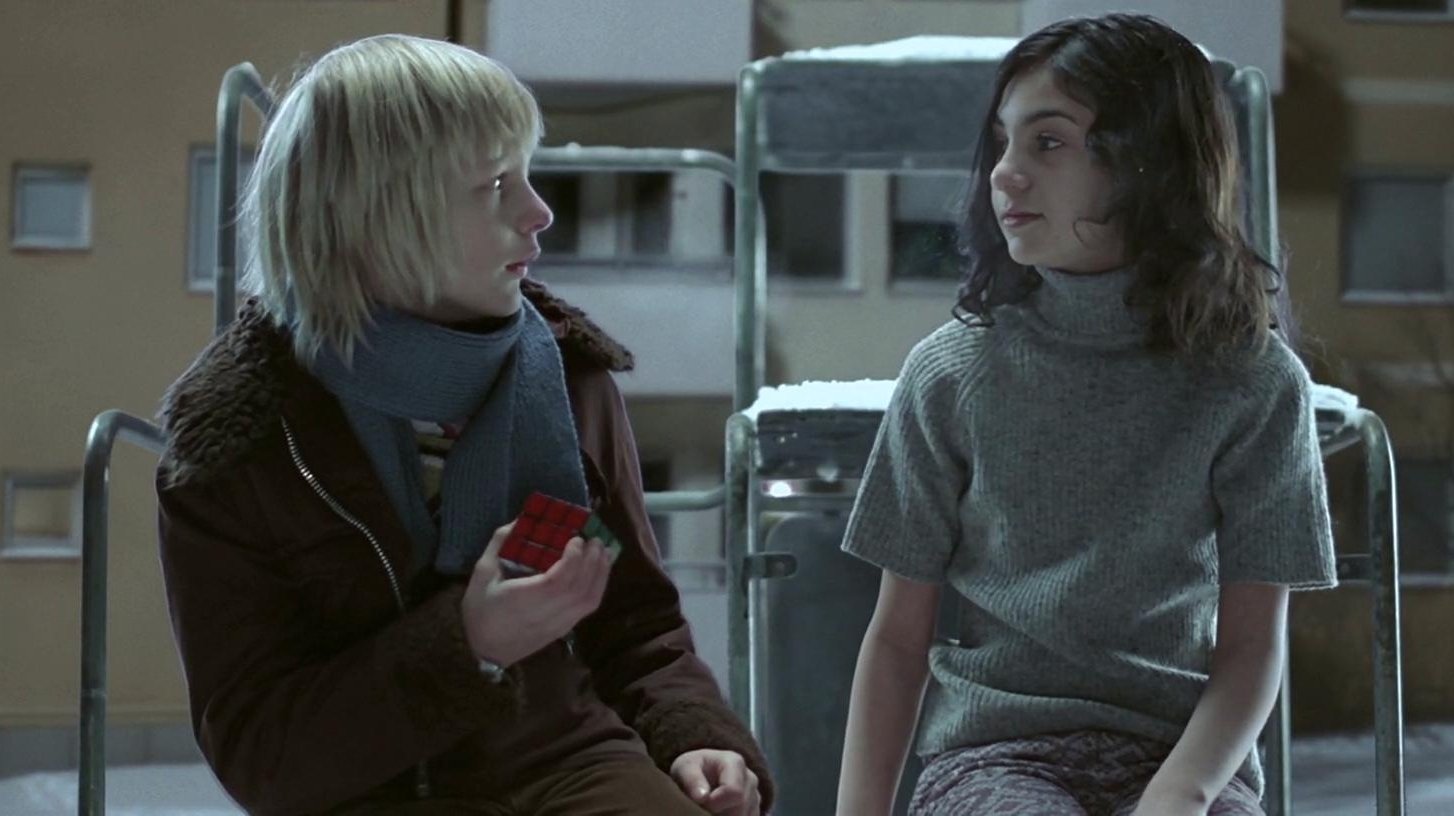
For those horror aficionados who found themselves breaking into cold sweats at the mere mention of the Twilight saga, Tomas Alfredson's Let the Right One In arrived as something of a balm upon a rather nasty wound. Released in 2008, this Swedish masterpiece demonstrates precisely why Hollywood has gradually forfeited its once-unquestioned monopoly over the horror genre, particularly within the increasingly stale sub-genre of vampire cinema.
Based upon John Ajvide Lindqvist's novel (with the author himself adapting the screenplay), the narrative unfolds during the winter of 1982 in Blackeberg, a particularly dreary suburb of Stockholm that seems to exist under a perpetually leaden sky. Our protagonist is Oskar (Kåre Hedebrant), a twelve-year-old boy living with his divorced mother, who endures relentless bullying at school without respite. The only figure to show him any measure of understanding is Eli (Lina Leandersson), a peculiar girl he encounters upon a local playground. Eli, of course, does not attend school, never appears during daylight hours, and rather ominously warns Oskar that she is "not really a girl"—a revelation that becomes rather more literal when we learn she shares her flat with Håkan (Per Ragnar), a middle-aged man who prowls the streets and parks, murdering random victims to harvest blood from their suspended corpses.
What elevates Alfredson's film above the glut of Hollywood vampire fare is his remarkable ability to integrate supernatural elements into a setting of uncompromising realism. Blackeberg, with its modern yet utterly impersonal concrete architecture, bears no resemblance to the glamorous, made-up androgyny that dominates American genre cinema. This is no advertisement for Swedish socialism's supposed benefits; rather, it is a portrait of a community where the protagonists have somehow been bypassed by any notion of social welfare. Indeed, nearly every human character proves thoroughly unappealing in either appearance or disposition. Under the grey skies and snow-covered streets, the residents seek solace only in alcohol (if they are of age) or in senseless violence (if they are young).
The young, naive, and still-unspoiled Oskar—abandoned by all who ought to care for him—finds himself drawn almost inevitably toward this dark girl whose demonic nature Alfredson reveals through genuinely shocking scenes of carnage. The director does not shy away from lending the relationship between the boy and his eternally youthful companion certain sexual undertones, though he stops short of the uncompromising approach taken in Lindqvist's source material, which included paedophilia as a subplot. Nevertheless, Let the Right One In merits genuine praise as a horror film that unsettles its audience not through the monsters it displays upon the screen, but through situations recognisable from everyday life.
The film effortlessly weaves together vampire mythology with pointed social commentary upon single parenthood, bullying, alcoholism, and violence, all whilst presenting a thoroughly un-nostalgic vision of the 1980s. Despite its graphic violence and generally grim atmosphere, the picture garnered considerable critical acclaim and in doing so, paved the way for what many considered an inevitable Hollywood remake.
Rating: 8/10
The 2010 Remake: Let Me In
Hollywood's 2010 remake, Let Me In, directed by Matt Reeves and starring Chloë Grace Moretz and Kodi Smit-McPhee, proved a curious case of critical division and commercial disappointment. With a budget of $20 million, the film managed only $27 million worldwide—earning a mere $12.1 million domestically and ranking as one of the lowest-grossing wide releases of 2010. Critics were sharply divided: whilst some hailed it as a rare faithful remake that "doesn't add insult to inspiration" (earning an 89% rating on Rotten Tomatoes and praise from Stephen King as "the best American horror film in the last 20 years"), others dismissed it as entirely redundant. Mark Kermode famously dubbed it "the most utterly redundant remake of the year," whilst the original's director Tomas Alfredson publicly opposed the project, stating, "If one should remake a film, it's because the original is bad. And I don't think mine is." The remake's failure to find a substantial audience—despite its critical defenders—only reinforced what Alfredson's original had already proven: some stories simply cannot be improved upon, nor should they be.
Blog in Croatian https://draxblog.com
Blog in English https://draxreview.wordpress.com/
InLeo blog https://inleo.io/@drax.leo
Substack https://draxster.substack.com/
BTC donations: 1EWxiMiP6iiG9rger3NuUSd6HByaxQWafG
ETH donations: 0xB305F144323b99e6f8b1d66f5D7DE78B498C32A7
BCH donations: qpvxw0jax79lhmvlgcldkzpqanf03r9cjv8y6gtmk9