Television Review: The Shield (Season 1, 2002)
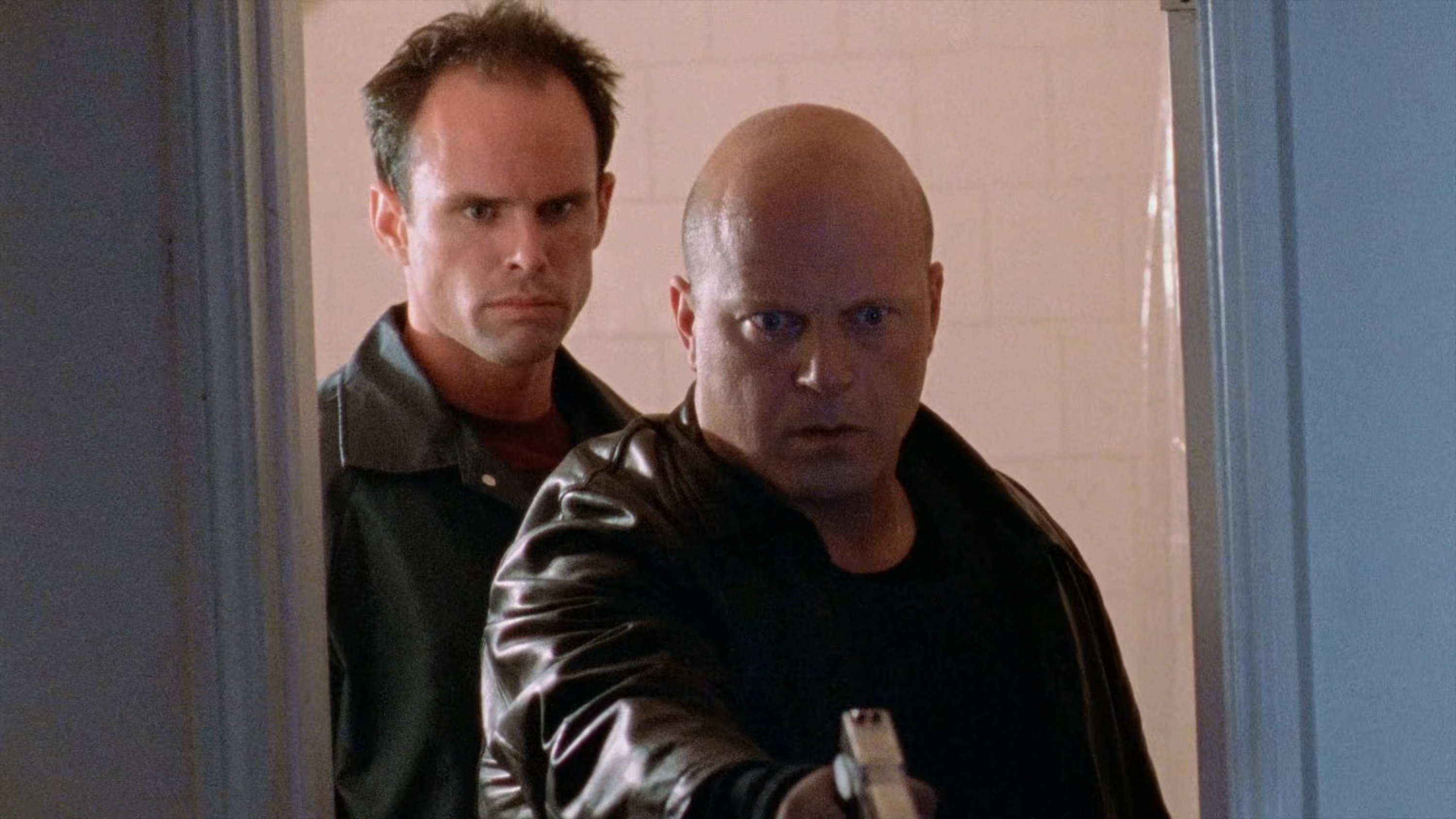
FX's inaugural foray into prestige television, The Shield, arrived in March 2002 as a gauntlet thrown before the conventions of the police procedural. Created by Shawn Ryan and produced for cable at a moment when HBO's dominance seemed unassailable, Season One establishes a world where the boundaries between law enforcement and criminality are not merely blurred but deliberately obliterated. Across thirteen episodes, the programme constructs an uncompromising vision of institutional rot, anchored by Michael Chiklis's ferocious portrayal of Detective Vic Mackey—a man whose capacity for violence is matched only by his self-delusion.
The season opens with a statement of intent so audacious it reshaped television narrative possibilities. The pilot episode's climactic execution of Detective Terry Crowley—played with devastating irony by Reed Diamond, listed among the regular cast only to be murdered before the credits roll—establishes Mackey not as a rogue cop with a heart of gold, but as a calculating murderer who takes a fellow officer's life to preserve his own criminal enterprise. This is not the weary cynicism of Hill Street Blues; it is something far more corrosive. The subsequent episode, Our Gang, plunges immediately into the suffocating aftermath, mining the duality of Mackey's public declaration of responsibility—interpreted by his colleagues as guilt-ridden honour, recognised by the audience as cold confession. Walton Goggins's Shane Vendrell emerges here as the moral barometer of the unit, his raw anguish during Crowley's funeral suggesting that the Strike Team is not a monolith of corruption but a fractious alliance of the compromised.
Yet the first season is not without its growing pains. Episodes such as The Spread (the third broadcast, though originally intended for later placement) reveal Ryan's initial uncertainty regarding the programme's longevity and identity. Here, the narrative stumbles into conventional procedural territory, with Mackey orchestrating the unlawful detention of a basketball star for personal financial gain—a storyline that leans uncomfortably into farce with strip club subplots and comedic interludes involving flooding toilets. Critics have rightly identified this as the series’ nadir, a moment where The Shield risks becoming merely another sensationalist cop drama rather than the morally complex examination it aspires to be. Glen Mazzara's script for this instalment prioritises locker-room humour and implausible coincidences over the institutional critique that defines the series at its best.
The season finds its surer footing when it confronts the realities that inspired it. Dawg Days, drawing directly from the LAPD's Rampart scandal, plunges the Strike Team into the toxic intersection of law enforcement, celebrity, and gang culture. The episode's centrepiece—Mackey confining two warring rappers to a shipping container with the implicit understanding that only one shall emerge—distils the series' thesis: justice here is indistinguishable from savage, self-determined retribution. Stephen Gyllenhaal's direction achieves a poetry of violence, particularly in the final shot of Kern and Vic silently watching the sunrise, bound by shared complicity in an unspeakable act.
The tension between gritty realism and melodramatic excess remains the season's defining contradiction. Episodes such as Blowback and Dragonchasers introduce plot machinations—stolen police vehicles, elaborate chains of custody for seized narcotics, strip club sting operations—that strain credulity and flirt with soap opera conventions. Kurt Sutter's script for Blowback in particular, though memorable for his own cameo as the silent Armenian assassin Margos Dezerian, relies upon a concatenation of improbable coincidences that threatens to undermine the programme's documentary aesthetic. Similarly, Cherrypoppers risks accusations of exploitation in its depiction of underage prostitution, though it largely transcends sensationalism by using the material to interrogate Mackey's own flickering moral consciousness. His brutal beating of informant Connie Reisler—performed with visible physical revulsion by Chiklis—serves as twisted aversion therapy, an attempt to force her toward survival that speaks to the character's buried idealism without excusing his methods.
What elevates the season is its refusal to present Mackey as an anomaly. The penultimate episode, Two Days of Blood, performs a crucial inversion: it reveals that Mackey, however compromised, is merely a symptom of far more insidious corruption. Assistant Chief Gilroy, played with reptilian menace by John Diehl, emerges as the true architect of systemic failure—deliberately endangering communities for financial gain and manipulating police response times to facilitate ethnic cleansing-by-neglect. The scriptwriters Kurt Sutter and Scott Rosenbaum construct a hierarchy of evil wherein Mackey's street-level brutality, however reprehensible, pales beside the corporate calculation of those above him. This culminates in Circles, the season finale, where Mackey confronts his mirror image in Gilroy—"a perverted reflection of himself"—yet chooses restraint over execution, delivering his former protector to custody rather than the morgue.
The finale's emotional architecture is devastating. Chiklis's performance—reportedly fuelled by a genuine panic attack during filming—captures the collapse of Mackey's carefully constructed world. His professional triumph over Gilroy is rendered hollow by the simultaneous dissolution of his domestic life; Corrine's departure with their children, including the autistic Matthew whose diagnosis has haunted the season, leaves Mackey alone in his ransacked home, his justifications for violence now stripped of their alibi. It is a masterclass in tragic structure, ensuring that victory feels as unsettling as defeat.
The ensemble deserves particular commendation. CCH Pounder anchors the proceedings as Claudette Wyms, the pragmatic detective whose ethical compromises—such as extracting false confessions through deception—remind us that corruption in this milieu operates on a spectrum rather than a binary. Jay Karnes's Dutch Wagenbach provides the season's most compelling character study, his devastation at failing to catch a child killer in Cherrypoppers revealing a vulnerability that transcends the cerebral detective archetype. Benito Martinez's Aceveda undergoes the most significant transformation, evolving from righteous reformer to pragmatic political animal willing to ally with Mackey against the greater threat of Gilroy—a development foreshadowing the morally ambiguous bargains that will define his subsequent career.
Technically, the series’ handheld cinematography and desaturated colour palette establish a visual language of authenticity distinct from the polished aesthetics of network contemporaries. Clark Johnson, himself an alumnus of Homicide: Life on the Street, directs key episodes with an improvisational energy that complements the documentary style, though occasional directorial flourishes—such as the parallel editing of police and gang funerals in Our Gang—can feel schematic rather than organic.
In retrospect, Season One of The Shield functions as a foundational text for the "Golden Age" of television that followed. Its willingness to centre an unrepentant murderer as protagonist, its rejection of procedural tidiness in favour of systemic critique, and its understanding that authenticity requires not merely grit but moral complexity, established parameters that programmes from The Wire to Breaking Bad would subsequently explore. That it achieves this whilst occasionally succumbing to the very sensationalism it aspires to transcend is not a failure but a testament to the difficulty of forging new territory. By the season's close, with Mackey alone in his empty house, the audience has been implicated in his corruption—we have rooted for the lesser evil, only to discover that the lesser evil remains, indubitably, evil. It is an unsettling achievement, and one that secured The Shield its place in the canon of American television's most ambitious works.
(NOTE: All reviews can be accesed via this link.)
Blog in Croatian https://draxblog.com
Blog in English https://draxreview.wordpress.com/
InLeo blog https://inleo.io/@drax.leo
BTC donations: 1EWxiMiP6iiG9rger3NuUSd6HByaxQWafG
ETH donations: 0xB305F144323b99e6f8b1d66f5D7DE78B498C32A7