The Quiet Engineering Behind Women’s Necklaces
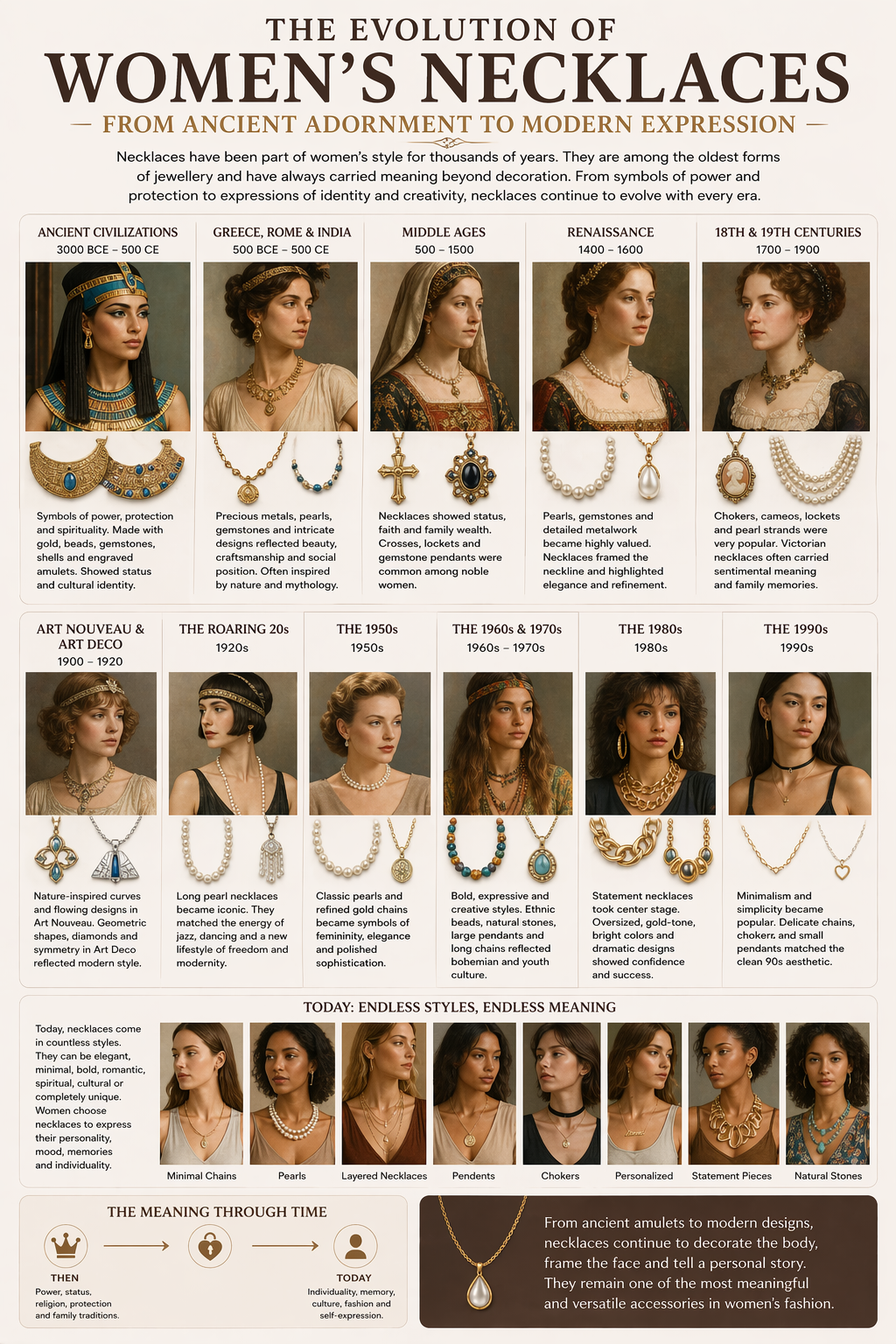
A necklace is one of the few accessories that can change the geometry of an outfit without changing the garment itself. A short chain sharpens attention around the neck, a pendant draws the eye downward, and a long strand can visually lengthen a jacket, dress, or plain top. These effects come from measurable design choices: length, metal tone, clasp position, pendant weight, surface texture, bead spacing, and how the piece sits against fabric.
For thousands of years, women’s necklaces have worked as more than decoration. They have carried signs of wealth, protection, belief, memory, craft skill, and personal identity. The object may be small, but its construction often reveals a great deal: drilled shells require patience, polished stones need abrasion and shaping, pearls demand careful matching, and metal chains depend on links that must be strong enough for daily movement.
A Timeline Worn Close to the Skin
Ancient necklaces were built from materials that could survive touch, climate, and travel. Shells, bones, stones, glass beads, and hammered metals were portable and visually expressive. In Egypt, broad collar necklaces used repeated bead patterns, gold details, turquoise shades, lapis tones, and carnelian color to create structured designs across the chest. Their value came from material rarity, skilled arrangement, and symbolic meaning.
In other ancient cultures, including Greek, Roman, Indian, and Mesopotamian settings, necklaces showed access to trade and specialized craftsmanship. Pearls had to be sourced and sorted, gemstones needed polishing or cutting, and engraved pendants required controlled tools. A necklace could communicate status, region, devotion, or taste before a person spoke.
Medieval jewellery in Europe often connected necklaces with faith, property, and family continuity. Crosses, lockets, gemstone pendants, and gold chains were not disposable fashion pieces. They could be stored, repaired, inherited, or used as valuable possessions. This practical role explains why necklaces often carried emotional and financial weight at the same time.
From Pearls to Pendants and Layered Chains
The Renaissance placed the necklace into a more deliberate relationship with clothing. Open necklines, structured gowns, and portraits made pearls, pendants, and layered chains highly visible. A necklace framed the upper body and helped create balance between fabric, skin, hairstyle, and face. It was not only an added object; it was part of the full composition.
The 18th and 19th centuries expanded the emotional vocabulary of jewellery. Cameos brought carved profiles and classical references. Lockets created a private inner space for portraits or keepsakes. Pearl strands added softness and symmetry, while gemstone necklaces introduced stronger color. Victorian mourning pieces also showed how jewellery could preserve memory through dark materials, symbolic motifs, and personal tokens.
Several technical details still decide how a necklace performs in real use:
-
A collar length emphasizes the neck and works best with open or structured necklines.
-
A princess-length chain is versatile because it sits near the collarbone.
-
A long strand adds vertical movement and pairs well with simple fabrics.
-
A pendant needs balanced weight so it stays centered during wear.
-
Smooth metal feels cleaner against skin than rough or heavily textured surfaces.
-
Layered chains need length separation to avoid tangling and visual clutter.
The early 20th century made necklaces lighter and more connected to movement. Art Nouveau designs used curved lines and nature-inspired forms, while Art Deco favored symmetry, contrast, pearls, diamonds, and geometric precision. In the 1920s, long pearl strands matched loose dresses and dance culture. In the 1950s, shorter pearls and refined chains supported polished silhouettes. Later, the 1960s and 1970s brought shells, beads, natural stones, and large pendants into everyday self-expression.
The contrast continued in the 1980s and 1990s. Oversized chains, bold collars, and bright gold-tone surfaces projected confidence in the 1980s. The 1990s reduced the scale with chokers, fine chains, small pendants, and simpler silver-toned pieces. That shift matters because modern jewellery design still moves between two poles: statement and restraint.
Today, a well-chosen necklace women piece can serve several practical purposes. It can soften a tailored shirt, add structure to a plain dress, introduce contrast to knitwear, or mark a personal memory through a pendant or charm. The best choice depends on proportion: the necklace should fit the neckline, match the weight of the fabric, and not compete with earrings, buttons, or prints.
What Makes the Necklace Endure
The necklace remains important because it is both visible and personal. It sits near the face during conversation, close to the heart in symbolism, and directly on the body in physical use. This makes it different from objects that are carried in a bag or seen only occasionally.
From ancient collars to modern minimalist chains, necklaces show how women’s style has changed with technology, society, and personal freedom. Materials have shifted, shapes have evolved, and meanings have broadened, but the core function is steady: a necklace frames the wearer, adds crafted detail, and turns material into identity.