Don't Get Fined: 5 Most Common "Factuur" Mistakes Expats Make (Amsterdam Freelancer Guide)
Don't Get Fined: The 5 Most Common Invoice "Factuur" Mistakes Expats in the Netherlands Make (+ How to Avoid Them)
As an expat freelancer (ZZP’er) in Amsterdam and the Netherlands, you’ve got enough on your plate: finding clients, doing the actual work, and figuring out Dutch bureaucracy.
The last thing you need is a surprise fine from the Belastingdienst because of a small mistake on your factuur (invoice).
Dutch tax law is strict about invoices. A single error can trigger a boekenonderzoek (audit) and a verzuimboete of up to €4,920 per factuur. Yes, per invoice. Even forgetting to send an invoice counts as a violation.
But don’t panic. After helping many expat solopreneurs in Amsterdam, we’ve seen the same five mistakes over and over. Here’s how to spot them — and fix them — so you can keep your business running smoothly and legally.
1. Missing or Incorrect BTW-nummer (VAT number)
Your BTW-nummer is NOT your Burgerservicenummer (BSN). It’s the VAT number you receive from the Belastingdienst after registering as a ZZP’er. It usually looks like NL123456789B01.
Common expat error: Using your BSN instead of the BTW-nummer, or forgetting to add the B01 suffix.
Fix: Always double-check your BTW-nummer on your Belastingdienst correspondence. Put it on every invoice, right next to your KvK number.
Pro tip: If you’re unsure about your BTW-nummer or need a full invoice template, our Amsterdam bookkeeper can help during a short consultation.
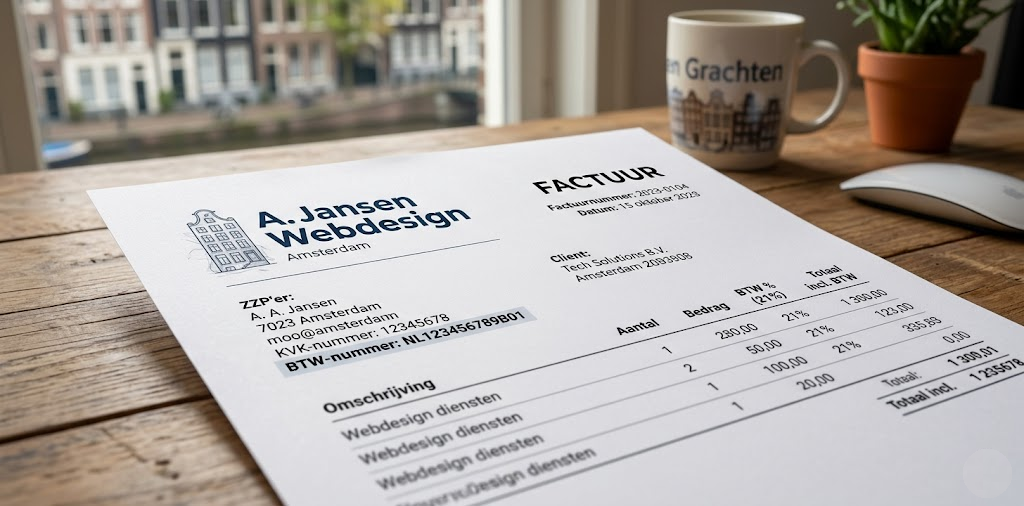
Your BTW-nummer must be clearly displayed – usually near your KvK number.
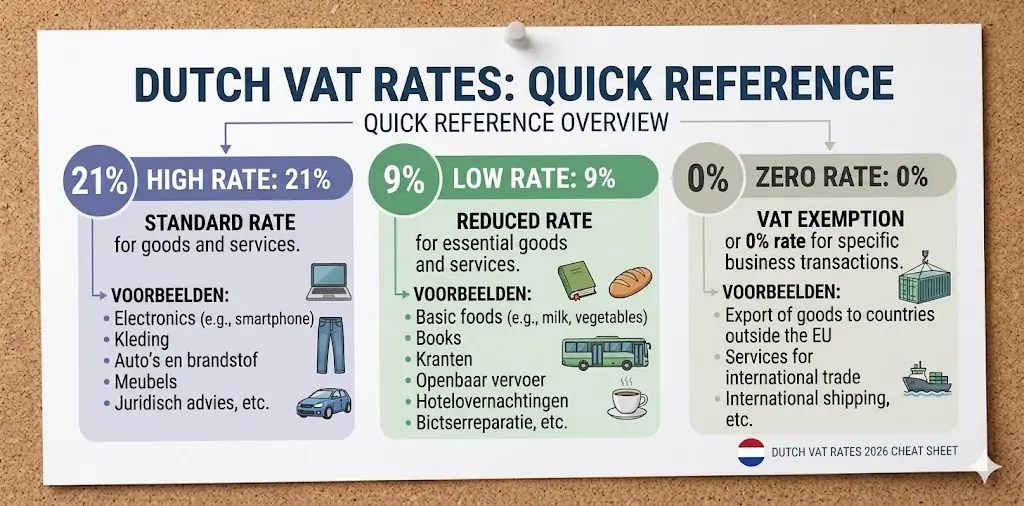
2. Wrong VAT Tariff (21% vs 9% vs 0%)
The Netherlands has three VAT rates: 21% (standard), 9% (reduced), and 0% (zero). Applying the wrong rate is a classic mistake, especially for expats offering services like consulting (21%) versus books or certain repairs (9%).
Example: A freelance graphic designer (21%) accidentally charging 9% on a logo design. The Belastingdienst sees this as underpaid tax, plus a possible fine.
Fix: Learn the official list of reduced-rate goods/services. When in doubt, use 21% – it’s safer. Better yet, let a professional handle your VAT returns.
3. No Clear Description of Goods or Services
Dutch law requires a specific description of what you delivered. “Consultancy services” is too vague. Instead: “10 hours of SEO analysis for website project X, delivered on 1 April 2026”.
Expat trap: Copying a generic English template that doesn’t meet Dutch standards.
Fix: Write at least one sentence that answers: what, how many, for whom, and when. The Belastingdienst needs to reconstruct the transaction without guessing.
4. Missing Invoice Date or Unique Invoice Number
Your invoice must have a date of issue and a consecutive, unique number (e.g., 2026-001, 2026-002…). Skipping numbers or restarting each month is not allowed.
Why it matters: The Belastingdienst uses these numbers to check if you’ve hidden income. Gaps in numbering raise red flags.
Fix: Use an automated bookkeeping tool or a simple Excel sheet that increments the number automatically. Never reuse or delete numbers — if you void an invoice, note it as “cancelled” but keep the number.
5. No VAT Amount Shown Separately
Your "factuur" must clearly show: subtotal (excl. BTW), BTW amount, and total (incl. BTW). Combining them is not allowed. Expats often write “Total €1,210 incl. 21% VAT” without splitting – that’s insufficient.
Fix: Always display:
- Subtotal: €1,000
- BTW (21%): €210
- Total: €1,210
This also helps you correctly report your VAT return.
Don’t Let a Small Mistake Cost You Thousands
Yes, some solopreneurs have received a fine for invoicing in the wrong way. But the good news is that most errors are preventable. If you’re an expat freelancer in Amsterdam, you don’t have to navigate this alone. A local bookkeeper who understands both Dutch tax law and the challenges of international entrepreneurs can save you time, stress, and money.
- We check your invoices for compliance.
- We file your VAT and income tax returns.
- We speak English and Dutch – no language barriers.
Ready to stop worrying about fines and focus on your business?
Contact our Amsterdam office for a free, no-obligation personal consultation.
This article is for informational purposes. Tax laws change – always consult a professional for your specific situation.