The last of the OLD WORLD GIANTS. 1
AI attempting to explain and fit these images in to a comforting version of history that fits with the mainstream narrative and view of history is hilarious . .
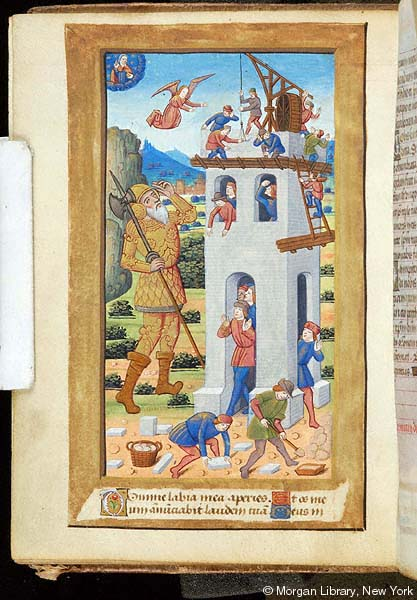
The image is a medieval miniature titled "Saint Christopher" (or specifically a scene depicting a giant overseeing construction), which originated in Rouen, France, around the year 1500.
Origin and Current Location
• Time: Created approximately ca. 1500.
• Where (Origin): It was written and illuminated in Rouen, France.
• Where (Current): It is part of a Book of Hours (MS H.1, fol. 24v) currently held at The Morgan Library & Museum in New York City.
Context of the Artwork
This illumination was recently featured in an exhibition titled "Medieval Monsters: Terrors, Aliens, Wonders". The scene shows a giant—representing Saint Christopher—holding a staff and overseeing the construction of a tower. In medieval art, giants were often used to illustrate wondrous or tales of power and were a popular subject for manuscript illuminations.
In this miniature from around 1500, he represents Saint Christopher, who was traditionally described as a man of immense stature. The other
The Contrast in Scale
• The Giant (Saint Christopher): He is depicted as a "monster" or giant to illustrate his legendary physical power. According to legend, his great size made him an ideal ferryman for travelers.
• The Normal Workers: These are masons and laborers building a tower. They are drawn at a much smaller scale to emphasize Saint Christopher’s extraordinary height.
• Hierarchical Scale: This is a common technique in medieval art where the most important figure (in this case, the saint) is drawn much larger than everyone else to show their spiritual or legendary significance.
Interestingly, in some versions of this same manuscript page, the giant is identified as Nimrod, the biblical figure associated with building the Tower of Babel. In either case, his massive size is meant to set him apart from the regular humans working on the construction.
In medieval art, giants are a mix of literal creatures from legend and a visual tool for status.
Literal Legends vs. Visual Tools
• Literal Giants: In the Middle Ages, people often believed giants had literally existed in the ancient past. Legends like Saint Christopher or the biblical Nimrod (often linked to the Tower of Babel) were seen as historical figures who were physically massive.
• Symbolic "Scale": Artists frequently used hierarchical scale, making important people look like giants to show they were powerful or holy. A king or a saint might be drawn three times larger than a peasant, not because they were actually 15 feet tall, but to tell the viewer, "This person is the most important part of the story".
Giants as "Monsters"
Medieval people grouped giants into a category of "monsters"—beings that were outside the "normal" human experience. Whether literal or symbolic, their size was meant to:
• Embody Power: They could do things normal humans couldn't, like carry the weight of the world (Saint Christopher) or build massive towers (Nimrod).
• Represent History: Ancient ruins, like the Roman walls or Stonehenge, were sometimes called the "work of giants" because people couldn't imagine how regular humans could have moved such stones.
So, while the artist likely believed these specific legendary giants were real, they used their size in the painting to make a point about their legendary importance.
So there is and was never literal giants? Just powerful and rich people painted as giants?
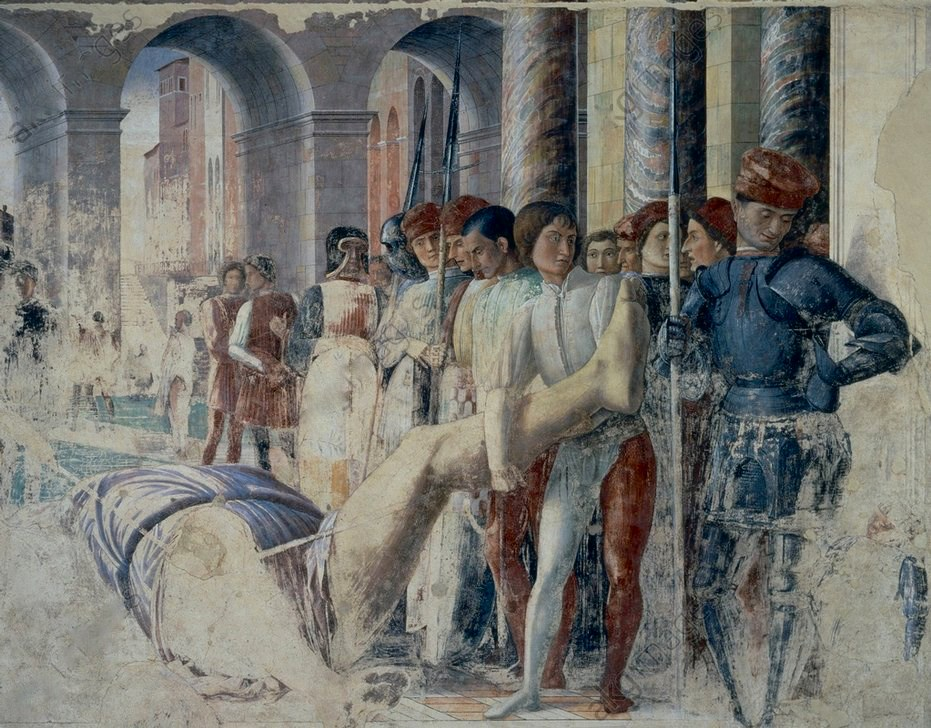
This fresco, titled The Martyrdom of Saint Christopher and the Removal of His Body, was painted by the Italian Renaissance artist Andrea Mantegna between 1448 and 1457.
Location and History
• Original Location: It was painted for the Ovetari Chapel in the Church of the Eremitani in Padua, Italy.
• Destruction: Tragically, the chapel was almost completely destroyed by Allied bombing on March 11, 1944, during World War II.
• Current State: Today, only fragments of the lower wall area remain. The image you provided shows the work in its restored state, recomposed from original pieces and historical photographs.
The scene specifically depicts a group carrying away the decapitated body of Saint Christopher after his martyrdom.