How AI Could Verify Proof of Reserve Automatically: The Future of Real-Time Crypto Transparency
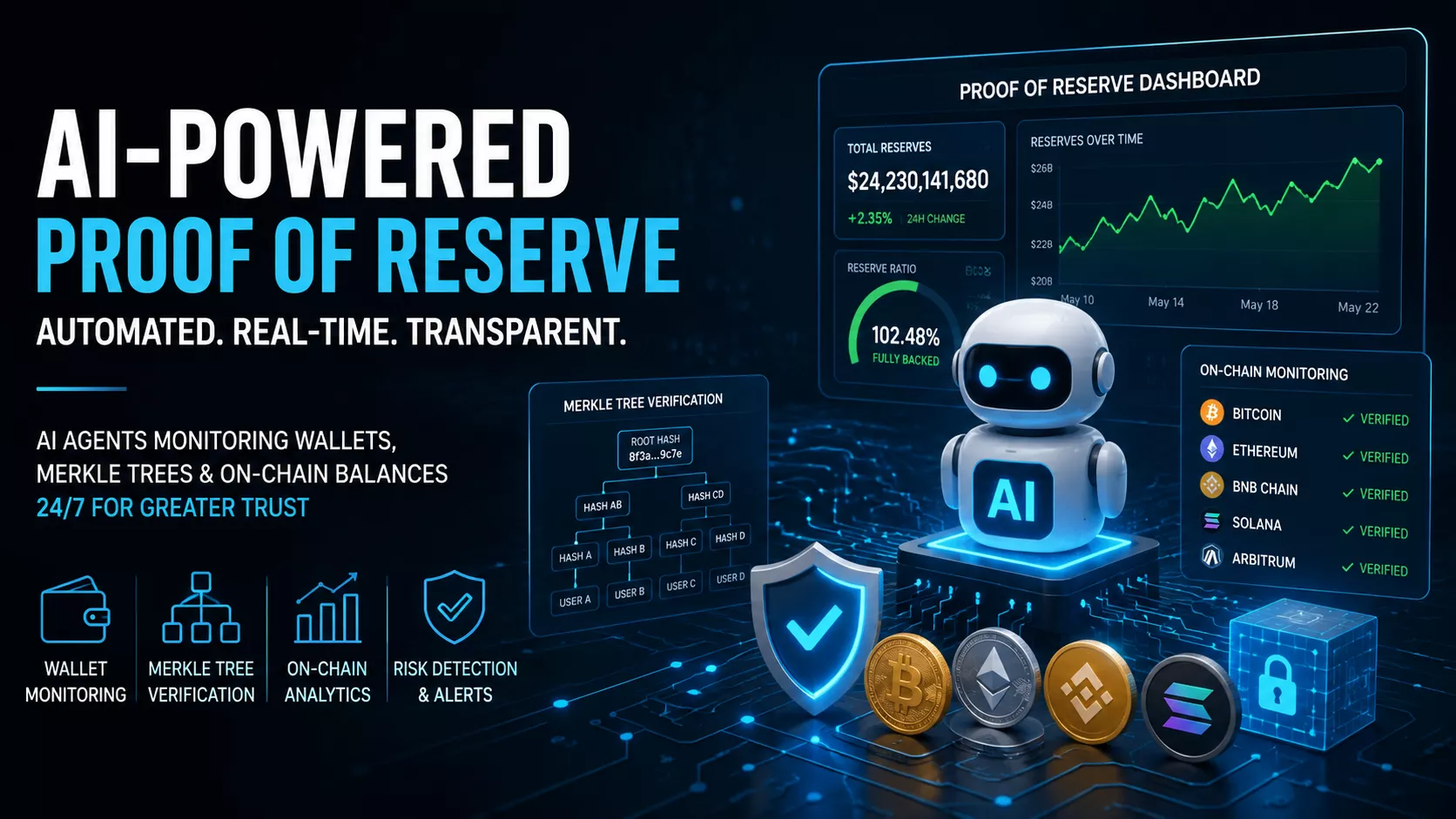
The collapse of major centralized exchanges in recent years highlighted a brutal reality in the digital asset space: periodic transparency is not transparency. Traditional Proof of Reserves (PoR) reports—typically generated as point-in-time snapshots by third-party accounting firms—are inherently vulnerable. They document a state of affairs that existed yesterday, providing no protection against the volatile, 24/7 nature of crypto markets.
To bridge this "trust gap," the industry is pivoting toward Real-Time Automated Verification, where Artificial Intelligence (AI) agents act as independent, persistent monitors of exchange solvency.
The Anatomy of the Trust Problem
To understand why AI is necessary, we must first look at the mechanism of a standard PoR:
- Proof of Assets: The exchange proves ownership of public wallet addresses holding the assets.
- Proof of Liabilities: The exchange constructs a Merkle Tree, a cryptographic data structure that aggregates user balances without revealing individual private data.
- The Commitment: The "Merkle Root"—a single hash representing all user liabilities—is published.
The Flaw: These audits are static. An exchange can temporarily move assets into a wallet to "pass" a snapshot audit, only to withdraw them immediately after. This is where AI automation changes the paradigm.
The AI Upgrade: Continuous Monitoring
AI agents move the industry from snapshot audits to continuous assurance. By integrating directly with blockchain data, AI agents provide a multi-layered verification stack:
1. Real-Time On-Chain Balance Tracking
AI agents operate as persistent listeners. They monitor the public wallets identified by the exchange and track every inflow and outflow against the reported Merkle Root. Unlike human auditors who perform monthly reviews, an AI agent can flag a balance deviation within seconds of an on-chain transaction.
2. Anomaly Detection in Transaction Patterns
Exchange reserves rarely stay static, but they follow predictable patterns. AI models trained on historical transaction data can distinguish between:
- Routine Liquidity Management: Standard transfers to hot wallets or DeFi yield protocols.
- Suspicious Outflows: Potential bank runs, unauthorized withdrawals, or "window-dressing" maneuvers designed to mask insolvency.
3. Automated Reconciliation
The AI agent acts as a validator that continuously reconciles the on-chain asset balance against the Merkle-sum of liabilities. If the assets fall below the liabilities, the AI can automatically trigger an alert to a DAO, a regulatory body, or an on-chain smart contract, potentially triggering a "circuit breaker" on the exchange’s withdrawal capabilities.
The Challenges: Can We Trust the Monitor?
While AI brings unprecedented efficiency, it introduces new risks that must be mitigated to maintain E-E-A-T (Experience, Expertise, Authoritativeness, and Trustworthiness) standards:
- The Oracle Problem: How does the AI know the off-chain data (the liabilities) is accurate? An AI is only as good as the input data. This is why AI must be paired with Zero-Knowledge Proofs (ZK-proofs), which mathematically guarantee that the data submitted to the AI has not been tampered with.
- Adversarial Manipulation: If an AI agent’s model is not transparent, bad actors could attempt to "train" the model to overlook specific, obfuscated transaction paths.
- Centralization Risks: If a single company controls the AI agent, the industry has simply moved the trust problem from the exchange to the AI provider.
The Solution: The logic driving the AI agents must be open-source, and the verification process should ideally run on a decentralized compute network to ensure no single entity can influence the "audit" results.
The Future: Toward Autonomous Auditing
The integration of AI and blockchain is moving toward Autonomous Auditing. In this future:
- AI Agents monitor the Merkle Tree in real-time.
- ZK-proofs generate immutable proofs of solvency every hour.
- Smart Contracts automatically freeze assets or publish solvency warnings if the reserve ratio drops below a predefined threshold.
By removing the reliance on slow, expensive, and intermittent human audits, AI-driven PoR turns transparency into a feature rather than a marketing exercise. For the retail investor, this signifies a move away from "trusting the exchange" toward "verifying the math."
Key Takeaways for Stakeholders
- For Exchanges: Adopt real-time reporting to differentiate your platform as a leader in transparency.
- For Regulators: Shift focus from legacy audit frameworks to real-time, AI-monitored compliance dashboards.
- For Users: Demand proof, not promise. Seek out exchanges that utilize open-source, continuous, cryptographic verification.
Disclaimer: This article is for informational purposes only and does not constitute financial or legal advice. Always conduct your own due diligence regarding the transparency measures of any financial institution.
References & Further Reading
- Chainlink Proof of Reserve Documentation: https://chain.link/proof-of-reserve
- The Merkle Tree Data Structure Explained: https://en.wikipedia.org/wiki/Merkle_tree
- Zero-Knowledge Proofs in Finance: Theoretical Foundations.
...