The AI-Powered Brokerage: How Intelligent CRM Is Redefining Real Estate Success

Imagine two real estate agents working in the same city targeting the same areas and marketing through the same online channels. Within minutes of each other, they both receive a new lead. They have access to similar property listings, similar market data and even budget for marketing. Yet after six months, one agent has closed many transactions whereas the other is chasing leads that never seem to move forward.
The real estate industry has quietly entered an era where capturing the most leads no longer determines success. The key to success lies in knowing who is really ready to act and how their intent changes with time and how to reach them at the right time. Artificial intelligence is making all of this possible by serving as the hidden infrastructure behind modern real estate operations. Every time someone visits the property listing, bookmarks the listing, opens your emails or does any type of searches, it adds another piece of context.
As AI becomes more deeply integrated into CRM platforms more and more, the question that brokerage firms now face is not whether they have enough leads. Rather, the real question is whether they are making the best use of opportunities right in front of them.
The End of CRM as a Digital Address Book
CRMs have been in use for decades to help organize information about prospects. Before AI, CRMs helped create order out of chaos by helping brokerages bring structure to their rapidly changing businesses.
Although CRM systems brought significant improvements, they ultimately did not evolve significantly beyond storing contact data. The primary limitation was that they rarely understood the data being collected. As lead generation has increased dramatically over time; today's agents are now managing hundreds or thousands of contacts at once. With each passing day comes a multitude of inquiries, website visits, email interactions, listings viewed and market updates. Although CRM systems continue to collect all this new information, the interpretation still rests largely with human judgment.
This is where the beginning of the next-generation CRM system began to emerge. Instead of being a passive database, today’s CRM platforms have been developing to become, as many industry observers refer to them, a living CRM – a system which constantly observes, learns and evolves along with new data. It does not just record activities but analyzes patterns, connects seemingly unrelated signals and constantly updates its understanding of every client in real time.
In a living CRM, every interaction gives more insight into client intentions. Any saved property search, revisits to the same neighborhood, greater engagement with market reports or even changes in the client’s search preferences are no longer isolated events. Together, they become part of a dynamic profile that evolves alongside the client.
Data Is No Longer Stored—It's Interpreted
For many years, all CRM systems did was collect data. Although it simplified record keeping, it still posed a challenge for the agents trying to interpret what that information actually meant.
The new age of AI-powered CRM platforms introduces behavioral intelligence. Instead of looking at each interaction in isolation, AI will be able to determine the buyer's intention from various touchpoints and interactions.
A prospect who keeps seeing similar price property homes, saving multiple property listings in the same neighborhood and visiting the property more than once in a week is a completely different buyer than the one who just happens to be viewing any property out of curiosity. Likewise, engagement through emails provides insight into the buyer’s intentions. If an email recipient opens each market report, clicks on listings and downloads a guide about the neighborhood, it means that they are interested.
Another level of intelligence can be gained through search history. Any changes in preferred locations, budgets or an increase in searches for larger houses usually indicate an event or a change of intent before the client communicates with them.
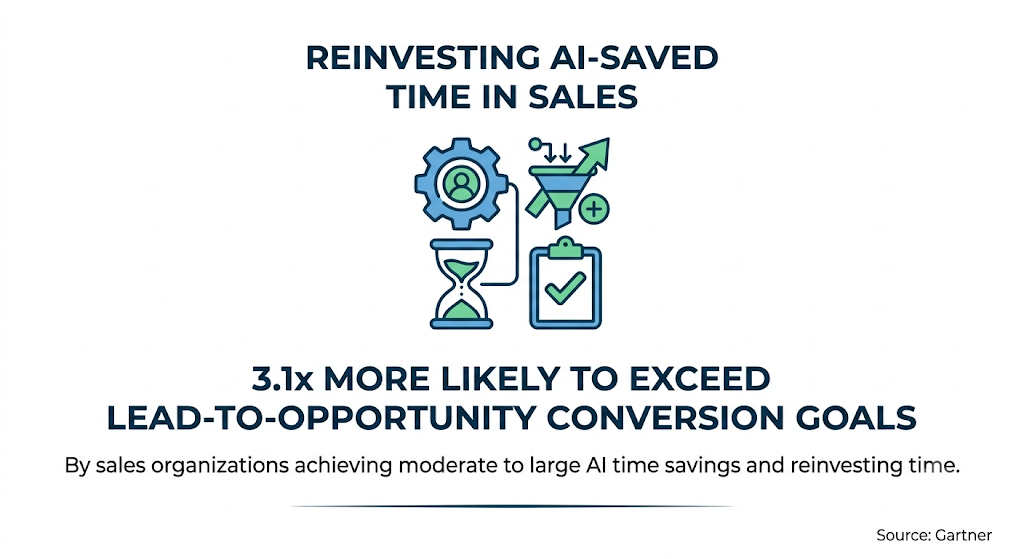
AI can connect all these digital signals to turn thousands of unrelated actions into actionable insights. The effect of this change goes further than just improving efficiency. As reported by Gartner, companies that efficiently reinvest time saved with AI into high-value selling activities are 3.1 times more likely to exceed their objectives for lead-to-opportunity conversion. This finding clearly shows that the main advantage of AI is not automation of routine tasks, but better decision-making based on customer actions.
Why Speed Is No Longer the Competitive Advantage
For many years, success in real estate business was determined by one very simple criterion: be quick. The idea was that whoever returned a call quickly after receiving an inquiry would win the customer. However, it is only natural that the speed of response became one of the main criteria of performance and it made sense then. Buyers and sellers are better prepared today, having done extensive research before talking to the agents.
Modern AI-powered CRM platforms are aware of the unique journey that every prospect will go through. It does not perceive any new customer in the same light anymore. It is aware of the behavior triggers which can be used to identify opportunities. Today's CRM do not send out automated responses based on fixed schedules but change their communication tactics based on the behavior of the customer. Each piece of communication is personalized according to what the customer is interested in.
Such customization is reshaping the entire outlook towards automation. Early marketing automation used emails in a very structured manner that felt repetitive and impersonal. Using AI, one can now produce emails based on the context of the customer, past interactions and even behavioral trends in order to make communications more relevant and timelier.
In today's real estate industry, competitive advantage does not come from who responds first but rather from knowing when and why you should respond.
From Lead Management to Opportunity Prediction
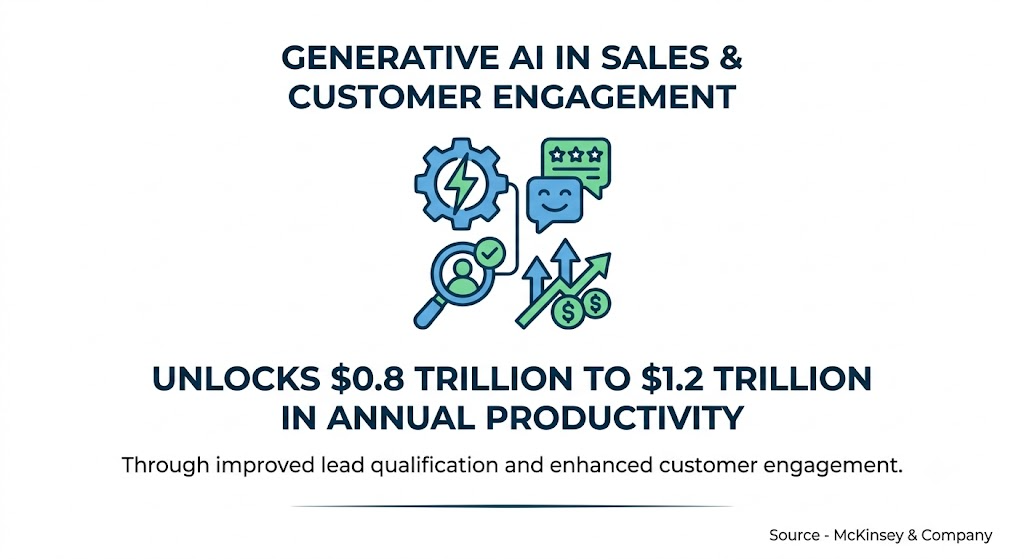
While CRM was once focused on lead management, the advent of AI is ushering in an even more valuable area, opportunity prediction. Instead of merely monitoring where a prospect stands in the sales funnel, AI continuously analyzes where a prospect will end up. Each time a prospect visits the website, saves a property, sends an email, searches the market or requests information on a listing, it contributes to a constantly evolving picture of customer intent. The ability to do this changes how leads are prioritized from a manual process into a predictive one. According to McKinsey & Company, generative AI could unlock $0.8 trillion to $1.2 trillion in annual productivity through improved lead qualification and customer engagement.
Predictive intelligence is transforming seller prospecting. While homeowners do not always advertise their plans to sell several months before doing so, their online activity provides signs that something is up. Any shift in the pattern of property search, engagement with local market news, property valuation inquiries and browsing habits could point to the fact that homeowners are preparing to sell.
The readiness of buyers is also becoming equally quantifiable. All inquiries don’t imply active buyers and all active buyers are not at the same stage of their process. Artificial intelligence makes a distinction between casual interest and real intentions to buy through analyzing consistence, frequency and progression of customer behavior. The CRM will adjust the approach depending on the level of readiness of the prospect.
The key to this revolution is behavioral pattern detection. It does not analyze one action but correlates hundreds of unconnected data points into meaningful insights. The end result is a paradigm shift in the way that real estate professionals look at their pipeline.
The Rise of Autonomous CRM
CRM software is now moving towards becoming operational partners who are capable of handling routine operations with little to no human interaction. At the core of such transformation are autonomous workflows. The CRM solutions do not have to wait for a user’s action before the next process begins but will be able to perform processes such as changing lead statuses, assigning tasks, following up with email notifications and adapting customer journeys based on real-time behavior. This ensures that opportunities continue moving forward, even when agents are focused elsewhere.
Customer nurturing has become much smarter as well. Instead of using set email sequences, AI adapts different means of communication depending on each prospect's activity and interests. The marketing campaign adjusts automatically as per changing buyer preferences, while built-in appointment scheduling takes care of scheduling meetings without any back-and-forth communication.
AI facilitates easier communication by writing personalized emails and messages using previous chats with the customer. Agents do not have to start from scratch but just have to read through and finalize the response.
The true benefit lies in the orchestration of workflows by which lead management, communications, scheduling and marketing work together as one.
What High-Performing Teams Are Doing Differently
The highest-performing real estate teams aren’t necessarily generating more leads. They are using better use of the ones they already have. Rather than having disconnected tools and inefficient manual processes, they are building workflows that integrate every single tool effectively.
The use of an integrated technology stack is central to this strategy. CRM software integrates with marketing software, the property portals, email system, calendar and communication tools. All this helps ensure that data moves smoothly through the system. Any interaction between the prospect and the listing or the campaign will be immediately recognized in the system.
Another equally critical component is centralizing your data. Instead of keeping different spreadsheets and client data stored in various locations, every activity including web traffic, property inquiries and prior communications, is recorded in one place for easy access by agents at all times. This gives agents a complete view of each client without switching between platforms.
High-performing teams also focus on the consistency of automation processes. Tasks like assigning leads, sending follow-up emails, sending appointment reminders and updating statuses happen automatically, ensuring that no opportunity is missed because an agent is busy with another client.
On the other hand, AI-assisted decision-making ensures that agents are able to concentrate on what is really important. Rather than having to go through all the contacts in the morning, the agents can start their day off with an agenda of the prospects that are showing maximum inclination to either buy or sell.
Ultimately, they realize that technology is there to support relationships and not replace them. These repetitive tasks are automated by them allowing the agents to spend time meeting their clients, negotiating, showing the properties and guiding them personally which helps them earn their trust. This is not only due to the cutting-edge technology which provides them with the edge but also because of the time which they can devote for human intervention.
AI Doesn't Replace the Human Advantage—It Protects It
In spite of rapid advancements in AI, the traits that characterize a successful real estate pro are very human. Purchasing or selling a property is one of the biggest financial and emotional decisions most people will make in their lifetime. No algorithm can replace the confidence one feels from working with an experienced, trusted advisor.
Negotiation takes more than data, for example. It consists of reading emotions, deciphering motivations, settling conflicts and finding common ground between buyers and sellers. Similarly, during the customer journey, employing empathy is essential. It takes patience, listening and personalized tips, as every client has unique concerns, timing and priorities that no technology can offer.
Familiarity with the area remains a strong differentiator. AI may provide analysis of the market and property data, but it cannot come close to knowing about the neighborhoods, schools, community improvements or subtle factors that influence a buyer's decision.
AI is great at easing the administrative burden that often stops agents from engaging in high-value tasks. The agents will have more time to counsel clients and build relationships as tasks such as updating records in the CRM, sending routine follow-ups, scheduling appointments, organizing customer data and more can be done automatically.
In that sense, AI does not detract from real estate professionals but enhances them. By managing repetitive work that may consume time and attention behind the scenes, AI frees agents to spend more energy on the conversations, trust and expertise that ultimately close deals. The future of real estate isn't about humans competing with technology. It's about technology creating more opportunities for humans to do what they do best.
Conclusion
The real estate industry has evolved alongside tech with listing houses online, taking the buyer for a virtual tour, sharing contracts digitally and communicating through mobile-first channels. The next stage of that evolution is artificial intelligence, but its role is very different. AI is not merely becoming a feature in our current software, it is becoming the underlying infrastructure that powers smarter decision-making, more efficient workflows and stronger client experiences.
For brokerages, it is not about replacing talent or expanding headcount. The best companies won’t necessarily be those who have the largest teams. They will be the ones who help their agents to work smarter. AI enables agents to devote more time to what they do best, building relationships, advising clients and closing deals by automating routine tasks, uncovering high-value opportunities and providing actionable insights.
Nonetheless, technology will never suffice on its own either. While information can show you where the opportunities are, it will not be able to negotiate a difficult contract, gain the trust of a client or read the emotions behind a decision that might change their life. These tasks can only be handled by experienced professionals, combining market awareness with empathy and good judgment.
The future of the industry is with people who realize the value of both halves of this equation. On one side, artificial intelligence will provide the necessary intelligence, agility and efficiency, whereas on the other side, professional experience will continue to drive the relationships that transform opportunities into deals.
Tomorrow's real estate will be the province of those whose systems know precisely how to use all of this information.