Real Estate Tokenization Explained: Benefits, Challenges, and Business Opportunities
Real estate has long been considered one of the most reliable asset classes for preserving and growing wealth. However, traditional property investment is often limited by high capital requirements, lengthy transaction cycles, fragmented ownership records, and complex legal processes. As digital asset infrastructure continues to mature, tokenization has emerged as a practical approach to modernizing how real estate assets are owned, managed, and transferred.
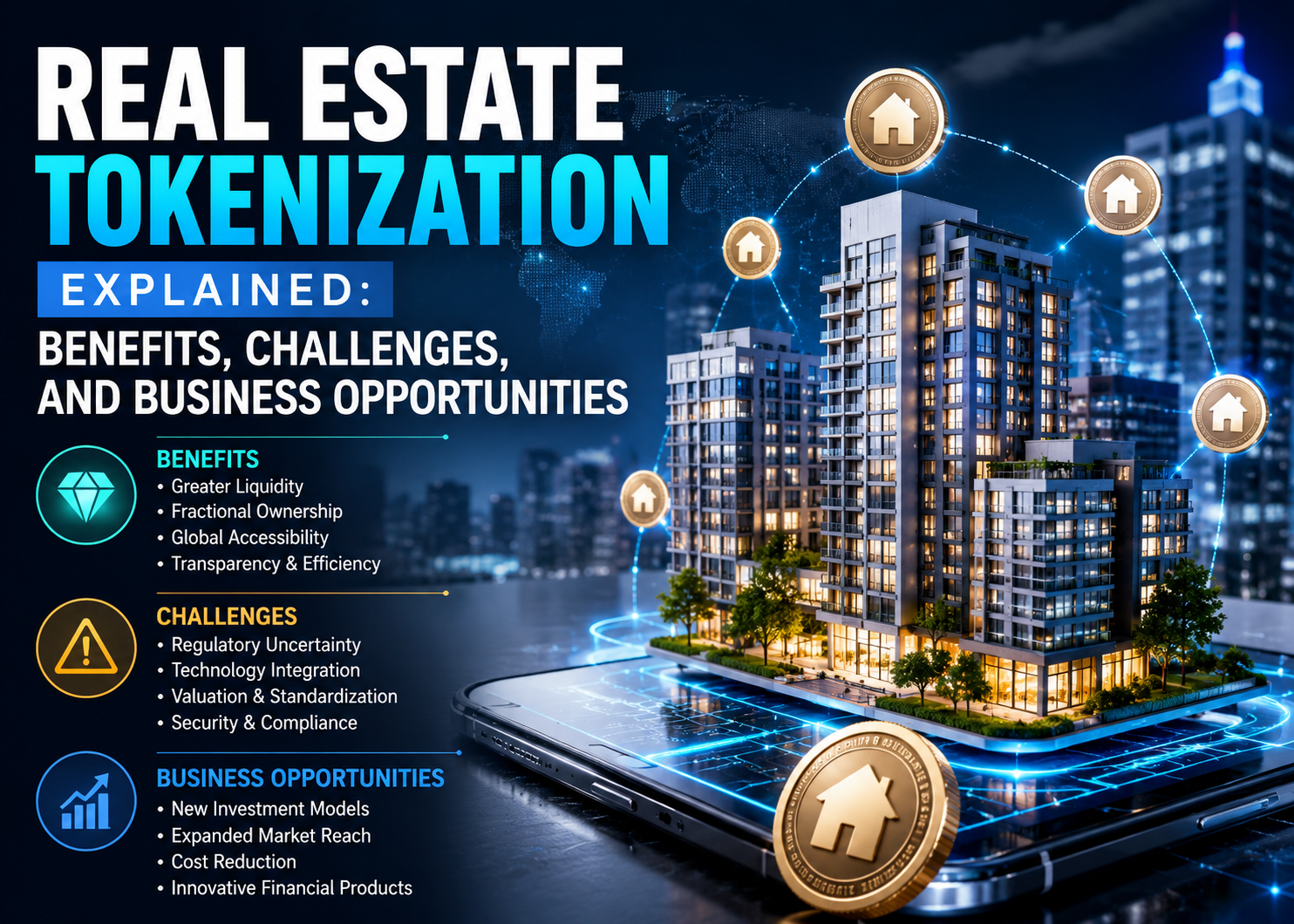
Real estate tokenization refers to the process of representing ownership rights in a physical property or property-backed asset through blockchain-based digital tokens. These tokens can represent full ownership, fractional ownership, or economic rights associated with a property. Unlike cryptocurrencies, these digital tokens derive their value from underlying real-world assets, making them an important part of the rapidly growing real-world asset (RWA) ecosystem.
Rather than replacing conventional real estate markets, tokenization introduces a digital ownership framework that can improve transparency, accessibility, and operational efficiency across the property lifecycle.
Understanding How Real Estate Tokenization Works
At its core, tokenization converts legal ownership or economic interests in a property into blockchain-based digital tokens. Before tokens are issued, the property undergoes legal verification, valuation, ownership structuring, and regulatory assessment. Once these processes are completed, smart contracts govern the issuance, transfer, and management of digital ownership records.
A typical tokenization model includes several interconnected components:
- Property identification and professional valuation
- Legal structuring through an appropriate ownership entity
- Smart contract deployment for token issuance
- Investor onboarding with KYC and AML verification
- Digital ownership recording on a blockchain network
- Ongoing distribution of rental income or other financial benefits
This framework creates a transparent audit trail while reducing dependence on manual documentation and multiple intermediaries.
Key Benefits of Real Estate Tokenization
Tokenization introduces several operational and financial improvements that address longstanding inefficiencies in property investment.
- Fractional ownership: Investors can purchase smaller ownership portions instead of acquiring an entire property, lowering entry barriers.
- Improved liquidity: Digital tokens may be transferred more efficiently than traditional property ownership interests, subject to applicable regulations and marketplace availability.
- Greater transparency: Blockchain records provide an immutable transaction history, reducing disputes over ownership records.
- Operational efficiency: Smart contracts automate administrative functions such as ownership transfers, dividend distribution, and compliance workflows.
- Global investment accessibility: Cross-border participation becomes more practical when supported by compliant digital infrastructure.
- Enhanced portfolio diversification: Investors can allocate capital across multiple properties rather than concentrating funds in a single asset.
These advantages have encouraged developers, institutional investors, and financial technology firms to explore Real estate tokenization platform development https://shamlatech.com/real-estate-tokenization-development-company/ as part of broader digital transformation initiatives within the property sector. However, technology alone does not determine project success; legal compliance and governance remain equally important.
Challenges That Continue to Shape Adoption
Despite its advantages, real estate tokenization is still an evolving market. Organizations entering this space must navigate several technical, operational, and regulatory challenges.
One of the primary concerns involves legal recognition of digital ownership. Property laws differ significantly across jurisdictions, making standardized implementation difficult. In many regions, legislation surrounding tokenized securities and digital property rights continues to evolve.
Another challenge involves secondary market liquidity. While tokenization aims to improve asset tradability, active secondary marketplaces remain limited in several jurisdictions. Without sufficient buyer participation, liquidity improvements may not fully materialize.
Cybersecurity also plays a crucial role. Since ownership records and transaction processes rely on blockchain infrastructure and digital wallets, organizations must implement strong security measures to protect investor assets and sensitive information.
Interoperability presents another obstacle. Different blockchain networks often operate independently, making seamless asset transfers across ecosystems more complex than expected.
Finally, market education remains essential. Many investors are familiar with conventional real estate investments but have limited understanding of blockchain-based ownership models. Building trust requires clear communication, regulatory transparency, and standardized reporting practices.
Business Opportunities Emerging Across the Industry
The evolution of tokenized real estate extends beyond investment products. Multiple industries are beginning to identify commercial applications for blockchain-enabled property assets.
Financial institutions can create innovative lending models using tokenized real estate as collateral. Property developers may access alternative fundraising methods by offering fractional investment opportunities during project development. Asset management firms can build diversified investment portfolios that combine multiple tokenized properties under unified digital management systems.
Additional business opportunities include:
1 .Digital marketplaces for compliant property trading
- Automated property income distribution systems
- Cross-border real estate investment platforms
- Institutional portfolio management solutions
- Property-backed security issuance
- Digital compliance and investor management services
As regulatory clarity improves, these business models may become increasingly integrated with existing financial infrastructure rather than operating as isolated blockchain solutions.
The Future of Tokenized Real Estate
Real estate tokenization represents more than a technological trend; it reflects a broader shift toward digitally enabled ownership models for real-world assets. Governments, financial regulators, technology providers, and institutional investors are gradually developing the standards required to support sustainable adoption.
Future growth will likely depend on stronger regulatory frameworks, greater interoperability between blockchain networks, standardized legal documentation, and increased institutional participation. As these elements mature, tokenization may become a complementary layer within traditional real estate markets rather than a replacement for them.
The long-term impact extends beyond simplifying property transactions. Digital ownership infrastructure has the potential to improve capital efficiency, enhance market accessibility, and streamline investment operations while maintaining regulatory oversight. Organizations that understand both the technological capabilities and the legal responsibilities associated with tokenized assets will be better positioned to participate in this evolving ecosystem.
As blockchain adoption continues across financial services and real-world assets, real estate tokenization is expected to remain an important area of innovation, offering new possibilities for investors, property owners, developers, and financial institutions seeking more efficient methods of managing property ownership in an increasingly digital economy.