The Rise of a Keto Ice Cream Brand, Its Product Appeal, and the Crisis That Could Define Its Future
The Rise of a Keto Ice Cream Brand, Its Product Appeal, and the Crisis That Could Define Its Future
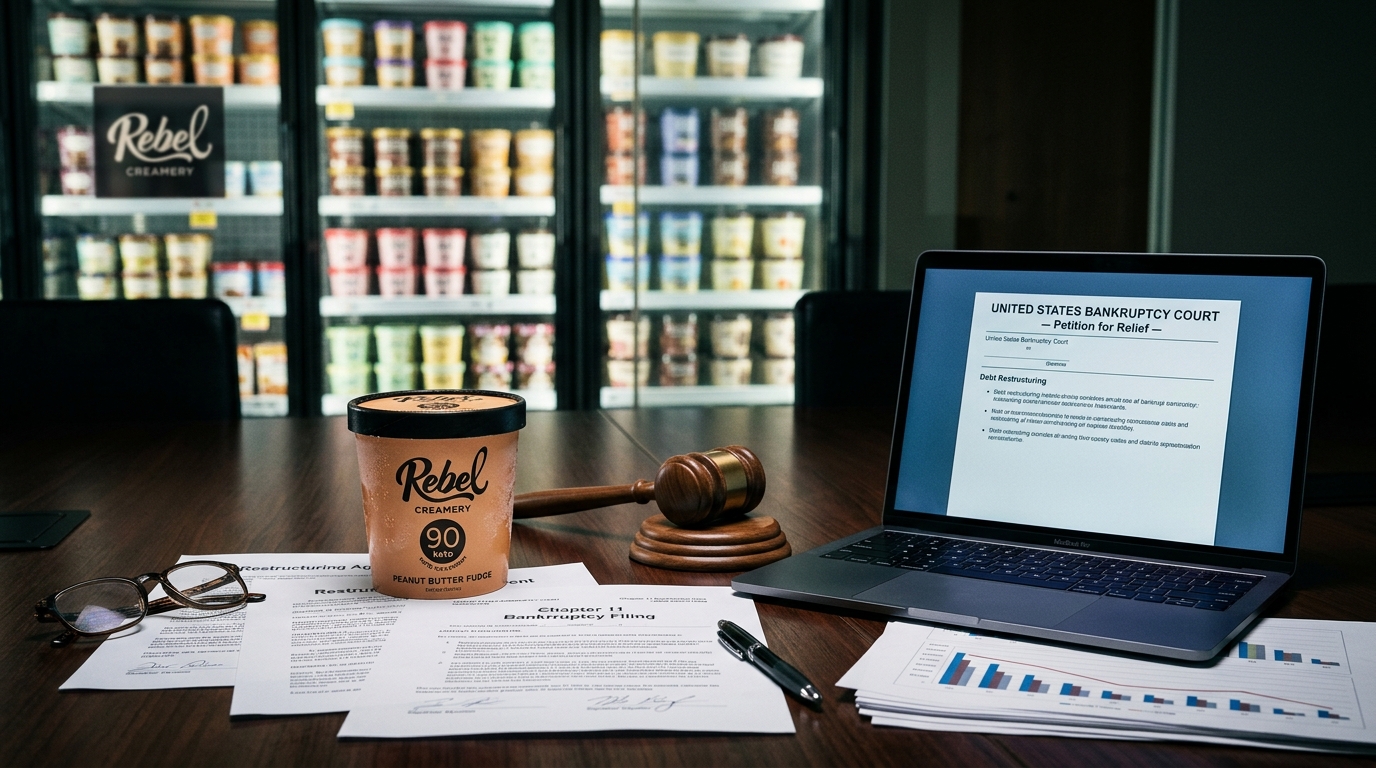
For years, ice cream has been associated with indulgence. It is the dessert people reach for on hot summer afternoons, after dinner, at birthday parties, or simply when they want something sweet. But the modern food market has changed that conversation. Consumers increasingly look for products that fit specific eating styles, including low-carb, keto-friendly, reduced-sugar, and higher-fat diets.
That shift created an opportunity for brands that could offer the experience of traditional ice cream while dramatically reducing sugar and carbohydrates. One of the brands that built its identity around that idea was Rebel Creamery, known to consumers primarily through its Rebel Ice Cream line.
That development raises an important question: What made Rebel Creamery successful in the first place, and can the brand survive and reinvent itself after such a major setback?
What Is Rebel Creamery?
Rebel Creamery developed its reputation around ice cream designed for consumers who wanted to reduce sugar and carbohydrates without giving up the creamy experience associated with traditional full-fat ice cream.
According to the company's own description, its products emphasize full-fat dairy, very low sugar, and keto-friendly ingredients. The company says its recipes were created specifically to preserve the richness and texture of conventional ice cream while avoiding the large amounts of sugar commonly found in traditional products.
This positioning helped Rebel distinguish itself from another category of products: low-calorie frozen desserts that often emphasize calorie reduction rather than a traditional ice-cream texture.
Rebel took a different approach.
Instead of asking consumers to accept a lighter, less indulgent dessert, the company built its identity around the idea that people could enjoy a rich, creamy product while dramatically reducing sugar and net carbohydrates.
That idea became the foundation of the brand.
How Rebel Creamery Started
Rebel's own account of its history begins with homemade ice cream.
The founders say they had been making ice cream at home for years before deciding to reduce their sugar intake. After changing their eating habits, they found that existing ice cream products did not provide the combination they wanted: very low sugar, substantial fat, and the creamy texture of traditional ice cream.
Rather than permanently giving up ice cream, they decided to experiment with their own recipes.
The company's story says the founders worked with food scientists to develop recipes that could maintain the structure and texture of conventional ice cream while substantially reducing carbohydrates.
The concept was tested publicly through a Kickstarter campaign in December 2017. According to Rebel, the campaign reached its funding goal within three hours and eventually raised approximately $80,000.
That response gave the founders an important signal.
There was a market for people who did not want to choose between their preferred eating style and the foods they enjoyed.
Why the Keto Connection Mattered
The growth of low-carb and ketogenic diets created an important opportunity for Rebel.
Traditional ice cream can contain significant amounts of added sugar. For someone following a strict low-carbohydrate eating plan, that can make conventional ice cream difficult to fit into their daily diet.
Rebel positioned itself as an alternative.
The company's products use ingredients such as cream, erythritol, vegetable glycerin, egg yolks, chicory-root fiber, milk proteins, monk fruit and other ingredients depending on the flavor.
For example, Rebel's current Chocolate product page lists 1.4 grams of net carbohydrates per serving and 4.2 grams per pint. Its Cookies & Cream product lists 2.6 grams of net carbohydrates per serving and 7.8 grams per pint.
These figures help explain the appeal of the product category.
Someone looking for a conventional dessert may care primarily about flavor. Someone following a low-carb lifestyle may be looking at the nutrition label before even considering flavor.
Rebel attempted to address both concerns simultaneously.
What Makes Rebel Different From Traditional Ice Cream?
One of Rebel's central selling points is texture.
The company argues that high-fat dairy helps create the creamy structure consumers expect from traditional ice cream. Rather than competing primarily as a low-calorie product, Rebel emphasizes richness and fat content.
That distinction is important.
There is a psychological difference between being told that a dessert is "lighter" and being told that you can have the dessert you actually want without the traditional amount of sugar.
Rebel's branding has consistently leaned toward the second message.
Its philosophy can essentially be summarized as:
Keep the indulgence. Reduce the sugar.
That is a powerful proposition for a consumer who enjoys ice cream but wants to control carbohydrate intake.
The Flavor Lineup
Another major part of Rebel's appeal is variety.
The company's current product lineup includes flavors such as Vanilla, Chocolate, Cookie Dough, Peanut Butter Cup, Coffee Chip, Mint Chip, Butter Pecan, Cherry Chip, Cookies & Cream, Salted Caramel, Triple Chocolate, Chocolate Peanut Butter, Banana Peanut Butter Chip, Snickerdoodle, Orange Cream and others.
The range matters because dietary products sometimes fail by offering too few choices.
If a consumer can only choose between vanilla and chocolate, the novelty can disappear quickly.
Rebel instead built a lineup designed to resemble the flavor variety of a conventional ice cream freezer.
Some of the company's current products have particularly strong customer ratings on its website. For example, its Peanut Butter Cup page shows a 4.7 rating from hundreds of reviews, while Mint Chip and Coffee Chip are listed at 4.8. Triple Chocolate is listed at 5.0 based on the reviews displayed on the company's site.
Of course, company-hosted reviews should not be treated as the same thing as independent product testing. Still, the volume of customer feedback provides an indication that the brand has developed a committed customer base.
Why Texture Is Such a Big Deal
Anyone who has tried a frozen dessert marketed as "healthy" knows that texture can make or break the experience.
Ice cream is not simply about sweetness.
The experience also involves creaminess, density, melt, mouthfeel and the way the product behaves as it warms.
Rebel acknowledges that its low-sugar formulation affects how the product behaves in the freezer. The company recommends allowing its ice cream to soften for approximately 10 to 15 minutes before eating.
That small detail is actually important.
Consumers who expect to open a pint directly from the freezer and immediately scoop it may have a different experience from consumers who allow it to soften.
For a premium frozen dessert, preparation can influence the perceived quality almost as much as the recipe itself.
Is Rebel Ice Cream Actually Healthy?
This is where consumers should be careful with marketing language.
A product being low in sugar or carbohydrates does not automatically mean that unlimited consumption is healthy for everyone.
Rebel's products are specifically formulated around a low-carb, high-fat philosophy. The company itself emphasizes that its products are not simply low-calorie alternatives.
That means consumers should look beyond a single number on the nutrition label.
Someone following a ketogenic diet may evaluate a product differently from someone counting calories. Another consumer may be concerned about ingredients, digestive tolerance, allergens, or total fat intake.
For example, some Rebel products contain milk and eggs, while certain flavors can contain additional allergens such as almonds.
The best choice therefore depends on the individual's dietary needs and preferences.
"Low carb" and "healthy for everyone" are not interchangeable terms.
What Consumers Say About Rebel
Consumer feedback is one of the most interesting parts of the Rebel story.
The company displays thousands of customer reviews on its website, and many are strongly positive. Customers frequently comment on creaminess, flavor intensity, and the ability to enjoy ice cream while following a low-carb lifestyle.
Some reviewers praise specific flavors, while others talk about difficulty finding particular varieties in local stores.
That second point highlights an important challenge for specialty food brands.
A product can have loyal customers and still lose potential sales if consumers cannot easily find it.
Frozen foods are especially dependent on distribution because shoppers often make purchasing decisions in the supermarket freezer rather than planning weeks in advance.
The Retail Challenge
Rebel has expanded beyond direct-to-consumer sales and has been distributed through major grocery retailers.
The company's own website encourages consumers to request that local stores carry its products, while recent reporting has identified retailers such as Walmart, Kroger, Target, Safeway and Albertsons among outlets associated with Rebel products.
Retail distribution can dramatically increase brand visibility.
Imagine a consumer walking into a grocery store looking for low-carb products. Seeing Rebel next to conventional ice cream and other better-for-you alternatives can introduce the brand to customers who may never have encountered it online.
But retail expansion also introduces another challenge: packaging.
And that issue would eventually become one of the biggest problems in Rebel Creamery's history.
The Packaging Dispute With Van Leeuwen
In 2021, Van Leeuwen Ice Cream filed a lawsuit against Rebel Creamery concerning the appearance of Rebel's ice cream packaging.
The dispute centered not on the Rebel name or logo, but on the overall visual appearance of the packaging—what trademark law refers to as trade dress.
According to the federal court's July 16, 2026 decision, Van Leeuwen argued that Rebel's packaging used a combination of visual elements that created a confusingly similar commercial impression.
Those elements included pastel monochromatic colors, minimalist design, black script lettering and other packaging characteristics.
This is an important distinction.
A company does not necessarily need to copy another company's logo or name to face a trade-dress dispute.
The overall appearance of a product can also become legally significant if consumers associate that appearance with a particular source.
What the Court Decided
On July 16, 2026, Judge Eric Komitee of the U.S. District Court for the Eastern District of New York ruled in favor of Van Leeuwen.
The court found Rebel liable for trade-dress infringement, unfair competition and dilution under applicable federal and New York law.
The court also rejected Rebel's counterclaims and ordered Rebel to stop selling products bearing packaging likely to cause confusion and to redesign its packaging.
The financial part of the decision was even more dramatic.
The court awarded Van Leeuwen $23.785 million in Rebel's profits associated with the infringing products.
The decision represents one of the most consequential moments in the company's history.
Why Packaging Matters So Much
For consumers, packaging can seem superficial.
For a food company, it can be one of its most valuable marketing assets.
A pint sitting inside a freezer has only seconds to capture attention.
Color, typography, imagery, layout and overall visual identity help consumers recognize products before they even read the brand name.
That is precisely why trade-dress law exists.
The Rebel case demonstrates that companies need to think beyond trademarks and logos when developing consumer packaging.
A design can appear different when individual elements are considered separately while still creating a similar overall impression when viewed as a whole.
The court's decision emphasized that the combination of design elements can matter even when individual elements, such as certain colors or fonts, are common elsewhere in the marketplace.
For food entrepreneurs, the lesson is straightforward: original product development should include original visual identity.
Rebel's Response and Appeal
The court ruling did not immediately end the story.
Rebel filed a notice of appeal shortly before its bankruptcy filing, according to current reporting.
That means the legal dispute has entered another phase.
An appeal does not automatically erase the original judgment. Instead, it provides a route for challenging the lower court's decision.
The ultimate outcome of that process could influence the company's financial future.
But Rebel now has an additional problem.
Rebel Creamery Files for Chapter 11
On August 14, 2026, Rebel Creamery filed for Chapter 11 bankruptcy protection.
The filing came only weeks after the $23.785 million judgment and shortly after Rebel appealed the decision. Current reports indicate that Rebel's filing listed approximately $13.78 million in assets and $23.85 million in liabilities, although some reporting summarizes the filing more broadly as placing assets and liabilities in the $10 million-to-$50 million ranges.
Chapter 11 is not necessarily the same thing as immediately shutting down.
It is generally a restructuring process designed to give a company an opportunity to reorganize its debts and operations while continuing to operate under court protection.
That distinction matters.
Consumers may hear the word "bankruptcy" and assume that a brand has disappeared.
But Chapter 11 can instead represent an attempt to survive.
For Rebel, the coming months could therefore be extremely important.
What Happens to the Rebel Brand Now?
The future is uncertain.
The company has built recognition around a specific product philosophy: full-fat, low-carb, low-sugar ice cream designed for keto-oriented consumers.
That underlying consumer demand has not necessarily disappeared simply because the company is experiencing financial and legal difficulties.
In fact, the broader market for products designed around specific dietary preferences remains significant.
The bigger question is whether Rebel can reorganize its business while addressing the problems that contributed to its current situation.
One possible path is a redesigned packaging strategy.
If the court's injunction remains applicable, Rebel will need packaging that creates a substantially different commercial impression from the disputed Van Leeuwen designs.
That could actually create an opportunity.
A new visual identity could allow Rebel to enter its next chapter with packaging that is more distinctive, recognizable and clearly its own.
Could a Packaging Redesign Help Rebel?
It could.
Brand redesigns can be risky because consumers become accustomed to familiar packaging.
But they can also create opportunities.
If Rebel develops a bold and unmistakable visual identity, consumers could eventually associate the new packaging directly with Rebel's low-carb positioning.
The challenge will be balancing three things:
Recognition.
Existing customers need to know they are still buying Rebel.
Legal differentiation.
The new packaging must avoid creating the same concerns that led to the judgment.
Shelf appeal.
The design still needs to stand out in a crowded freezer.
That is not an easy assignment, but it is also not impossible.
The Bigger Lesson for Food Brands
The Rebel Creamery story is larger than ice cream.
It is a lesson in how quickly a consumer brand can evolve.
Rebel began with a simple idea: people wanted to enjoy ice cream without the traditional amount of sugar.
That idea helped create a recognizable niche.
The company then developed dozens of flavors, built an online customer base, expanded through retail distribution and became recognizable among consumers interested in low-carb eating.
But growth brings new risks.
The larger a brand becomes, the more visible its decisions become.
Packaging, advertising, product claims, ingredients, distribution agreements and intellectual property all become increasingly important.
The Rebel case demonstrates that a successful product concept alone is not enough.
A modern food company must protect every part of its brand.
Is Rebel Creamery Still Worth Watching?
Absolutely.
Regardless of what happens in the bankruptcy and appeal proceedings, Rebel Creamery remains an interesting case study in modern food entrepreneurship.
Its original proposition was clear.
Take a familiar indulgence.
Change the nutritional profile.
Preserve the experience.
Build a community around it.
That formula proved attractive enough to generate substantial consumer interest.
The company's current product catalog also demonstrates that it did not rely on a single novelty flavor. It developed a broad portfolio designed to keep consumers interested over time.
The next phase will be about whether that consumer demand can support a financially sustainable and legally secure business.
The Future of Low-Carb Ice Cream
Regardless of Rebel's outcome, the low-carb ice cream category is unlikely to disappear.
Consumers continue to look for alternatives that fit their individual eating preferences.
Some want fewer carbohydrates.
Some want less added sugar.
Others simply want products that provide indulgence without feeling identical to conventional desserts.
The opportunity for manufacturers is therefore still significant.
But the competition is also intense.
Brands need more than a low-carb label.
They need great flavor, texture, attractive packaging, reliable distribution, reasonable pricing and a trustworthy identity.
Rebel demonstrated that there is a market for this combination.
Its current crisis demonstrates how difficult it can be to protect and sustain that market.
Final Thoughts
Rebel Creamery began with an idea that sounds simple but addressed a genuine consumer problem: Can people enjoy real ice cream while significantly reducing sugar and carbohydrates?
The company spent years developing products around that concept.
Its lineup expanded to include familiar favorites such as Vanilla, Chocolate, Peanut Butter Cup, Mint Chip, Coffee Chip, Butter Pecan, Cherry Chip and Triple Chocolate, alongside more distinctive flavors.
Customer reviews on the company's website show that many buyers appreciate the flavor and creamy texture, although individual experiences naturally vary.
But in 2026, Rebel Creamery's story has taken an unexpected turn.
A federal court found the company liable in a major packaging trade-dress dispute and awarded Van Leeuwen $23.785 million. Rebel was also ordered to redesign the disputed packaging.
Then, on August 14, Rebel filed for Chapter 11 bankruptcy protection while appealing the judgment.
That leaves the brand at a crossroads.
Will Rebel emerge from Chapter 11 with a new identity and stronger business model?
Will a redesigned package help the company regain momentum?
Will loyal customers continue buying the products?
Or will the financial and legal challenges ultimately become too difficult to overcome?
Those questions cannot be answered yet.
But one thing is clear: Rebel Creamery has become much more than a story about low-carb ice cream. It is now a story about innovation, branding, consumer loyalty, intellectual property and the enormous risks that can come with building a national food brand.
What Do You Think?
Now it's your turn.
Have you ever tried Rebel Ice Cream?
If you have, which flavor did you try—and did you think it tasted close enough to traditional ice cream?
And after learning about the company's current legal and bankruptcy situation, would you still buy Rebel products if they remain available in stores?
There is also a bigger question worth discussing:
Do you think a food company's packaging should be considered as important as its name and logo when it comes to protecting a brand's identity?
Share your experience and opinion in the comments. If you've tried Rebel, tell us your favorite flavor and whether you would recommend it to someone following a low-carb or keto lifestyle.