What Is the Coldest Place on Earth?
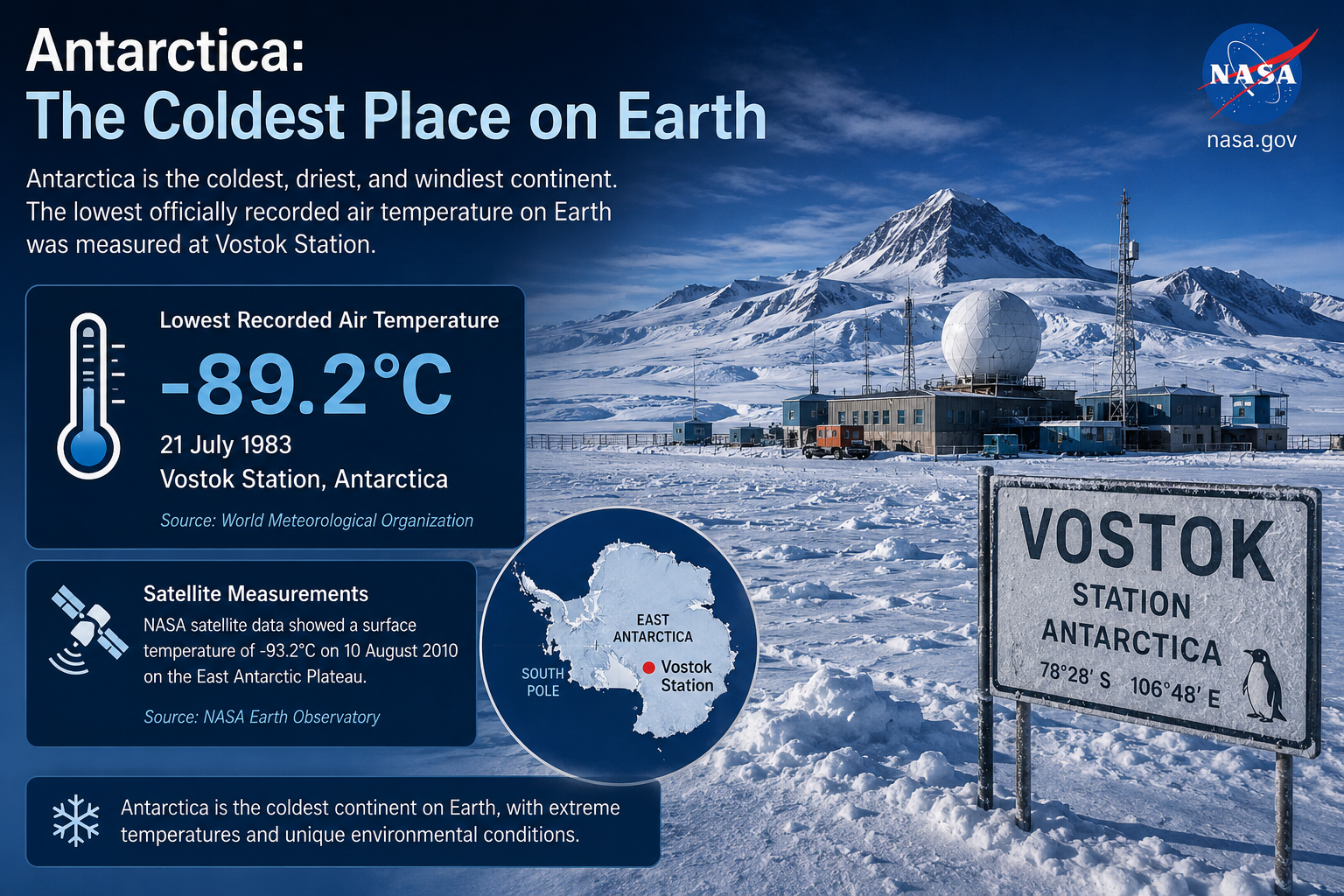
When people think about the coldest place on Earth, they may imagine the North Pole covered in snow and ice. However, the lowest natural temperatures ever recorded on our planet have been measured in Antarctica, the frozen continent at the southernmost part of Earth. Antarctica is already one of the coldest, driest, and windiest places on the planet, but some areas are much colder than others. The combination of high elevation, extremely dry air, clear skies, and long winter nights allows temperatures to fall to extraordinary levels, making Antarctica a fascinating place for scientists studying Earth's extreme environments.
One of the coldest known regions is the high Antarctic Plateau. In certain areas, satellites have detected surface temperatures dropping below −90°C during the Antarctic winter. These locations are far colder than ordinary household freezers and even colder than the coldest inhabited places on Earth. The air is so dry that there is very little moisture to trap heat near the surface. When the sky remains clear, heat escapes from the snow-covered ground into the atmosphere and space, causing the surface temperature to fall dramatically.
Life in such extreme conditions is incredibly difficult, but some specially adapted organisms can survive in parts of Antarctica. Scientists visit the continent to study climate change, ice sheets, atmospheric conditions, and the history of Earth's climate preserved inside ancient ice. Research in these extreme environments can also help scientists understand what conditions might be like on other worlds. Antarctica therefore acts as a natural laboratory where researchers can study cold, isolation, and environmental changes that cannot easily be observed elsewhere.
Personally, I think Antarctica is one of the most fascinating places on Earth because it shows how extreme our planet can become. Temperatures below −90°C are difficult to imagine, yet they occur naturally in one of Earth's most remote regions. Studying these places not only helps us understand our own planet but may also give scientists clues about extreme environments beyond Earth.
What Are Your Thoughts?
If you enjoyed this article, your support through an upvote would mean a lot to me. Thanks for reading and supporting my work!