A 20-legged robot has been created for environmental monitoring in extreme terrains/Crean un robot de 20 patas para el monitoreo ambiental en terrenos extremos
Source
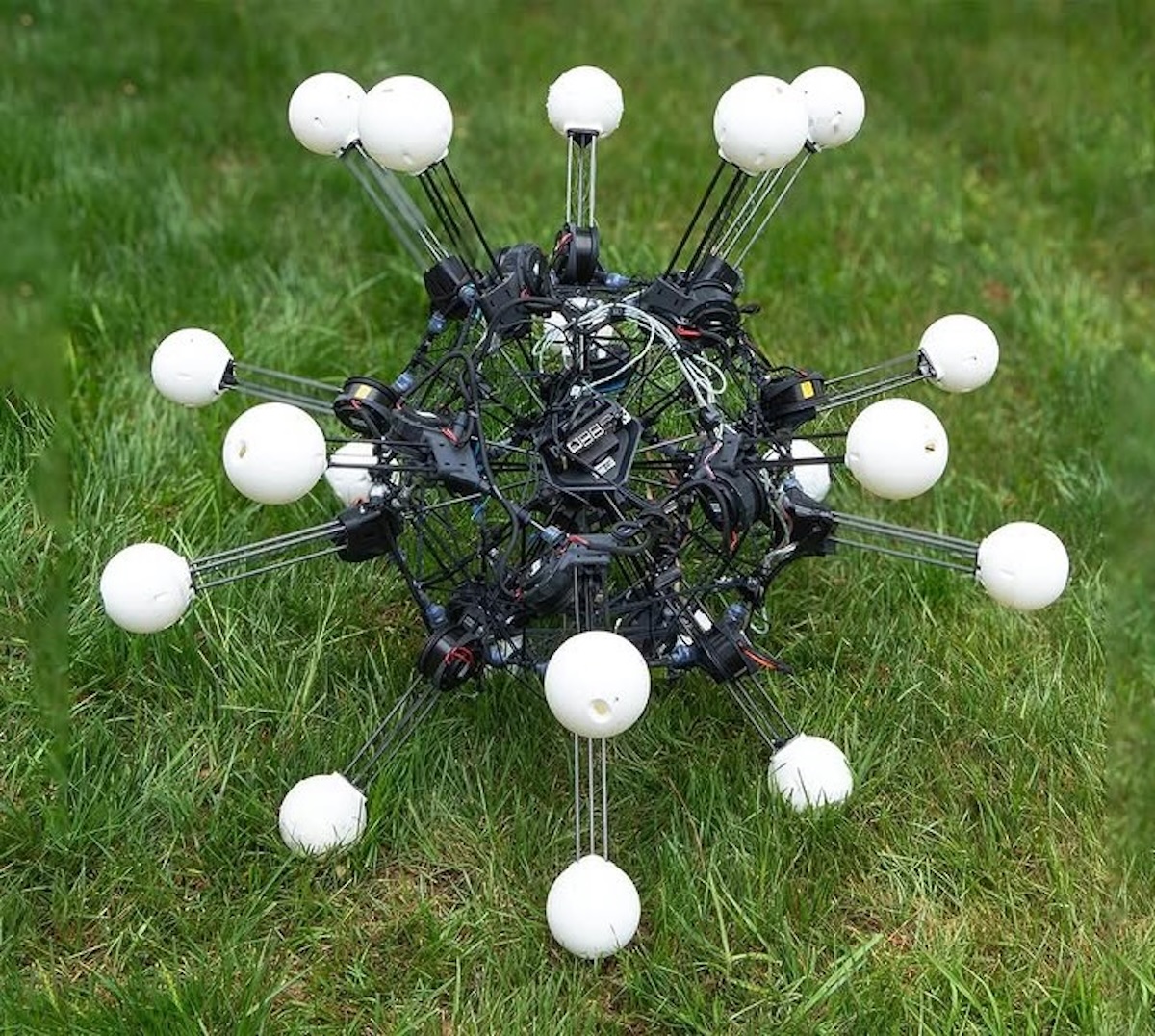
Although we find them the most spectacular, humanoid robots aren't always the most ideal for the tasks they're intended to perform. Often, robots shaped like other animals, wheeled contraptions, or, as in the case we're discussing today, a robot with twenty legs that vaguely resembles a sea urchin, are more useful. That's Argus, the latest invention from Duke University, and probably one of the strangest and most fascinating robots I've seen in years. It has no head, no tail, no up or down. It's a perfect sphere formed by twenty legs protruding in all directions, and at the tip of each leg is a small camera.
Aunque a nosotros nos parecen los más espectaculares, los robots humanoides no son lo más ideal según las tareas que se les pretenda asignar. Muchas veces son más útiles si tienen formas de otros animales, artilugios con ruedas o, como en el caso que hoy nos ocupa, un robot con veinte patas que recuerda vagamente a un erizo de mar. Eso es el Argus, el último invento de la Universidad de Duke, y probablemente uno de los robots más raros y fascinantes que he visto en años. No tiene cabeza, no tiene cola, no tiene arriba ni abajo. Es una esfera perfecta formada por veinte patas que sobresalen en todas direcciones, y en la punta de cada una de esas patas hay una pequeña cámara.
Any robot you know—whether it's a robot dog, it has to turn to change direction; if it's a drone, it has to tilt; and if it's a self-driving car, it needs to maneuver—is faster going forward than backward or sideways. It's as if they were athletes who can only run well in a straight line. The Duke team wondered if it was possible to design a robot that was equally fast in any direction, and to achieve this, they didn't look to nature or copy an animal. They copied a physical principle: dynamic isotropy, which is a fancy way of saying that the robot can accelerate just as well in any direction without needing to reorient itself.
Cualquier robot que conozcas, si es un perro robot tiene que girar para cambiar de dirección, si es un dron tiene que inclinarse y si es un coche autónomo necesita maniobrar. Todos ellos son más rápidos hacia adelante que hacia atrás o hacia los lados. Es como si fueran atletas que solo saben correr bien en línea recta. El equipo de Duke se preguntó si se podría diseñar un robot que fuese igualmente rápido en cualquier dirección y para lograrlo, no se inspiraron en la naturaleza ni copiaron un animal. Copiaron un principio físico: la isotropía dinámica, que es una forma elegante de decir que el robot puede acelerar igual de bien hacia los 360 grados sin necesidad de reorientarse.

Source
To achieve this, they placed twenty motorized legs at the vertices of a dodecahedron (a perfectly symmetrical polyhedron with twelve faces). Each leg pushes and supports itself, and the software coordinates everything so the robot can roll, jump, or crawl in any direction without needing to know where it's "facing." In fact, the robot doesn't even have "facing" in the human sense. Its twenty cameras give it a constant 360-degree view. It always sees everything. In the tests carried out, the Argus has done things that would leave you speechless.
Pare conseguirlo colocaron veinte patas motorizadas en los vértices de un dodecaedro (un poliedro de doce caras perfectamente simétrico). Cada pata empuja y se apoya, y el software coordina todo para que el robot ruede, salte o gatee en cualquier dirección sin tener que saber hacia dónde está "mirando". De hecho, el robot ni siquiera tiene "mirar" en el sentido humano. Sus veinte cámaras le dan una visión de 360 grados constante. Siempre lo ve todo. En las pruebas realizadas, el Argus ha hecho cosas que te dejarían con la boca abierta.
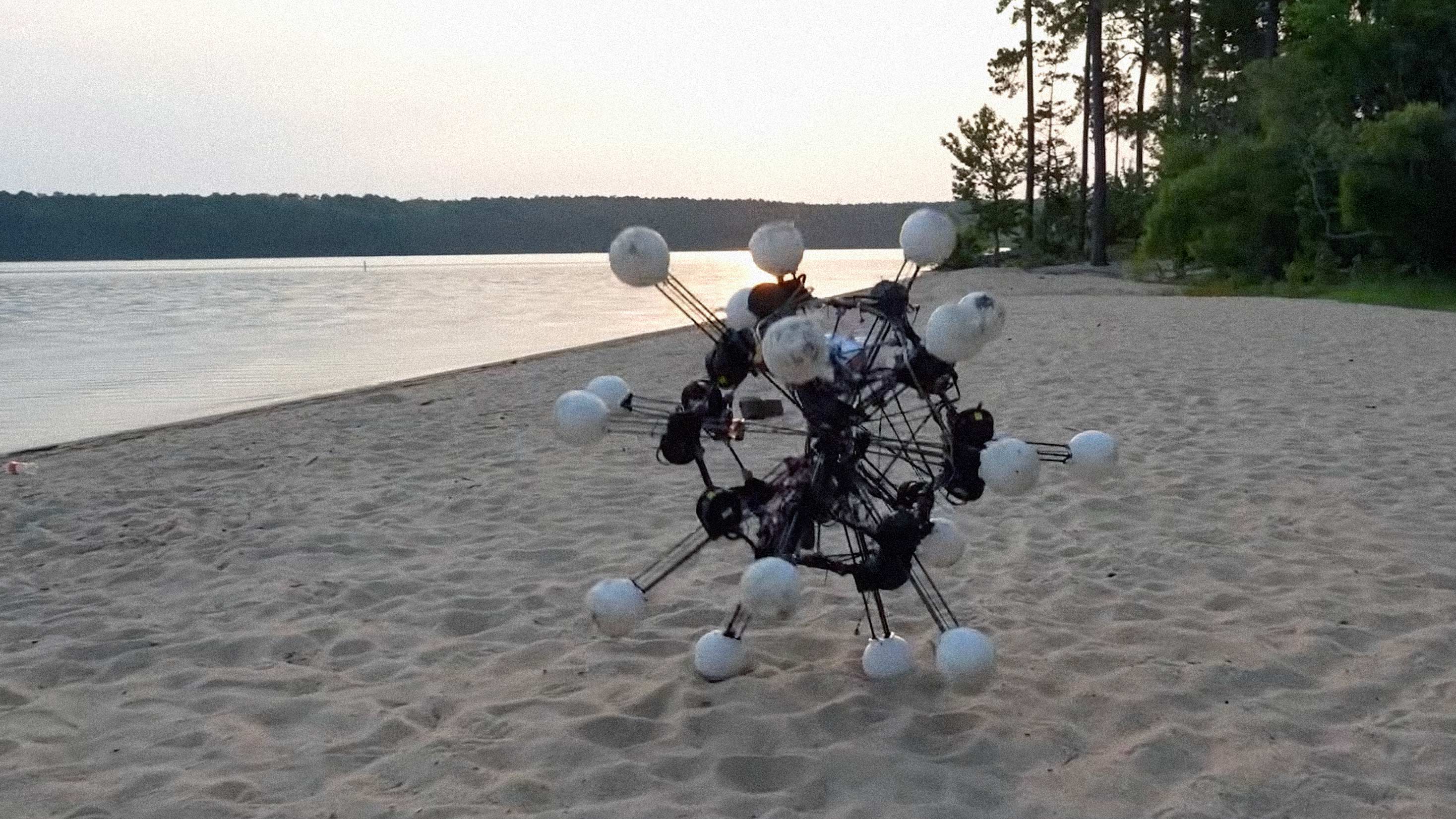
It walks on sand, through forest, on wet asphalt, or on uneven ground without a problem, and climbs 13-centimeter steps, which is quite impressive for its size. If two or three legs break, it keeps working. It literally doesn't care. It can climb between two walls by pushing sideways, and it carries 4.5-kilo loads almost as fast as when unloaded. Until now, almost all robots imitated something: a dog, a human, a snake, an octopus. Argus doesn't imitate anything. It's a robot born from a mathematical equation. It's pure functional design, with no concessions to form.
Camina sobre arena, bosque, asfalto mojado o suelo irregular sin problema, sube escalones de 13 centímetros que para su tamaño no está nada mal. Si se le rompen dos o tres patas, sigue funcionando. Literalmente, le da igual. Puede trepar entre dos paredes haciendo fuerza hacia los lados, lleva cargas de 4,5 kilos casi a la misma velocidad que sin carga. Hasta ahora, casi todos los robots imitaban a algo: un perro, un humano, una serpiente, un pulpo. Argus no imita nada. Es un robot que nace de una ecuación matemática. Es diseño funcional puro, sin concesiones a la forma.
Source
Robots of this type can be used in disasters like earthquakes, where there are half-collapsed buildings, unstable spaces, dust, and smoke. A robot with legs has to choose its path. A robot with wheels gets stuck. A drone can't enter enclosed spaces. Argus, on the other hand, squeezes through any opening and moves equally well to the right, up, or backward. It doesn't need to turn around, and the same applies in contaminated areas like Chernobyl or a chemical waste dump. Even for simpler tasks, like monitoring a forest, since Argus has no front or back, it doesn't disrupt the movement patterns of the animals. It's simply there, rolling without a preferred direction.
Robots de este tipo pueden ser en desastres como un terremoto donde hay edificios medio derrumbados, huecos inestables, polvo, humo. Un robot con patas tiene que elegir por dónde ir. Un robot con ruedas se atasca. Un drone no puede entrar en espacios cerrados. Argus, en cambio, se cuela por cualquier sitio y se mueve igual de bien hacia la derecha, hacia arriba o hacia atrás. No necesita dar la vuelta y lo mismo en zonas contaminada, como Chernóbil o un vertedero químico. Incluso para cosas más sencillas, como vigilar un bosque ya que, como Argus no tiene delante ni detrás, no altera los patrones de movimiento de los animales. Simplemente está ahí, rodando sin dirección preferente.
Researchers believe the same design could be used as a robotic hand. Typically, a robotic arm has a wrist and a gripper, and it has to rotate the gripper to grasp objects. But if the gripper is a sphere with twenty fingers pushing from all angles, then it can grasp a cup, an egg, a stone, or a pencil without knowing where the object is or how it's oriented. It simply wraps around it and squeezes. But we're not going to see any of these on the market just yet, since Argus is what engineers call a "proof of concept": it exists, it works, and it demonstrates that dynamic isotropy is possible. Now the challenge is to miniaturize it, reduce costs, and see if it can be manufactured more easily.
Los investigadores creen que el mismo diseño podría usarse como mano robótica. Normalmente, un brazo robótico tiene una "muñeca" y una "pinza", y tiene que girar la pinza para agarrar objetos. Pero si la pinza es una esfera con veinte dedos que empujan desde todos los ángulos, entonces puede agarrar una taza, un huevo, una piedra o un lápiz sin saber dónde está el objeto ni cómo está orientado. Solo lo envuelve y aprieta. Pero todavía no vamos a ver ninguno en el mercado ya que Argus es lo que los ingenieros llaman una "prueba de concepto": existe, funciona y demuestra que la isotropía dinámica es posible. Ahora el reto es miniaturizarlo, abaratar costes y ver si se puede fabricar de forma más sencilla.
More information/Más información
https://techxplore.com/news/2026-05-sea-urchin-strange-legged-machine.html
Building a sphere with twenty legs based on pure maths is a clever bit of engineering. The fact that it can keep going even if it loses a few limbs is brilliant. Most tech breaks the second something small goes wrong, so making something that actually stands up to a bit of a beating is a massive win.
But I do have a few doubts about using it to monitor forests without bothering the animals. If a giant, headless mechanical sea urchin with twenty cameras started rolling towards me in the woods, I’d run a bloody mile. It sounds terrifying.
Plus, keeping twenty separate motors running sounds like a nightmare. If dirt gets inside those joints when it's rolling through sand, it's going to get stuck pretty fast.
Thx.
Realmente se ve innovador, esta especie de erizo es además versátil. Ya tenemos que aprender un nuevo término "isotropía dinámica", como que lo ve todo a su alrededor.
Gracias por compartir...!
¡Un fuerte abrazo y éxitos..!
What stands out most is the clean symmetry - a ball-shaped machine with limbs evenly spread, unlike anything in nature. Moving smoothly in every direction, never needing to turn around, feels like a quiet breakthrough. Toughness matters though; if it can survive harsh environments without constant fixes, rescue missions might look completely different. Machines like Argus skip biology entirely, built only for purpose. Progress isn’t always loud - sometimes it rolls silently into rubble or caves, doing what older robots simply cannot.
读了楼主的文章我发现最惊人的仿人机器人并不是最适合它们被设计执行的任务的理想选择。通常机器人的形状更像是一种轮式装置而不是完美的解决方案。但现在我们看到的这款二十腿机器人却提供了一个不同的思考视角。它能够在极端环境中进行环境监测;并且即使失去某些腿依然能够继续运作。这样的设计无疑增加了机器人在复杂地形中的工作的灵活性和持续工作能力。