A concrete megastructure could prevent the AMOC from collapsing/Una megaestructura de hormigón podría evitar el colapso de la AMOC
Source
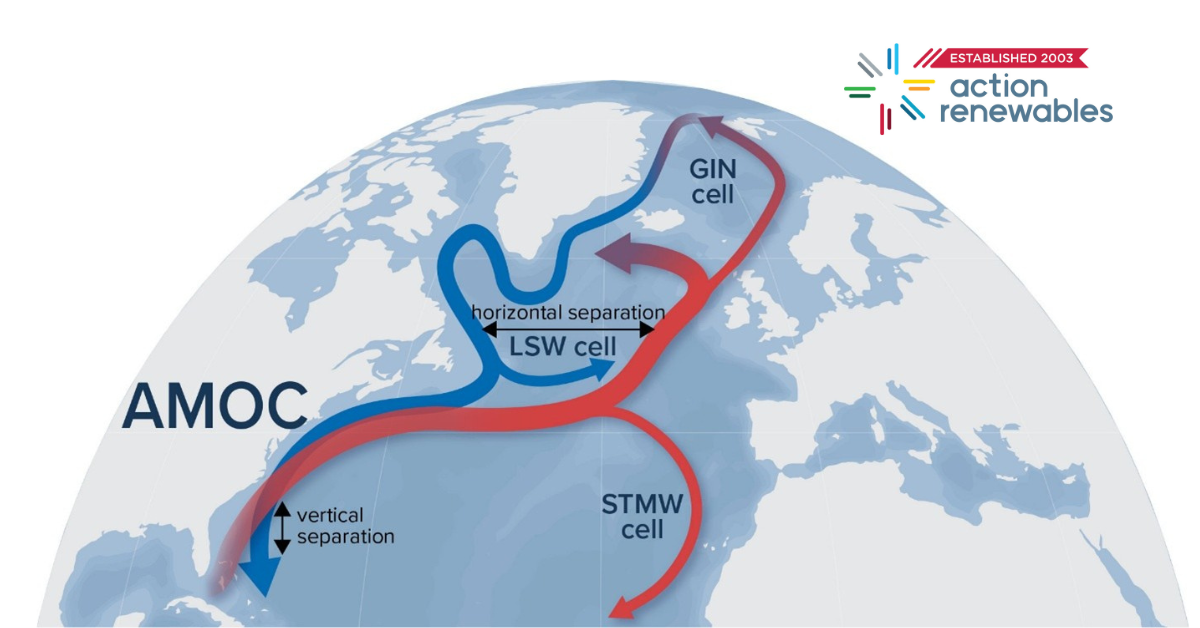
The AMOC (Atlantic Meridional Overturning Circulation) is a large system of ocean currents, often described as a giant "conveyor belt" in the Atlantic. Its function is to carry warm, salty surface water from the tropics into the North Atlantic (giving Europe a more temperate climate). There, the water cools, becomes denser, sinks, and returns southward in the depths. Climate change is pouring freshwater from melting Greenland into the North Atlantic. Being less dense than saltwater, this freshwater prevents the surface water from sinking, weakening the entire "conveyor belt."
La AMOC (Atlantic Meridional Overturning Circulation) es un gran sistema de corrientes oceánicas, a menudo descrito como una "cinta transportadora" gigante en el Atlántico. Su función: es llevar agua superficial cálida y salada desde los trópicos hacia el Atlántico Norte (lo que le da a Europa un clima más templado). Allí, el agua se enfría, se vuelve más densa, se hunde y regresa hacia el sur en las profundidades. El cambio climático está vertiendo agua dulce procedente del deshielo de Groenlandia en el Atlántico Norte. Al ser más ligera que el agua salada, esta agua dulce impide que la superficie se hunda, lo que debilita toda la "cinta transportadora".
If the AMOC were to stop, the consequences would be global and severe. In Europe, temperatures would drop dramatically, and the UK's climate could resemble Canada's; growing seasons would shorten, and there would be a major impact on food security. In North America, sea levels on the US East Coast could rise by more than a foot (about 30 cm). Globally, rainfall patterns would be disrupted in regions such as the Amazon and the Sahel. In short, a disaster, especially for the Northern Hemisphere.
Si la AMOC se detuviera, las consecuencias serían globales y graves. En Europa, las temperaturas bajarían drásticamente y el clima del Reino Unido podría parecerse al de Canadá, se acortarían las temporadas de cultivo y habría un gran impacto en la seguridad alimentaria. En América del norte, los niveles del mar en la costa este de Estados Unidos podrían aumentar más de un pie (unos 30 cm). A nivel global, se alterarían los patrones de lluvia en regiones como el Amazonas y el Sahel. Es decir, un desastre sobre todo para el hemisferio norte.
Source
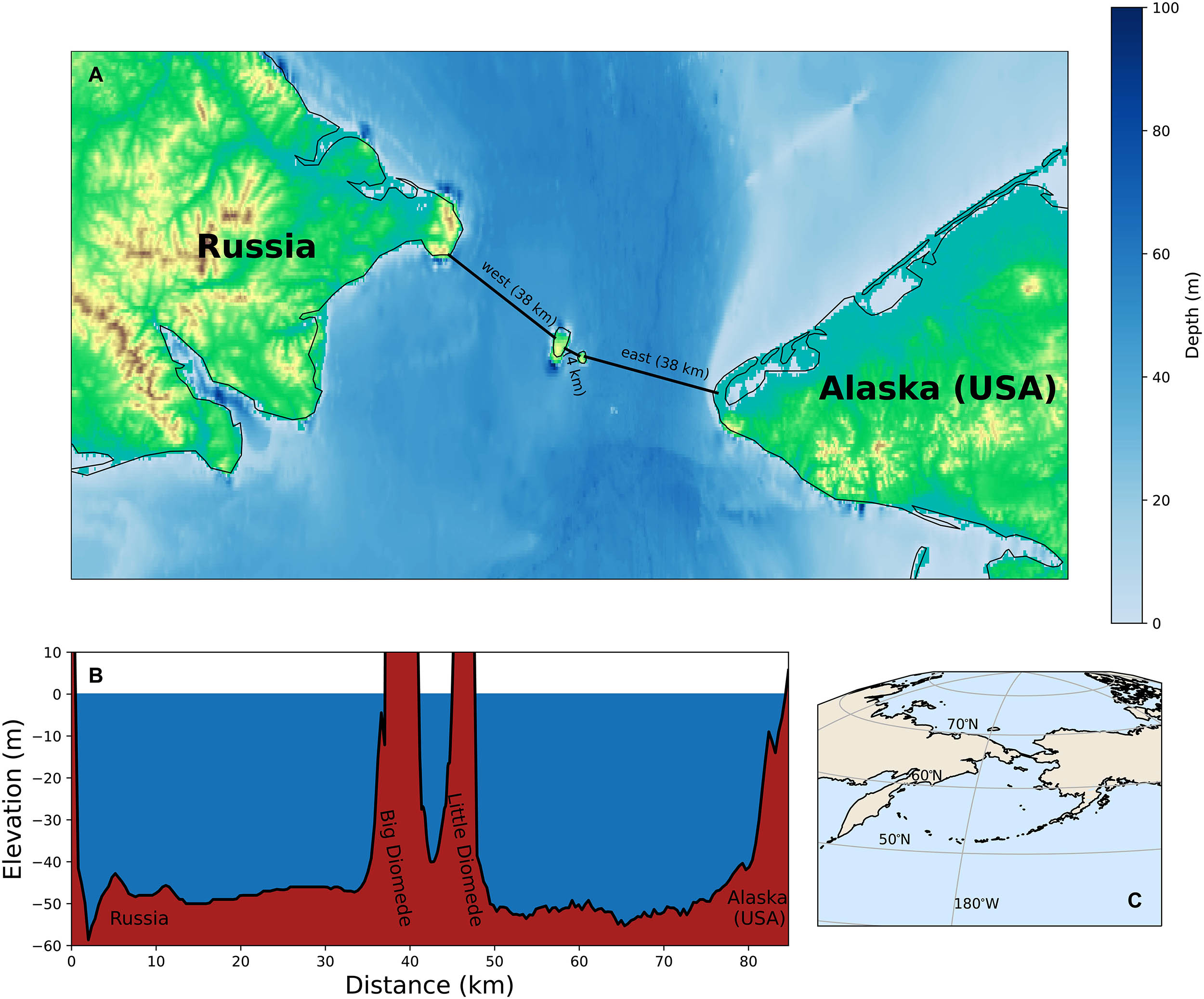
To prevent this catastrophe, the following mechanism has been proposed: Currently, the Bering Strait allows a relatively fresh surface water current from the Pacific to enter the Arctic Ocean. This water eventually reaches the North Atlantic, contributing to its dilution and exacerbating the weakening of the AMOC. The proposal is to build a dam approximately 80 km long between Alaska (USA) and Russia to block this influx of fresh water. By doing so, the North Atlantic would remain saltier and denser, thus promoting the stability of the AMOC.
Para evitar esta catástrofe, se ha propuesto el mecanismo siguiente: Actualmente, el estrecho de Bering permite que entre al Océano Ártico una corriente de agua superficial relativamente fresca procedente del Pacífico. Esta agua termina llegando al Atlántico Norte, contribuyendo a "diluirlo" y agravando el debilitamiento de la AMOC. La propuesta es construir una presa de unos 80 km de largo entre Alaska (EE. UU.) y Rusia para bloquear esa entrada de agua dulce. Al hacerlo, se mantendría el Atlántico Norte más salado y denso, favoreciendo la estabilidad de la AMOC.
The study uses climate models to analyze the dam's effect, and its main conclusion is that the outcome depends critically on when it is built. Building the dam on time could help stabilize the system and increase its "safe carbon budget"—that is, the amount of CO2 the atmosphere could hold before the system collapses. But if the AMOC is already very close to collapse, the dam could have the opposite effect, further destabilizing it and accelerating the collapse. Arctic freshwater, unable to flow into the Pacific, would remain in the Atlantic.
El estudio utiliza modelos climáticos para analizar el efecto de la presa y la conclusión principal es que el resultado depende críticamente del momento en que se construya. Construir la presa a tiempo podría ayudar a estabilizarla y aumentar su "presupuesto de carbono seguro", es decir, la cantidad de CO2 que la atmósfera podría tener antes de que el sistema colapse. Pero, si la AMOC ya está muy cerca del colapso, la presa podría tener el efecto contrario, desestabilizándola aún más y acelerando el colapso. El agua dulce del Ártico, al no poder salir hacia el Pacífico, se quedaría en el Atlántico.

Source
This proposal has generated intense debate and widespread skepticism due to its enormous implications. The Bering Strait is a vital ecosystem for whales, seals, walruses, and a wide variety of marine life. A dam would destroy their habitat and migratory routes. It would directly affect the Indigenous communities living in the region on both the American and Russian sides, whose livelihoods and culture depend on the sea. Furthermore, it would block a key shipping route for Arctic maritime trade and damage local fisheries.
Esta propuesta ha generado un intenso debate y un gran escepticismo por sus enormes implicaciones. El estrecho de Bering es un ecosistema vital para ballenas, focas, morsas y una gran variedad de vida marina. Una presa destruiría su hábitat y las rutas migratorias. Afectaría directamente a las comunidades indígenas que viven en la región tanto del lado americano como ruso, cuya subsistencia y cultura dependen del mar. Además bloquearía una ruta de envío clave para el comercio marítimo en el Ártico y dañaría las pesquerías de la zona.
The biggest problem is our ignorance about the current state of the AMOC. Scientists disagree on exactly how fast it is weakening, or how close it is to a tipping point. Essentially, the current proposal is seen by most of the scientific community as an extremely risky idea. The safest and most sensible solution for preserving the AMOC remains the same: stop burning fossil fuels. But that is much easier said than done, although efforts seem to be moving in that direction.
El mayor problema es nuestra ignorancia sobre el estado actual de la AMOC. Los científicos no se ponen de acuerdo a qué velocidad exactamente se está debilitando, ni lo cerca que está de un punto de inflexión. En esencia, la propuesta actual es vista por la mayoría de la comunidad científica como una idea extremadamente arriesgada. La solución más segura y sensata para preservar la AMOC sigue siendo la misma: dejar de quemar combustibles fósiles. Pero eso es mucho más fácil de decir que de hacer, aunque los esfuerzos parece que van en esa dirección.
More information/Más información
https://www.earth.com/news/scientists-are-proposing-to-build-dam-across-bering-strait-between-russia-and-alaska/
The concept is intriguing and serves as a good reminder of how delicate the AMOC system is. However, the idea of constructing a dam in the Bering Strait seems quite speculative given the uncertainties we currently face. While climate models can help us explore different scenarios, the potential real-world impacts on ecology, geopolitics, and Indigenous communities alone make justifying such a massive project extremely challenging. This also underscores a crucial point: the most effective way to address the issue is still by reducing emissions, rather than resorting to large-scale geoengineering with unpredictable consequences. Focusing on enhancing research related to ocean circulation and developing early warning systems seems like a more practical and less risky approach compared to direct structural interventions. In essence, this discussion is thought-provoking, but it's vital to exercise caution and prioritize mitigation efforts over direct intervention. Long-term global collaboration is key in addressing these complex challenges.
0.00 SBD,
0.55 STEEM,
0.55 SP