DAAAM, the system that allows robots to have spatial memory similar to that of humans/DAAAM, el sistema que permite a los robots tener memoria espacial similar a la humana
Source
MIT (Massachusetts Institute of Technology) has presented DAAAM, a system that provides robots with a spatial and temporal memory very similar to that of humans. DAAAM stands for "Describe Anything, Anywhere, Anytime, at Any Moment." Its objective is to solve a fundamental problem in current robotics, robots are very good at seeing what is in front of them, but terrible at remembering where they saw something a while ago. Robots do not have a long-term memory of their environment; If he doesn't see it at that moment, it doesn't exist for him.
El MIT (Massachusetts Institute of Technology) ha presentado DAAAM, un sistema que dota a los robots de una memoria espacial y temporal muy similar a la humana. DAAAM son las siglas de "Describe Anything, Anywhere, Anytime, at Any Moment" (Describe Cualquier Cosa, en Cualquier Lugar, en Cualquier Momento). Su objetivo es resolver un problema fundamental de la robótica actual, los robots son muy buenos para ver lo que tienen delante, pero pésimos para recordar dónde vieron algo hace un rato. Los robots no tiene una memoria a largo plazo de su entorno; si no lo ve en ese momento, para él no existe.
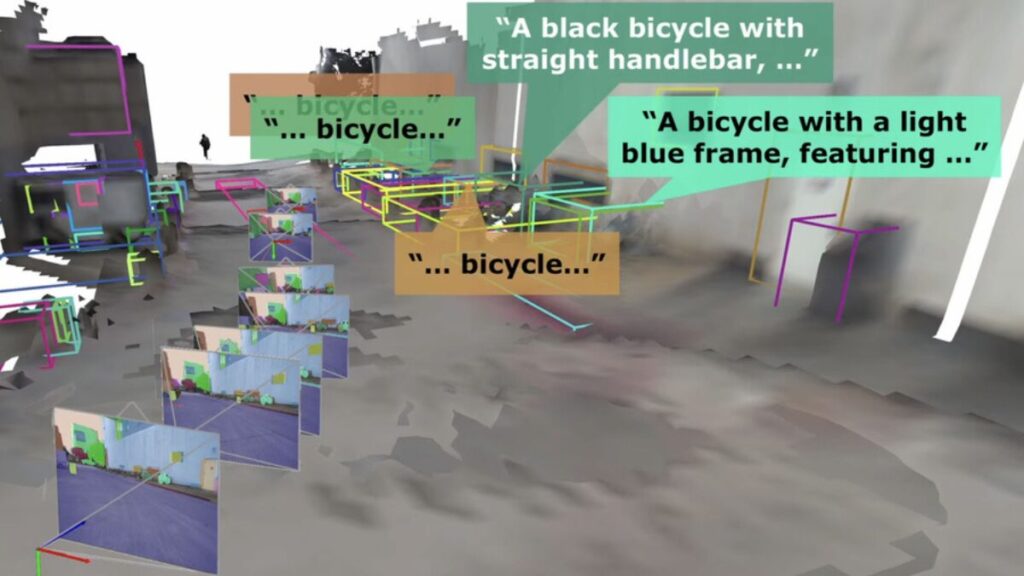
DAAAM changes this, allowing the robot to build a detailed mental model of large, complex spaces over time. DAAAM unites computer vision (to identify and describe objects) with robotic mapping (to know where they are in space). Thus, not only does it know that there is an object at a coordinate, but it associates it with a description and a place. As the robot moves, it labels objects with detailed descriptions. For example, you not only see a "bicycle," but you remember that it is a "red bicycle with a flat tire parked next to the building." This information is saved in a 3D map, connecting the object, its description and its location.
DAAAM cambia esto, permitiendo al robot construir un modelo mental detallado de espacios grandes y complejos a lo largo del tiempo. DAAAM une la visión por computador (para identificar y describir objetos) con el mapeo robótico (para saber dónde están en el espacio). Así, no solo sabe que hay un objeto en una coordenada, sino que lo asocia a una descripción y un lugar. A medida que el robot se mueve, etiqueta los objetos con descripciones detalladas. Por ejemplo, no solo ve una "bicicleta", sino que recuerda que es una "bicicleta roja con una rueda pinchada aparcada junto al edificio". Esta información se guarda en un mapa 3D, conectando el objeto, su descripción y su ubicación.
Source
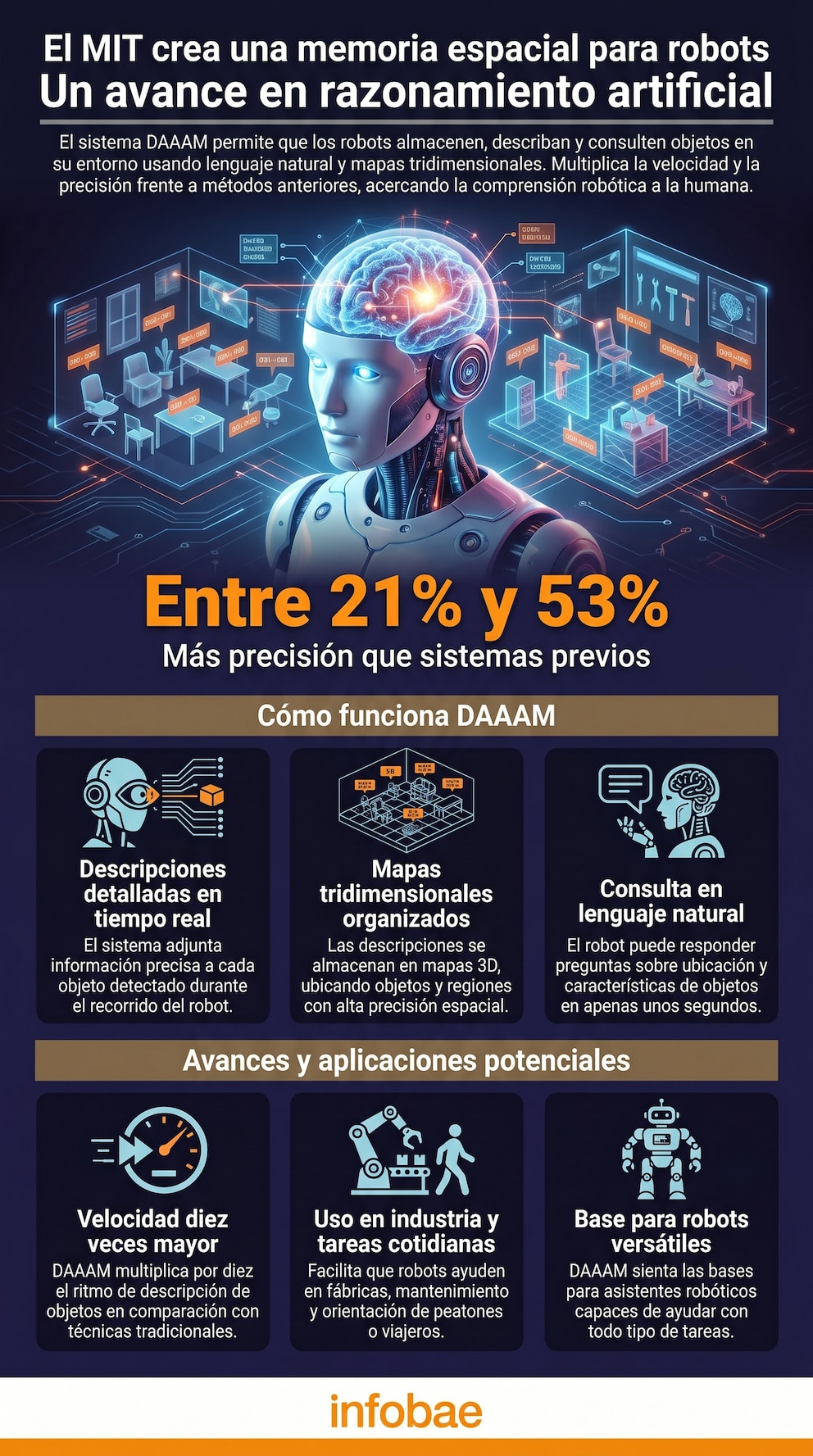
To make this work without slowing down the robot, the researchers optimized the process. Instead of analyzing each image, the system selects "keyframes" that show multiple objects and groups them together to describe them all at once. This makes the system up to 10 times faster. To "ask" the robot where things are, DAAAM uses a large language model (LLM). You can ask questions in natural language like "Where did I leave my wallet?" or "Go get the component we started putting together last night."
Para que esto funcione sin ralentizar al robot, los investigadores optimizaron el proceso. En lugar de analizar cada imagen, el sistema selecciona los "fotogramas clave" que muestran varios objetos y los agrupa para describirlos todos a la vez. Esto hace que el sistema sea hasta 10 veces más rápido. Para "preguntarle" al robot dónde están las cosas, DAAAM utiliza un modelo de lenguaje grande (LLM). Puedes hacer preguntas en lenguaje natural como "¿Dónde dejé mi cartera?" o "Ve a buscar el componente que empezamos a montar anoche".
The LLM interprets the question and searches the database in the robot's memory. In testing, this system proved to be between 21% and 53% more accurate than current methods for answering these types of questions. Although it is still a research project and not ready for the market, the potential is enormous. We could have personal assistance and home robots, which can help you find your keys, remote control or any lost items, or remember where you left something important.
El LLM interpreta la pregunta y busca en la base de datos de la memoria del robot. En las pruebas, este sistema demostró ser entre un 21% y un 53% más preciso que los métodos actuales para responder a este tipo de preguntas. Aunque todavía es un proyecto de investigación y no está listo para el mercado, el potencial es enorme. Podríamos tener robots de asistencia personal y domésticos, que puedan ayudarte a encontrar las llaves, el control remoto o cualquier objeto perdido, o que recuerde dónde dejaste algo importante.
Source
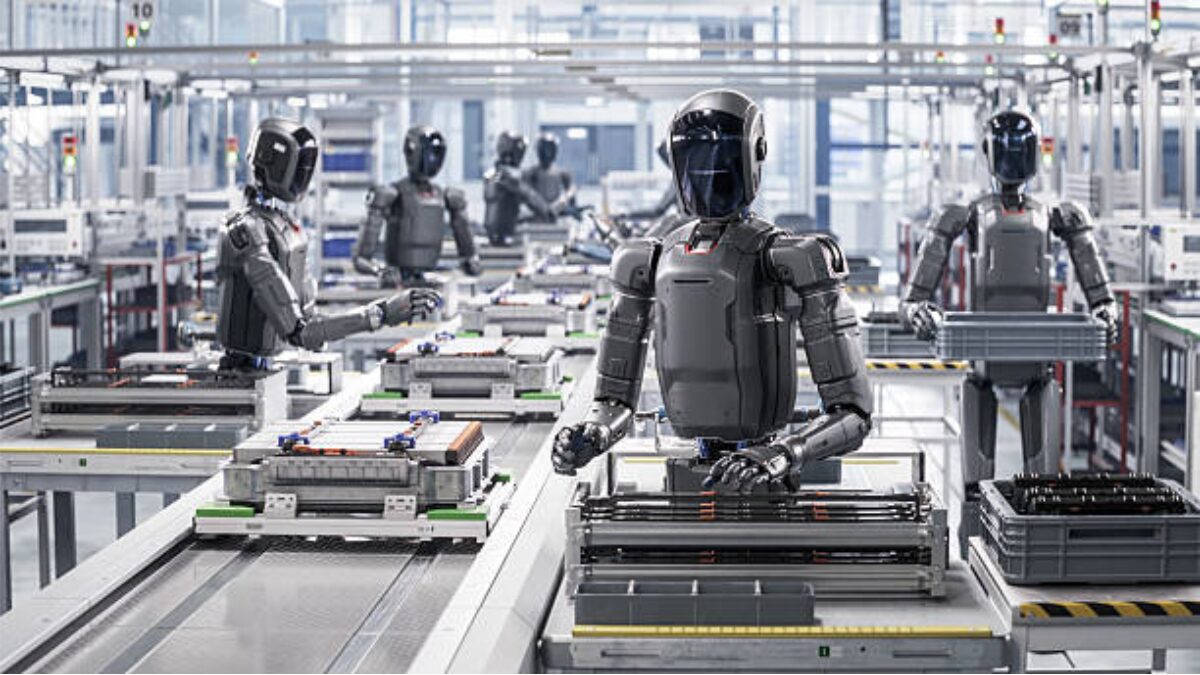
In the automation of factories and warehouses, robots that remember where a specific part, a tool or an order was left, streamlining logistics and production. In terms of health and care for the elderly, robots that can remember where they left glasses, medication or a telephone, offering more effective assistance at home. A spatial memory system could power AR (Augmented Reality), overlaying precise information about real-world objects and places that the system has "remembered" over time.
En la automatización de fábricas y almacenes los robots que recuerden dónde se dejó una pieza específica, una herramienta o un pedido, agilizando la logística y la producción. En cuanto a la salud y cuidado de personas mayores los robots que puedan recordar dónde se dejaron las gafas, la medicación o un teléfono, ofreciendo una asistencia más eficaz en el hogar. Un sistema de memoria espacial podría potenciar la RA (Realidad Aumentada), superponiendo información precisa sobre objetos y lugares del mundo real que el sistema ha "recordado" con el tiempo.
But, as we said, DAAAM is not yet operational for general use. It is a promising scientific advance, but it is still in the research and development phase, with several important challenges to overcome before it can reach, for example, a robot in your home. In tests, DAAAM proved to be fast enough to run in real time on a mobile robot and more accurate than other existing methods for answering questions about the environment, with an improvement that can be between 21% and 53%. It's a proof of concept that works, but it's not a product yet.
Pero, como dijimos, DAAAM aún no está operativo para uso general. Es un avance científico prometedor, pero todavía se encuentra en fase de investigación y desarrollo, con varios retos importantes por superar antes de que pueda llegar, por ejemplo, a un robot en tu hogar. En las pruebas, DAAAM demostró ser lo suficientemente rápido para funcionar en tiempo real en un robot móvil y más preciso que otros métodos existentes para responder preguntas sobre el entorno, con una mejora que puede llegar a ser de entre el 21% y el 53% . Es una prueba de concepto que funciona, pero aún no es un producto.
More information/Más información
https://news.mit.edu/2026/could-ai-tell-you-where-you-left-your-keys-0617
Interesting news--DAAAM's spatial memory for robotic applications addresses a major defect of current day robots. Robots can now utilize sensory inputs combining vision, mapping data and LLM's to allow for recall of an object and its associated description and location. Utilising the batching of key frames increases the processing speed by 10 times, and the greater than 21%-53% improvement in accuracy is also very impressive. The potential applications around homes and factories are enormous--e.g., robots finding lost keys or tracking inventory. Although this work remains research oriented, it is very encouraging.