Detected, for the first time, an atmosphere on a planet similar to Earth, potentially habitable/Detectan, por primera vez, una atmósfera en un planeta similar a la Tierra, potencialmente habitable
Source
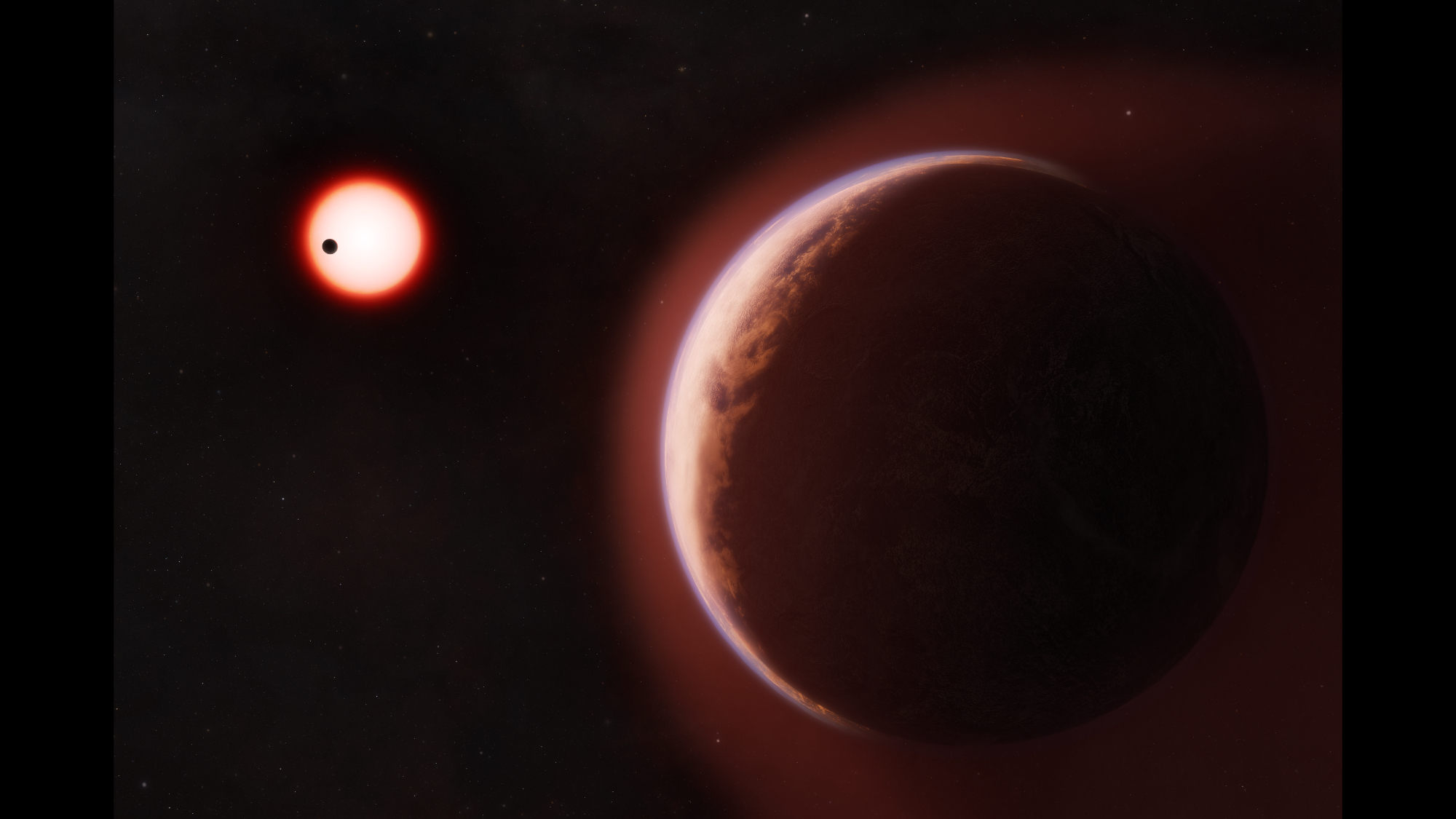
As you all know, an exoplanet (or extrasolar planet) is any planet that orbits a star other than the Sun and, therefore, does not belong to our solar system. To date, thousands of these worlds have been confirmed in the Milky Way, revealing a much more diverse and extreme range of environments than astronomers imagined. Recently, astronomers have detected for the first time an atmosphere on a rocky exoplanet similar to Earth and located in its habitable zone. This is the planet LHS 1140 b, located about 48 light years from our solar system, whose discovery represents a milestone for astrobiology.
Como todos sabéis, un exoplaneta (o planeta extrasolar) es cualquier planeta que orbita una estrella diferente al Sol y que, por lo tanto, no pertenece a nuestro sistema solar. Hasta la fecha se han confirmado miles de estos mundos en la Vía Láctea, revelando una variedad de entornos mucho más diversa y extrema de lo que los astrónomos imaginaban. Recientemente astrónomos han detectado por primera vez una atmósfera en un exoplaneta rocoso similar a la Tierra y ubicado en su zona habitable. Se trata del planeta LHS 1140 b, situado a unos 48 años luz de nuestro sistema solar, cuyo hallazgo supone un hito para la astrobiología.
The planet is called LHS 1140 b and is a "super-Earth" about 5.6 times the mass of Earth, orbiting a red dwarf star about 48 light years away. Astronomers, using the Magellan Clay telescope in Chile, detected an abundant signal of helium in the planet's upper atmosphere. This confirms that the planet has an atmosphere and that it is escaping into space. Unlike other very active red dwarfs, LHS 1140 b's star is unusually quiet, which has allowed the planet to retain its atmosphere for billions of years.
El planeta se llama LHS 1140 b y se trata de una "súper-Tierra" con unas 5.6 veces la masa de la Tierra, que orbita una estrella enana roja a unos 48 años luz de distancia. Los astrónomos, usando el telescopio Magellan Clay en Chile, detectaron una abundante señal de helio en la atmósfera superior del planeta. Esto confirma que el planeta posee una atmósfera y que esta se está escapando al espacio. A diferencia de otras enanas rojas muy activas, la estrella de LHS 1140 b es inusualmente tranquila, lo que ha permitido que el planeta conserve su atmósfera durante miles de millones de años.

Source
This discovery is a giant step in the search for life outside our solar system for several reasons. It is the "best laboratory" to search for life since by having an atmosphere and being in the habitable zone (where liquid water could exist), LHS 1140 b becomes the most promising candidate to study the conditions necessary for life. It shows that it is possible to detect atmospheres on rocky and temperate worlds, and not just on hot gas giants. This will encourage scientists to look for similar signals on other planets.
Este hallazgo es un paso de gigante en la búsqueda de vida fuera de nuestro sistema solar por varias razones. Es el "mejor laboratorio" para buscar vida ya que al tener una atmósfera y estar en la zona habitable (donde podría existir agua líquida), LHS 1140 b se convierte en el candidato más prometedor para estudiar las condiciones necesarias para la vida. Demuestra que es posible detectar atmósferas en mundos rocosos y templados, y no solo en gigantes gaseosos calientes. Esto animará a los científicos a buscar señales similares en otros planetas.
Unfortunately it is not an "Earth 2.0", although it is a great advance, scientists insist that there is no evidence of life on this planet. Furthermore, its environment is very different from ours, its gravity is twice that of Earth, which would be very hard for human beings. It is most likely an "eye planet" or "water world", with one side always illuminated by its star and the other in perpetual darkness. There is no doubt that this is an important milestone, but it is more of a technological and not a biological milestone.
Lamentablemente no se trata de una "Tierra 2.0", aunque es un gran avance, los científicos insisten en que no hay evidencia de vida en este planeta. Además, su entorno es muy diferente al nuestro, su gravedad es el doble que la de la Tierra, lo que sería muy duro para los seres humanos. Es muy probable que sea un "planeta ojo" o un "mundo acuático", con un lado siempre iluminado por su estrella y el otro en oscuridad perpetua. No cabe duda de que se trata de un hito importante pero se trata más bien de un hito tecnológico y no biológico.
Source
In short, we have achieved the technical feat of confirming that a distant, rocky world is not naked (it has air), but that air is an inert gas that is leaking and the planet is a hell of crushing gravity. This doesn't really have any impact for the average citizen but it does have a lot for astrophysicists, because now they know that their detection technique works and they will be able to target other, more promising planets. But from there to something changing in our lives there is a long way to go.
En resumen, hemos conseguido la proeza técnica de confirmar que un mundo lejano y rocoso no está desnudo (tiene aire), pero ese aire es un gas inerte que se está fugando y el planeta es un infierno de gravedad aplastante. Esto no tiene realmente ningún impacto para el ciudadano de a pie pero si tiene mucho para los astrofísicos, porque ahora saben que su técnica de detección funciona y podrán apuntar a otros planetas más prometedores. Pero de ahí a que cambie algo en nuestras vidas hay un largo trecho que recorrer.
But honestly, even if there were intelligent life, 48 light years is a distance we can't even imagine. Simply a WhatsApp to tell the neighbors: "Hello, how are you --> Good, and you" would take us a century, so the most likely thing is that, when the conversation ends, neither of us will still be alive. And let's not talk about paying them a visit, even if we are capable of traveling at 10% of the speed of light, which is still very far away, it would take us 500 years to get there and the ship's crew will have already forgotten what the hell they are doing on that ship.
Pero honestamente, incluso si hubiese vida inteligente, 48 años luz es una distancia que ni siquiera podemos imaginar. Simplemente un whatsapp para decirles a los vecinos: "Hola, como estás --> Bien, y tú" nos llevaría un siglo, por lo que lo mas probable es que, cuando termine la conversación, ninguno de los dos siga con vida. Y no hablemos de hacerles una visita, aun siendo capaces de viajar a un 10% de la velocidad de la luz, cosa que aún nos queda muy grande, tardaríamos 500 años en llegar y los tripulantes de la nave ya habrán olvidado que coño hacen en esa nave.
More information/Más información
https://www.sciencealert.com/for-the-first-time-astronomers-have-detected-an-atmosphere-around-a-rocky-planet-in-the-habitable-zone
Es increible imaginar la distancia que nos separa de los exoplanetas. Lo que estamos viendo ahora con los telescopios mas avanzados posibles es simplemente el pasado, lo que ha ocurrido hace 48 años luz ¿cómo acortar ese camino?
Gracias por compartir ..!
Tremendous breakthrough! The discovery of the atmosphere of LHS 1140 b is a big step for astronomy because it demonstrates that scientists can analyze the atmosphere of terrestrial planets located in habitable regions. While this does not imply finding life, it opens a new fascinating instrument in the exploration of planets that might one day reveal stronger hints of habitability.
@mauromar, justo andaba con algo dando vueltas y tu post me ayudó a ponerlo en orden.
@mauromar, justo venía siguiendo este tema y tu post me aclaró un par de cosas.
Compartir lo que uno piensa en la plataforma no siempre es fácil. Gracias por animarte a hacerlo.