Remote-controlled robots that communicate with each other are building solar farms in Australia/Robots teledirigidos que se comunican entre si construyen parques solares en Australia
Source
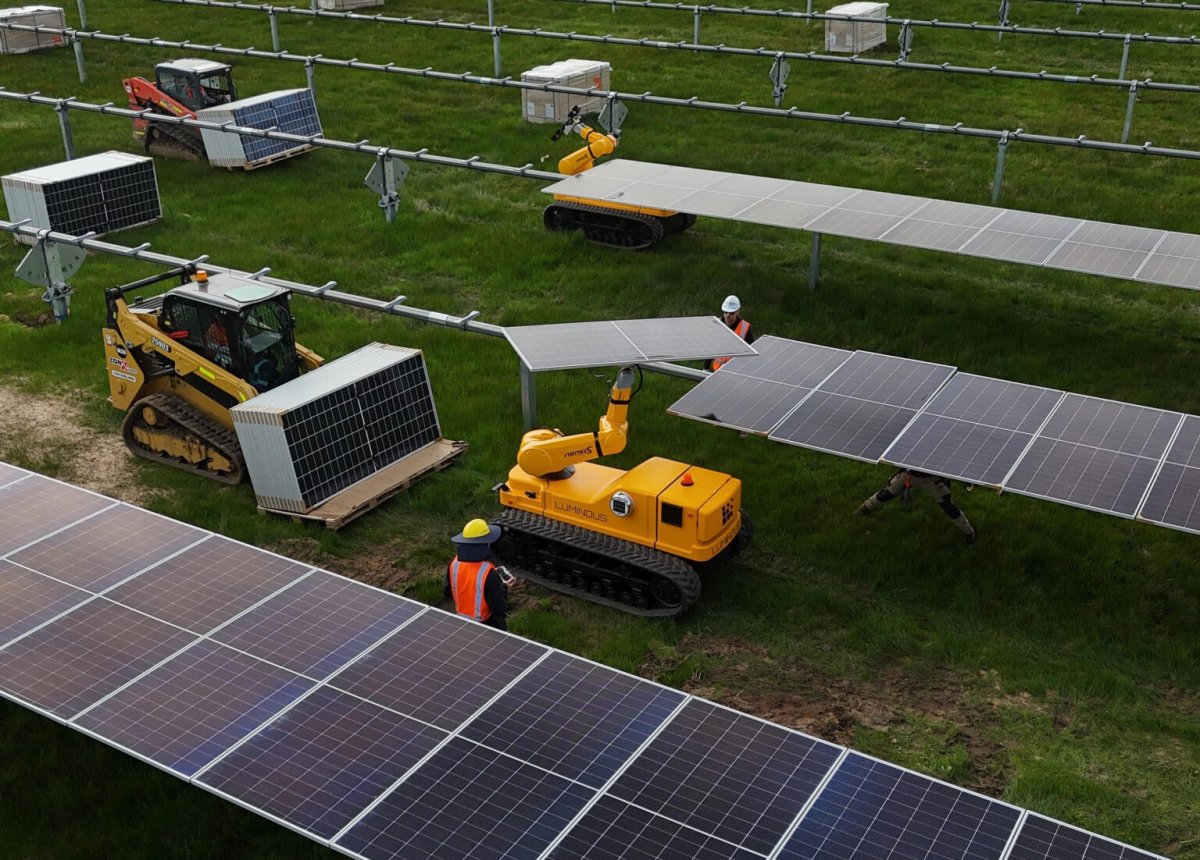
Encountering robots that build all kinds of structures is no longer surprising, but robots now not only build better and faster than any human crew—they are also capable of communicating with one another, potentially eliminating the need for human oversight of construction projects in the near future. In this vein, the Boston-based company Luminous Robotics is using a fleet of intelligent, remote-controlled robots to build solar farms in Australia, aiming to revolutionize large-scale solar construction by making it faster, safer, and more cost-effective.
Encontrarnos con robots que construyen cualquier tipo de estructuras es algo que ya no sorprende a nadie, pero ahora los robots no solo construyen mejor, más rápido que cualquier cuadrilla humana sino que ya son capaces de comunicarse entre sí para, a corto plazo, prescindir del ser humano incluso para la supervisión de la obra. En esta línea la compañía Luminous Robotics con sede en Boston, está utilizando una flota de robots teledirigidos e inteligentes para construir parques solares en Australia que busca revolucionar la construcción de energía solar a gran escala, haciéndola más rápida, segura y económica.
Although in theory the robots can be controlled from anywhere in the world (even from the company's offices in Boston), in practice, safety regulations require technicians to closely supervise them on-site. The essence of the system—known as "synchronized autonomy of heterogeneous fleets"—is that the robots work in coordination, communicate with one another, and learn from their environment. The robot picks up a solar panel, lifts it, and places it onto the support structure with millimeter precision. This is one of the most arduous tasks—and one carrying the highest risk of injury—in traditional construction.
Aunque en teoría los robots pueden ser controlados desde cualquier parte del mundo (incluso desde las oficinas de la empresa en Boston), en la práctica, por normativas de seguridad, siempre hay técnicos supervisándolos de cerca en el sitio de construcción. La esencia del sistema, llamado "autonomía sincronizada de flotas heterogéneas", es que los robots trabajan de forma coordinada, se comunican entre sí y aprenden del entorno. El robot toma un panel solar, lo levanta y lo coloca con precisión milimétrica sobre la estructura de soporte. Esta es una de las tareas más arduas y con mayor riesgo de lesiones en la construcción tradicional.

Source
LUMI moves across the terrain on tracks and is equipped with an industrial robotic arm. It uses advanced computer vision systems to "see" and correctly position the panels, adapting to changing terrain conditions. As they work, the robots map the terrain in real time, enabling the creation of a "digital twin" of the solar plant—a virtual model that records the GPS location of each panel, before-and-after installation images, and terrain geometry. This information is used to optimize the operations of the entire fleet.
El LUMI se desplaza por el terreno usando orugas y cuenta con un brazo robótico industrial. Utiliza sistemas avanzados de visión por computadora para "ver" y posicionar los paneles correctamente, adaptándose a las condiciones cambiantes del terreno. Mientras trabajan, los robots cartografían el terreno en tiempo real lo que les permite crear un "gemelo digital" de la planta solar, un modelo virtual que registra la ubicación GPS de cada panel, las imágenes de antes y después de la instalación y las geometrías del terreno. Esta información se usa para optimizar el trabajo de toda la flota.
Test results in Australia have been very positive. The technology is designed to address labor shortages and the need to accelerate the energy transition. Installation can be up to 3.5 times faster than traditional manual methods. Because the robot reduces the size of the required crew, productivity per worker has increased by 330%. A two-person team with a robot installs more panels per hour than a six-person manual team.
Los resultados de las pruebas en Australia, han sido muy positivos. La tecnología está destinada a abordar los problemas de escasez de mano de obra y la necesidad de acelerar la transición energética. La instalación puede llegar a ser hasta 3,5 veces más rápida en comparación con los métodos manuales tradicionales. Como el robot reduce la cuadrilla necesaria, la productividad por trabajador se ha incrementado en un 330% . Un equipo de dos personas con un robot coloca más paneles por hora que un equipo manual de seis.

Source
The deployment of these robots is not merely a matter of efficiency; it has far-reaching implications for the future of renewable energy. It reduces construction time, allowing more solar farms to come online faster and contribute clean energy to the grid. It does not eliminate jobs, but rather transforms them. More specialized technicians will be needed to operate and maintain the robots, requiring workforce retraining. These robots are ideally suited for work in deserts or regions with extreme climates, where sending human crews would be difficult and dangerous.
La implementación de estos robots no solo es una cuestión de eficiencia, sino que tiene implicaciones de gran alcance para el futuro de las energías renovables. Reduce el tiempo de construcción, permitiendo que más parques solares entren en operación más rápido y contribuyan a la red eléctrica con energía limpia. No elimina el empleo, pero lo cambia. Se necesitarán más técnicos especializados para operar y mantener los robots, requiriendo una recapacitación de la fuerza laboral. Estos robots son ideales para trabajar en desiertos o zonas climáticas extremas donde es difícil y peligroso enviar equipos humanos.
Luminous plans to release the collected data so that any company can use it to improve the technology, thereby "democratizing" solar innovation. In short, this project represents a major breakthrough in renewable energy automation. It is a real-world example of how collaborative robotics—robots working alongside humans—is boosting efficiency and safety, with the long-term goal of making solar energy faster, cheaper, and more scalable to combat climate change.
Luminous planea liberar los datos recopilados para que cualquier empresa pueda usarlos y mejorar la tecnología, "democratizando" la innovación solar. En resumen, este proyecto representa un gran avance en la automatización de las energías renovables. Se trata de un caso real donde la robótica colaborativa (robots que trabajan con humanos) está aumentando la eficiencia y la seguridad, con el objetivo a largo plazo de hacer la energía solar más rápida, barata y escalable para combatir el cambio climático.
More information/Más información
https://reneweconomy.com.au/remote-control-robots-that-talk-to-each-other-are-building-solar-farms-in-australia/
The combination of robotics and renewable energy is significant. The robots are capable not only of installing solar panels but also of communicating, collaborating, and independently adjusting to the various site conditions. Through the use of computers and digital maps for precise panel placement, robots also help in collecting valuable data about the solar farm as a complete entity.
The team productivity improvements are significant. A small team working with robots can accomplish far more than a larger crew that is doing manual, physical work, in part because of the time reduced from the overall construction schedule for completing the project in order to bring clean energy online sooner. In addition, robots don't take away the role of skilled workers; skilled workers still support, operate, and maintain the machines.
I think this technology has a special place for remote locations and challenging job site conditions where it is difficult and dangerous for human workers to perform construction work. If manufacturers allow sharing of information and the ability to make improvements in how these robots work, it will spur innovation among other renewable energy companies. Overall, this project is an example of how humans and robots can come together to produce lower-cost, higher-efficiency, and more accessible renewable energy while assisting in the fight against climate change.
Side talks: the lengthy comment doesn't mean anything but instead; to supply everything straight from my heart. I hope the author may not get exhausted too!
0.00 SBD,
0.75 STEEM,
0.75 SP
The comment is as big as the post. ;-)
Thank you now, I get a sense of direction !
0.00 SBD,
0.72 STEEM,
0.72 SP