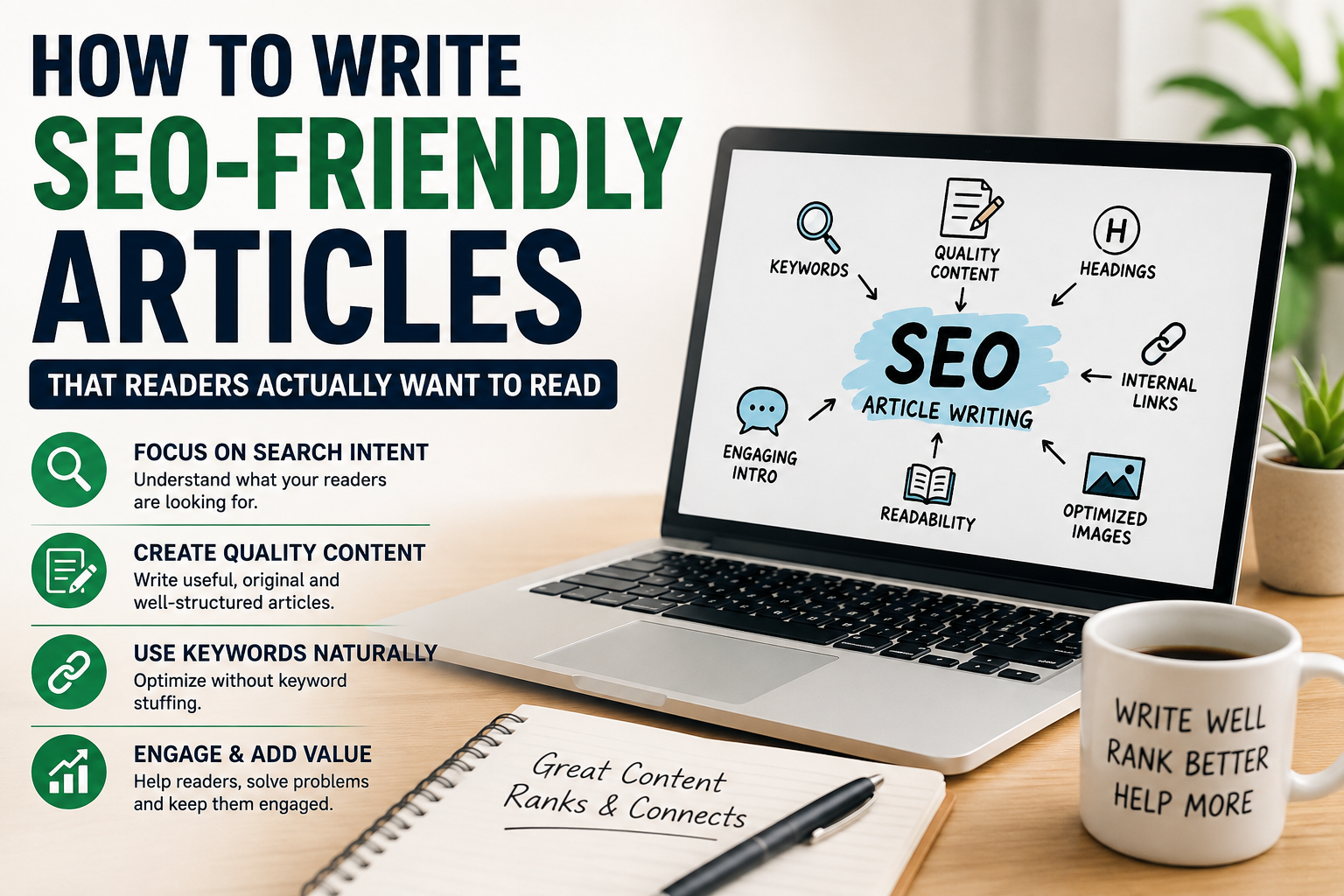
How to Write SEO-Friendly Articles That Readers Actually Want to Read
SEO Writing | Article Writing | Content Writing | Blogging
Writing an article is easy. Writing an article that people actually want to read is much harder.
Today, thousands of new blog posts and articles are published every day. Because of this competition, simply putting keywords into an article is no longer enough. A successful article needs to be useful, easy to read, well-structured, and written for a real audience.
This is where SEO-friendly article writing becomes important.
Search engine optimization can help an article become more discoverable, but good SEO should never come at the expense of the reader. The best content combines search visibility with genuine value.
In this guide, we will explore how beginner writers can create SEO-friendly articles that are useful to readers, easy to understand, and professionally structured.
What Is an SEO-Friendly Article?
An SEO-friendly article is content that is structured and written in a way that helps both readers and search engines understand its purpose.
A good SEO article usually has:
A clear topic
A useful title
Relevant keywords
Well-organized headings
Short and readable paragraphs
Helpful information
Natural language
Good search intent alignment
Original explanations and examples
However, SEO writing is not about repeating the same keyword again and again.
The goal is to create the best possible answer for the reader's question.
Why Reader-Focused SEO Matters
Imagine searching for a topic online and clicking on an article that looks promising.
The title is attractive, but the introduction is confusing. The paragraphs are extremely long, the same keyword appears repeatedly, and the article does not actually answer your question.
Would you continue reading?
Probably not.
This is why writers should think about the reader before thinking about keywords.
A useful article can encourage readers to stay longer, explore more content, share the information, or return to the website later.
SEO may help someone discover your article, but quality is what gives them a reason to read it.
8 Practical Steps to Write Better SEO Articles
- Start With a Specific Topic
A common mistake among beginner writers is choosing topics that are too broad.
For example:
Too broad:
“SEO”
More specific:
“How to Use Keywords Naturally in a Beginner SEO Article”
The second topic has a clearer purpose. It also gives the writer a better idea of what information the article should contain.
Before writing, ask:
What specific problem will this article solve?
If you can answer that question clearly, you already have a stronger foundation.
- Understand Search Intent
Search intent means understanding what a person really wants when they search for something.
For example, someone searching for:
“How to write an article”
may want a step-by-step tutorial.
Someone searching for:
“Best article writing tools”
may want a comparison or list.
Someone searching for:
“Article writing definition”
may simply want an explanation.
If your article does not match the reader's intention, even excellent writing may fail to provide value.
So before starting your article, identify the question behind the search.
- Choose One Primary Keyword
A primary keyword is the main phrase that describes the subject of your article.
For example, if your article is about writing SEO-friendly content, your primary keyword could be:
SEO-friendly articles
You can also use related phrases such as:
SEO article writing
SEO content writing
writing optimized content
search-friendly articles
content optimization
The important thing is to use keywords naturally.
Do not force them into every paragraph.
- Create a Strong and Clear Title
Your title is one of the first things a reader sees.
A good title should tell readers what they will gain from the article.
Compare these two titles:
Weak:
“SEO Article Writing”
Stronger:
“How to Write SEO-Friendly Articles That Readers Actually Want to Read”
The second title gives the reader a clear benefit and creates curiosity without making an unrealistic promise.
A strong title should be:
Specific
Relevant
Easy to understand
Honest
Focused on reader value
- Write an Introduction That Creates Interest
The introduction should quickly answer two questions:
What is this article about?
and
Why should I keep reading?
Avoid spending too much time on unnecessary background information.
A useful introduction can identify a problem, explain why it matters, and tell readers what they will learn.
For example, instead of starting with a long definition of SEO, begin with the challenge writers face: there is enormous competition for readers' attention.
Then introduce your solution.
This creates a natural connection between the reader's problem and your article.
- Use Headings to Organize Your Ideas
Good headings make an article easier to scan.
Many online readers do not read every sentence immediately. They first look through the headings to decide whether the article contains the information they need.
For that reason, use descriptive headings instead of vague ones.
Instead of:
“Some Tips”
write:
“5 Ways to Improve Your Article Introduction”
Specific headings help readers understand the structure of your article.
- Keep Paragraphs Short and Readable
Large blocks of text can make online articles difficult to read.
Try to keep paragraphs relatively short and focus each paragraph on one main idea.
You can also use:
Bullet points
Numbered lists
Bold emphasis
Subheadings
Examples
These elements create visual breaks and make information easier to scan.
Good formatting is not just about appearance. It improves the reading experience.
- Add Real Value Instead of Filler
One of the biggest problems with low-quality content is unnecessary information.
An article may contain 2,000 words but provide less value than a well-written 800-word guide.
Before adding a paragraph, ask:
Does this help the reader?
If the answer is no, consider removing it.
Useful content can include:
Practical steps
Examples
Common mistakes
Simple explanations
Checklists
Personal observations
Actionable advice
The goal is not to make an article longer.
The goal is to make it more useful.
How to Use Keywords Naturally
Keyword placement matters, but natural writing matters more.
A primary keyword can appear in appropriate places such as:
The title
Introduction
One or more headings
Body content
Conclusion
Relevant image description when appropriate
However, there is no need to repeat the exact phrase in every paragraph.
For example, instead of repeatedly writing:
“SEO-friendly article writing is important because SEO-friendly article writing helps SEO-friendly articles rank…”
write naturally:
“Good SEO content should communicate its topic clearly while remaining useful and enjoyable for readers.”
The second version sounds more professional and provides a better reading experience.
Why Originality Matters in Content Writing
A professional article writer should never depend on copying another writer's work.
Research is important, but research should be used to understand a subject—not to reproduce someone else's sentences.
A stronger approach is:
Research → Understand → Organize → Write → Edit
Read several reliable sources when researching a topic. Identify the important information, think about what the reader actually needs, and then explain the subject using your own structure and language.
You can also add value through examples, comparisons, practical recommendations, or your own observations.
Originality gives your writing a distinct voice.
The Importance of Editing
Many writers think their job is finished after writing the final sentence.
It isn't.
Editing is one of the most important stages of professional article writing.
During editing, look for:
Grammar and Spelling
Correct obvious errors before publishing.
Repetition
Remove sentences that repeat the same idea.
Clarity
Replace confusing expressions with simpler language.
Flow
Check whether one section naturally leads into the next.
Accuracy
Make sure important facts and claims are properly researched.
Readability
Read the article as if you were the target reader.
If a sentence feels unnecessarily complicated, simplify it.
A Simple SEO Article Writing Workflow
If you are a beginner writer, you can use this workflow for almost any informational article:
Step 1: Choose a specific topic.
Step 2: Identify the target reader.
Step 3: Understand the search intent.
Step 4: Select a primary keyword and relevant related terms.
Step 5: Research the subject.
Step 6: Create an outline.
Step 7: Write the first draft.
Step 8: Add useful examples and practical information.
Step 9: Edit for clarity, grammar, and repetition.
Step 10: Review the title, headings, keywords, and overall reader experience.
Step 11: Publish and learn from reader feedback.
This process may seem slow at first, but it becomes much faster with practice.
Common SEO Writing Mistakes to Avoid
Keyword Stuffing
Using a keyword excessively can make content sound unnatural.
Writing Only for Search Engines
Search engines help people discover content, but people are the ones who read it.
Weak Introductions
If the opening does not create interest, readers may leave before reaching the useful sections.
Excessive Filler
Longer does not automatically mean better.
Poor Formatting
Huge paragraphs and unclear headings can make even good information difficult to consume.
Ignoring Editing
Small grammar and structure problems can make otherwise useful content look unprofessional.
Final Thoughts
SEO-friendly article writing is not simply about keywords and rankings.
It is about creating content that clearly answers a reader's question and makes the information easy to understand.
A successful article combines several elements:
Research + Structure + Originality + Readability + SEO + Reader Value
If you are a beginner article writer, focus on improving these skills one article at a time.
Do not worry about making every article perfect. Instead, learn from every draft, every editing session, and every piece of reader feedback.
The more useful content you create, the stronger your writing portfolio becomes.
And ultimately, the best SEO strategy is simple:
Write for people first, optimize thoughtfully, and always give the reader a reason to keep reading.