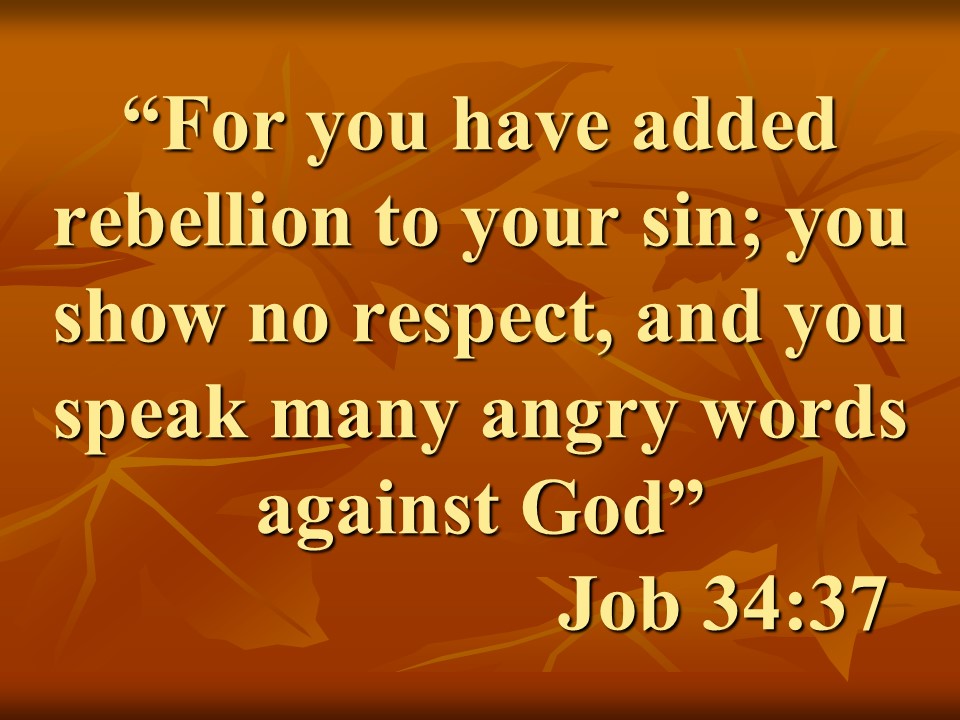
God and Job: For you have added rebellion to your sin; you show no respect, and you speak many angry words against God. Job 34:37
The Book of Job is a book of the Old Testament that tells of the events that happened to a God-fearing man in a land called Uz, probably located in the Middle East. The Book of Job is a book that seeks to make a profound spiritual critique of that wisdom that claims to explain everything, and in this sense, the Book of Job has a certain resemblance to some teachings of the apostle Paul in the New Testament, who criticized the pagan Greeks for subjecting everything to that purely human wisdom. For the ancient sages, ethical laws, such as the law of sowing and reaping, were intended to explain why there is happiness for some, the righteous men, and suffering for others, the foolish, but in Job, for some reason that he and his friends did not understand, this did not work.
The Book somehow attempts to explain in a very genuine way the problem of suffering in man, a problem that Thomas Aquinas also addressed in his work Summa Theologica. The spiritual themes dealt with in the Book of Job far outweigh the book, and that is why the Book of Job, with its character, gives rise to the themes of providence and faith.
The Book of Job begins by recounting that Job had seven sons and three daughters and a very large estate; Job prospered and was happy. But it happened that in God's court, the adversary appeared and questioned Job's integrity, and so God allowed the adversary to test him.
Thus, a series of misfortunes befell Job, which caused him great sadness, and four friends, aware of Job's troubles, approached him, and so began a series of cycles of discourses between Job and his friends Eliphaz, Bildad, Zophar, and Elihu. Faced with his misfortunes, Job questioned God's justice and wisdom in his speeches, and Eliphaz, Bildad, and Zophar attempted to answer and sought in God's wisdom the answers to Job's anguish.
But the speeches did not reach a response of Job's problem until Elihu intervened, and perhaps being the wisest of all, he responded to his friend Job: "For you have added rebellion to your sin; you show no respect, and you speak many angry words against God" Job 34:37. For Elihu, Job's attempt to judge God was a sin, and this friend of Job ended the speeches by teaching that God can teach men through suffering, and that if he allows evil, it is to extract from it a good. The Bible concludes by recounting that God delivered Job from his trial and that he was greatly blessed. Ultimately, the Book of Job is a reflection on what would later be known in Christianity as the poverty of spirit.
For more information, check out my profile, follow the link, and download my ebook.