Why Recent Form Can Mislead Without Opponent Strength
Why Recent Form Can Mislead Without Opponent Strength
A practical sports-analysis guide to short streaks, opponent quality, venue, sample size, and why a five-match record needs context.
Recent Form Is Useful Because It Is Current - and That Is Also Its Weakness
Recent form is popular because it compresses a lot of information into a simple sequence of wins, draws, and losses from the latest few matches. It is easy to read and can be more relevant than a full-season record when a team has changed coach, lineup, tactics, or fitness. The problem begins when the sequence is treated as if every opponent and every match carried the same level of difficulty.
A team that has won four of its last five matches can look stronger than a team that has won only two. But if the first team faced mostly weak opposition and the second faced several elite opponents, the raw form line can exaggerate the difference. Statistical team-strength models routinely account for opponent quality because observed performance depends partly on who the team played.
For readers using the 711Bet information hub or any other sports-information source, the safest interpretation is simple: recent form is a starting signal, not a complete rating. The next question should be who those results came against.

Two Identical Form Lines Can Describe Different Levels of Performance
Imagine Team A and Team B both show W-W-W-L-W across five matches. Team A earned those results against opponents near the top of the league. Team B faced mostly teams near the bottom. The form line is identical, but the competitive resistance behind it is not.
That difference does not mean Team A must be better. Upsets happen, playing styles interact, and a difficult opponent can underperform on the day. Opponent strength is context, not a guarantee. Still, ignoring the level of competition removes information that helps explain how impressive a streak really is.
Team-strength models such as Bradley-Terry and Poisson approaches are built around the idea that results are generated by the interaction between two teams, not by one team in isolation. That is why a result against a strong opponent does not carry the same analytical meaning as the same result against a much weaker one.
Venue and Match Importance Can Change the Meaning of a Result
Opponent quality is not the only missing variable. Home advantage can make a difficult opponent easier to face than the same opponent away. Research using time-varying Bradley-Terry models has found home advantage to remain meaningful even after accounting for team strength, which is a reminder that venue belongs in the context around a form streak.
Match importance matters as well. League matches, knockout games, friendlies, preseason fixtures, and dead-rubber matches do not always create the same incentives or lineup choices. A recent-form sequence that mixes low-stakes games with high-stakes competition can look cleaner than the underlying competitive picture.
This is why the best form analysis labels the conditions around the result. A five-match sequence should ideally be accompanied by opponent quality, venue, competition type, and at least a basic indication of whether the performance itself was convincing.

Scoreline Alone Can Hide How the Match Was Played
A win can be deserved, fortunate, dominant, or barely survived. Two 1-0 victories count the same in a form table even if one team controlled the match while the other faced sustained pressure and scored from its only clear chance. That does not make the second win invalid; it means the outcome and the performance are different pieces of information.
Sports models often use more than results for this reason. Margin, shot quality, possession value, expected scoring measures, or other sport-specific performance indicators can help describe how repeatable a result might be. The exact metric depends on the sport and the quality of the available data.
Recent form becomes more informative when it is treated as an outcome summary and then checked against how the team actually performed. A streak built on repeated narrow escapes may deserve a different interpretation from the same streak built on consistent, controlled performances against strong competition.
Why a Five-Match Sample Can Swing So Quickly
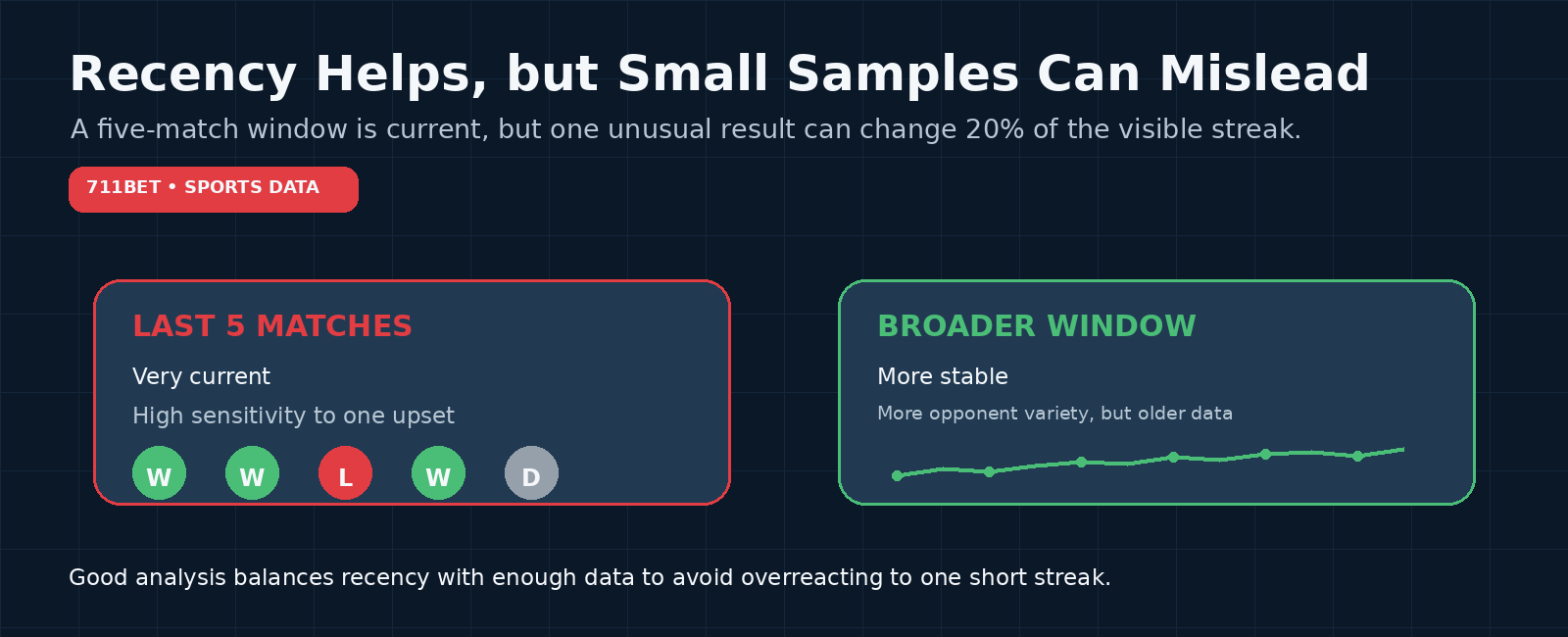
The shorter the window, the more one unusual match can dominate it. In a five-game sample, a single upset changes 20 percent of the sequence. A red card, injury, weather disruption, late penalty, overtime result, or unusually poor finishing can transform the visible form line even when the team's underlying level has not changed very much.
A broader window gives more stability but creates a different problem: older matches may describe an earlier version of the team. That is the tradeoff between recency and sample size. Statistical ranking work in football often uses time-depreciation weights so that newer matches matter more without discarding older information completely.
There is no magic number of matches that solves the problem for every sport. The useful habit is simply to recognize the tradeoff. Very short form is current but noisy; longer form is more stable but can become stale.
Opponent Adjustments Help Reduce Hindsight Bias
Fans naturally reinterpret a streak after seeing what happened next. If a team wins five matches and then loses badly to elite opposition, people may decide the earlier run was meaningless. If the team keeps winning, the same run suddenly looks like proof that a breakthrough was obvious all along. Opponent-adjusted analysis helps reduce that hindsight effect by evaluating the difficulty of the competition at the time the results were produced.
That does not make adjusted ratings infallible. Every model still depends on assumptions, weighting choices, data quality, and the definition of team strength. The value is that the method makes those assumptions visible instead of pretending a five-character form sequence explains everything.
The goal is not to replace simple recent form with a mysterious number. It is to stop asking one short sequence to answer questions it was never designed to answer.
Four Questions to Ask Before Trusting a Form Streak
First, who did the team play? Compare the quality of the opponents rather than treating every result as equal evidence. Second, where were the matches played? Home and away conditions can change the difficulty of the same matchup.
Third, how were the results achieved? Look beyond the scoreline when performance information is available. Fourth, how large is the sample? A five-match run can be useful, but it should not automatically outweigh a broader pattern without a reason.
These four checks are simple enough for ordinary fans and flexible enough to work across many sports. They also fit the editorial approach described in the 711Bet editorial overview, which presents the site as an independent information platform rather than an official operator source.

Final Takeaway
Recent form deserves attention because teams change and current information matters. But a sequence of wins and losses becomes misleading when the difficulty of the opposition is invisible. Two identical streaks can represent very different levels of performance.
Use form as one layer. Add opponent strength, venue, performance quality, match importance, and sample size before drawing a strong conclusion. Context does not make sports perfectly predictable; it simply makes the analysis more honest about what the recent results actually tell us.
Sources & References
• Ley, Van de Wiele & Van Eetvelde - Ranking soccer teams on basis of their current strength: a comparison of maximum likelihood approaches.
• González Soffner & Leonelli - An analysis of factors impacting team strengths in the Australian Football League using time-variant Bradley-Terry models.
• Macrì-Demartino et al. - Bayesian weighted discrete-time dynamic models for association football prediction.
• Davis et al. - Methodology and evaluation in sports analytics: challenges, approaches, and lessons learned (opponent-based adjustments).
• 711Bet - About Us (used only to describe the linked site as an independent information platform).