Guardian Figures Statues: Protection, Spiritual Meaning, and Decorative Harmony in Modern Spaces
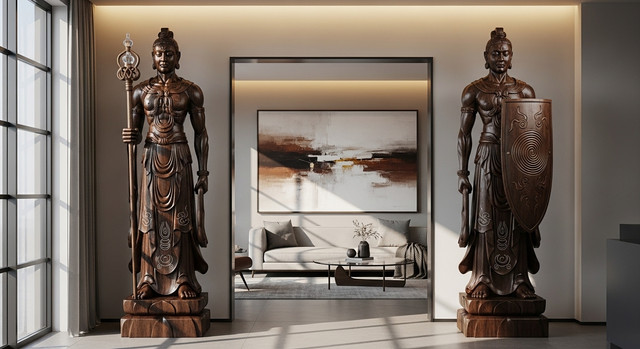
Walk through the entrance of an ancient temple in Kyoto and two fierce figures flank the gate, their expressions powerful enough to stop you mid-step. Wander through an old Chinese courtyard and stone lions sit in perfect symmetry, their gaze steady and unwavering. Step into a Balinese family compound and carved demons grimace from every doorpost — not to frighten the residents, but to frighten away whatever might threaten them.
Across every continent, every era, and virtually every spiritual tradition humanity has produced, one impulse appears with remarkable consistency: the desire to place a powerful figure at the threshold between the safe interior world and the unpredictable world beyond.
Guardian figures statues protection decor represents one of the oldest and most cross-culturally universal expressions of human spiritual life — and one of the most enduringly relevant. Because despite everything that has changed in how people live, the fundamental human need to create protected, intentional spaces has not changed at all.
What Are Guardian Figure Statues?
More Than Decoration
A guardian figure statue is, at its most basic level, a sculptural representation of a protective force. It might take the form of a deity, a mythological creature, a sacred animal, a warrior, or an abstracted symbol of power — but its core function is consistent across all these forms: it stands between the space it protects and whatever might threaten it.
This protective function can be understood on multiple levels simultaneously, which is part of what makes these objects so enduringly meaningful.
On the spiritual level, guardian figures are understood in their native traditions as active presences — not merely representations of protective forces, but actual vehicles for those forces in the physical world. Placing such a figure at an entrance or within a sacred space is understood as genuinely inviting that protective energy to dwell there.
On the psychological level, guardian figures create a felt sense of safety and boundary — a clear signal to the unconscious mind that this space has been consciously set apart and protected. This effect is real and measurable in how people experience spaces containing these objects.
On the aesthetic level, guardian figures are often objects of considerable beauty — embodying the sculptural traditions of cultures that developed extraordinary craft skills in service of their spiritual lives. Their presence enriches any environment visually as much as energetically.
The Threshold as Sacred Space
To understand why guardian figures matter so much, it helps to think carefully about what a threshold actually is.
A threshold — whether a doorway, a garden gate, a room entrance, or the boundary between a meditation space and ordinary domestic space — is a point of transition. It is where inside becomes outside, where known becomes unknown, where protected becomes exposed.
Every spiritual tradition that has developed a guardian figure practice understands this transition point as spiritually significant. It is not merely a physical boundary but an energetic one — a place where the quality of what enters can be influenced, where intentions can be set, and where protective forces can be stationed.
This is why guardian figures are almost always positioned at thresholds rather than in the middle of spaces. They are not presiding over interiors. They are guarding the passage between one state and another.
Guardian Figures Across Cultures: A Global Tradition
China: Lions, Dragons, and the Celestial Guardians
Chinese guardian tradition is among the richest and most visually distinctive in the world. The shi — stone lions that flank the entrances of temples, palaces, government buildings, and wealthy residences — are perhaps the most recognizable guardian figures in existence. Their stylized manes, their powerful bodies, and their characteristic expressions (one with mouth open, one closed — representing the sounds of creation and completion) have been refined over centuries into a form of extraordinary visual authority.
Chinese guardian tradition also includes the Men Shen — door gods, typically depicted as armored warriors — whose images are placed on the main gates of homes and temples during important festivals. They are understood as active spiritual presences that stand watch, preventing malevolent spirits and negative energies from crossing the threshold.
Dragon figures, as explored extensively in Chinese spiritual tradition, serve guardian functions as well — particularly for treasures, sacred spaces, and people of importance. The dragon's cosmic power is understood as inherently protective when properly invoked.
Japan: Nio, Komainu, and the Guardian Tradition
Japanese guardian tradition is deeply influenced by Chinese precedent but has developed its own distinctive aesthetic and spiritual vocabulary.
The Niō — fierce, muscular guardian figures that stand at the entrance gates of Buddhist temples — are among the most powerful examples of guardian figure sculpture anywhere in the world. Their expressions are deliberately frightening: bulging eyes, grimacing mouths, bodies coiled with barely contained power. Their purpose, paradoxically, is to protect the peace of the temple interior by making the approach deeply uncomfortable for negative forces.
The Komainu — lion-dog figures that guard Shinto shrines — occupy a more familiar, accessible register. Like Chinese stone lions, they come in pairs, one with mouth open and one closed. They are protective without being overtly threatening, powerful without being aggressive.
Southeast Asia: Kala, Nāga, and Temple Guardians
In Balinese Hindu tradition, the Kala — a fierce, wide-eyed demon face — appears above doorways and gates throughout Bali, where it is understood as consuming negative energy before it can enter sacred space. What looks threatening to an outside observer is understood locally as profoundly protective: the Kala does not threaten residents, it devours threats on their behalf.
The Nāga — the sacred serpent deity of Hindu and Buddhist tradition — appears throughout Southeast Asian temple architecture as a protective force associated with water, fertility, and the underworld. Nāga balustrades line the approaches to temples like Angkor Wat, creating a protected processional corridor where the divine space is clearly demarcated from the ordinary world beyond.
Western and Middle Eastern Traditions
Guardian figure traditions in the West include the gargoyles of medieval European cathedrals — which were understood not merely as decorative grotesques but as protective figures that warded off evil spirits through their fearsome appearance.
Ancient Mesopotamian traditions produced the lamassu — winged bulls or lions with human heads — which guarded the gates of Assyrian palaces. Ancient Egyptian tradition featured the sekhmet — lioness-headed goddess figures that protected royal spaces. Ancient Greek households maintained herm figures — boundary markers with protective function — at property thresholds.
The thread running through all of these traditions is identical: the recognition that thresholds need protection, that protection can be embodied in sculptural form, and that the presence of such forms genuinely changes the energy and experience of the spaces they guard.
What Guardian Figures Symbolize
Strength That Protects
The most visible and immediate symbolic quality of guardian figures is strength. These are almost never delicate or tentative forms. They are powerful, substantial, and visually commanding — whether that power is expressed through fierce expressions, imposing scale, martial attributes, or simply the density and solidity of their material.
This strength is not aggressive. It does not threaten. It is strength in service of protection — the kind of power that makes aggression unnecessary because nothing that might cause harm would willingly approach.
In contemporary terms, this translates to a felt sense of safety and stability. Spaces anchored by guardian figures tend to feel more grounded, more secure, and more clearly defined as protected territory. This is as true for modern living rooms and meditation spaces as it was for ancient temple compounds.
Safety and the Creation of Sacred Interiority
Guardian figures, by marking and protecting thresholds, create a distinction between interior and exterior that is more than physical. They establish that the space within is qualitatively different from the space without — that it operates by different principles, holds different intentions, and is governed by different energies.
This creation of sacred interiority is one of the most important functions of guardian figure statues in both traditional and modern contexts. In a contemporary home, where the boundaries between work and rest, between public and private, between stimulation and calm are constantly eroded, the intentional marking of a space as protected and different carries genuine psychological and spiritual value.
Just as practitioners across different spiritual traditions are thoughtful and intentional about every aspect of their sacred environment — including, as explored in reflections on the spiritual significance of monastic dress and sacred space preparation, the objects and symbols that surround and define their practice — placing guardian figures with conscious awareness transforms ordinary space into intentional space.
Positive Energy and the Invitation of Auspicious Forces
Guardian figures in Chinese and broader East Asian tradition do not only repel negative forces. They also actively attract positive ones.
The stone lions at the entrance of a prosperous household do not merely guard against misfortune — they are understood to attract good fortune, to signal to auspicious energies that this is a space worthy of blessing. Many guardian figures serve this dual function: warding away what is harmful while welcoming what is beneficial.
This positive attraction dimension is worth holding alongside the protective one. The best guardian figures are not merely defensive. They are also invitational — creating the conditions for prosperity, harmony, and good energy to flow into the spaces they watch over.
Guardian Figures in Contemporary Homes
Entrance and Threshold Placement
The most traditional and energetically coherent placement for guardian figures in a home remains the entrance — flanking the front door, positioned at either side of a gate, or placed on a hallway console table facing the door.
This placement honors the original logic of the guardian tradition. The figures are positioned where their protective function is most needed: at the transition point between outside and inside, between the unpredictable world and your personal sanctuary.
For paired guardian figures — such as the traditional paired lions or matched warrior figures — symmetrical placement is both aesthetically correct and symbolically meaningful. Symmetry in this context is not mere tidiness. It represents balance, completeness, and the equal distribution of protective energy across the full breadth of the threshold.
Single guardian figures can be placed slightly off-center facing the door, positioned so their gaze naturally covers the entrance. The key principle is orientation: guardian figures should always face toward potential threat, outward from the protected space.
Living Spaces and Energy Anchors
Beyond entrances, guardian figures work beautifully as energy anchors within living spaces — substantial, intentional objects that ground the energy of a room and create a stable center of gravity.
A well-chosen guardian figure on a mantelpiece, a bookshelf, or a side table does something different from purely decorative objects. It carries presence. People notice it in a way they don't always notice purely aesthetic pieces. It invites a momentary pause, a slight gathering of attention — which is itself a subtle mindfulness practice woven into the flow of ordinary domestic life.
In terms of interior design, guardian figures bring textural richness, cultural depth, and a sense of history that contemporary minimalist or generic furnishings often lack. A bronze Foo dog, a carved wooden Balinese figure, or a stone-finish Chinese warrior brings layers of visual and cultural complexity that make a space feel genuinely curated rather than merely assembled.
Family Spaces and the Protection of What Matters Most
Guardian figures have always been placed wherever what is most precious is kept. In traditional Chinese homes, they guarded the master's study. In Japanese homes, they protected the family altar room. In Balinese compounds, they watched over the sleeping quarters of the family's eldest members.
This logic translates naturally into modern family homes. Placing guardian figures in children's rooms — appropriate to the age and aesthetic sensibilities of the children — introduces them early to the concept of intentional space and protective symbolism. Many children respond to guardian figures with genuine fascination, sensing their significance even without explicit instruction.
Guardian Figures in Gardens and Outdoor Spaces
Gatekeepers of the Garden
The garden, in many spiritual traditions, occupies a particularly charged position — it is simultaneously the most natural space within human habitation and the most deliberately cultivated one. It is where the human desire to create order and the natural world's tendency toward wildness negotiate their ongoing relationship.
Guardian figures placed at garden entrances honor this charged quality. They mark the transition from the purely domestic space of the house into the more complex, more alive, more symbolically rich space of the garden. They signal that the garden is a meaningful place deserving of conscious attention — not merely a patch of managed greenery but a genuine sanctuary.
Stone lions, dragon figures, warrior statues, and deity representations all work well as garden guardians. In outdoor contexts, material selection matters significantly: cast stone, concrete composites, bronze, and weather-treated metals all weather in ways that can enhance their presence over time, developing the patinas and textures that make ancient guardian figures so visually compelling.
Boundary Markers and Protective Perimeters
In traditional garden design across Asian cultures, guardian figures were used not only at entrances but along significant boundaries — creating a perimeter of protective attention around the entire space.
This practice can be adapted for contemporary gardens of any size. A series of smaller guardian figures placed at the corners of a garden space, or at intervals along a significant hedge or wall, creates a protective perimeter that is both symbolically meaningful and visually engaging — turning a boundary into a narrative.
Focal Points for Garden Meditation
Guardian figures placed at the end of a garden path, as the focal point of a meditation area, or beside a water feature create destinations within the garden — places the eye is drawn to, places the mind naturally moves toward during contemplative walks or sitting practice.
A guardian figure positioned to be viewed from a meditation seat creates a specific quality of contemplative experience. As explored elsewhere in the guardian tradition, these figures are understood to support and amplify whatever intentional practice occurs in their proximity. Their presence is not passive — it actively participates in creating the conditions for stillness, clarity, and depth.
Guardian Figures in Meditation and Spiritual Spaces
Defining Sacred Space
Dedicated meditation and spiritual practice spaces represent perhaps the most intentional application of guardian figure symbolism in modern life.
Placing guardian figures at the entrance to a home meditation room — or at the four corners of a meditation area within a larger space — creates a clearly defined energetic container for practice. The figures mark where ordinary space ends and sacred space begins, making the transition into practice more immediate and the quality of that practice correspondingly deeper.
This is not about creating elaborate ceremonial theater. It is about using physical cues to support mental and spiritual states — one of the oldest and most effective techniques in the human toolkit for consciousness development.
Pairs and Balance in Sacred Arrangement
The pairing of guardian figures in meditation spaces carries additional significance. Matched pairs represent balance — the harmony of opposing forces, the stability that comes when power is distributed and complementary rather than one-sided.
In both Taoist and Buddhist traditions, this kind of balance is understood as a prerequisite for genuine spiritual development. The practitioner who cultivates only one dimension of their nature — only discipline without openness, only receptivity without discernment — creates an unstable foundation. Matched guardian figures embody the principle of complementary balance that the practitioner is themselves cultivating.
Personal Altars and Devotional Spaces
At the most intimate scale, small guardian figures — approachable in both size and visual character — are appropriate for personal altar spaces, bedside tables, and the quietly sacred corners that many people maintain within their homes without necessarily advertising them as such.
A small bronze guardian figure on a personal altar, positioned alongside other meaningful objects — photographs, crystals, candles, incense holders — participates in a devotional ecosystem. It carries its protective quality into the most private dimensions of one's spiritual life.
Choosing Guardian Figures for Modern Spaces
Aesthetic Coherence and Personal Resonance
The single most important factor in choosing a guardian figure for any space is personal resonance. No amount of cultural authenticity or symbolic correctness will make a figure work if the person living with it feels no genuine connection to it.
That said, some consideration of the figure's tradition and symbolism enriches the relationship. Understanding that the fierce expression of a Niō or a Kala is protective rather than threatening — that the apparent aggression is directed outward, away from the protected space — transforms how you experience its presence. Knowledge, in this case, deepens feeling rather than replacing it.
Aesthetically, guardian figures can be integrated into virtually any interior or exterior design style. The key is choosing the right material, scale, and finish for the context. A weathered stone Foo dog suits a traditional garden. A sleek bronze abstract warrior figure might suit a contemporary minimalist interior. A warmly patinated wooden Balinese guardian brings textural richness to a bohemian living space.
Scale and Presence
Scale matters. A figure that is too small for its intended space will be visually ineffective — its presence swallowed by surrounding objects. A figure that is too large will overwhelm rather than anchor.
The goal is a presence that is noticed and felt without dominating. Guardian figures should have enough visual weight to assert themselves clearly, but they should work with the space rather than competing with it.
Conclusion: Ancient Guardians for Modern Lives
The tradition of guardian figures statues protection decor spans virtually the entire breadth of human civilization — appearing independently in cultures separated by oceans and centuries, testifying to something fundamental in human experience: the deep need to create protected, intentional, meaningful space.
What those ancient craftsmen who carved the first temple guardians understood — and what people who bring these figures into their homes and gardens today are rediscovering — is that the spaces we inhabit shape us as much as we shape them. The quality of attention, intention, and symbolic meaning embedded in our physical environments flows back into our psychological and spiritual lives in ways both subtle and profound.
Guardian figures, chosen with care and placed with intention, do more than decorate. They define. They protect. They anchor. They transform ordinary architectural spaces into environments with genuine spiritual resonance — places where the people within them feel genuinely held, genuinely safe, and genuinely at home.
The threshold has always needed a guardian. It still does.