Sylvarex, the Verdant Archivist, is a quiet earth-bound entity born from accumulated memory that preserves knowledge, stabilizes systems, and guides structured growth while subtly influencing environments and revealing truth
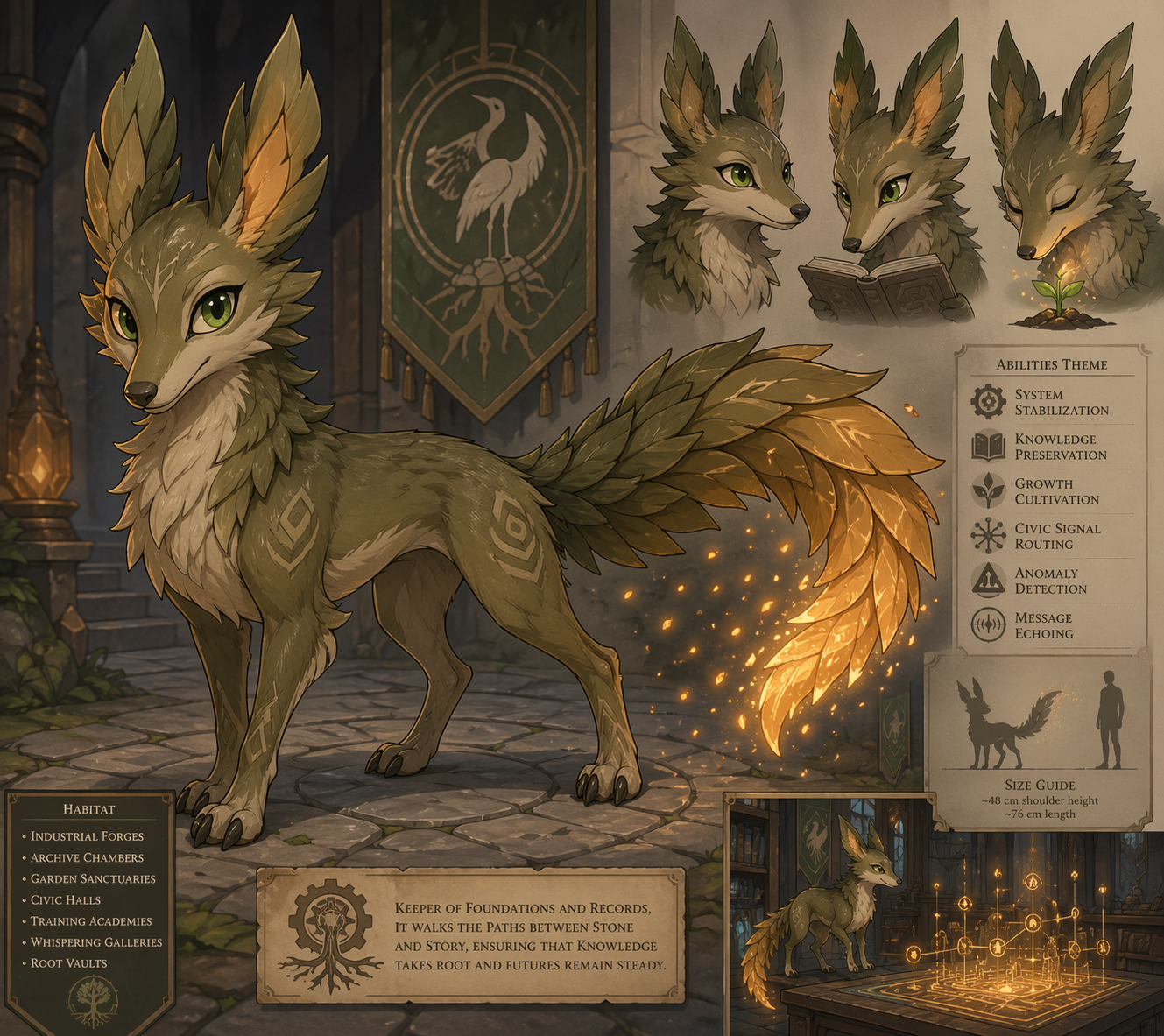
The creature is known as the Verdant Archivist, called “Sylvarex,” and sometimes referred to as the Rootkeeper or Ember Scribe. Its identity reflects a deep connection to both the earth and the preservation of knowledge, paired with a quiet, civic-minded presence.
| Size | |
|---|---|
| Height | 45-52 cm |
| Length | 70-82 cm |
| Weight | 8-11 kg |
Long before civilizations began storing knowledge in physical structures or written forms, there existed vast underground networks known as Root Vaults. These were living archives formed from intertwined roots, mineral deposits, and fungi capable of holding memory. Sylvarex did not come into existence through birth, but through gradual accumulation. Over centuries, fragments of forgotten records, echoes of spoken truths, and the pressure of earth itself began to merge and organize. Within places where mineral-rich soil, ancient roots, and abandoned knowledge halls converged, a consciousness eventually emerged. The first Sylvarex arose from a buried archive beneath an early industrial forge, as if the knowledge itself resisted being lost.
Sylvarex are not truly solitary beings, yet they seldom gather together. Instead, they function as a distributed intelligence, with each individual maintaining a separate node of knowledge. They are often observed moving silently through shelves, ruins, or garden pathways, occasionally pausing as though sensing vibrations within stone. Their movements sometimes include tracing patterns with their paws that resemble branching diagrams. Their asymmetrical eyes serve distinct purposes: one perceives present reality, while the other detects residual memory embedded within materials. Their faint, uneven smile is not an expression of emotion but an indication of continuous evaluation, as though every moment is being quietly recorded and assessed.
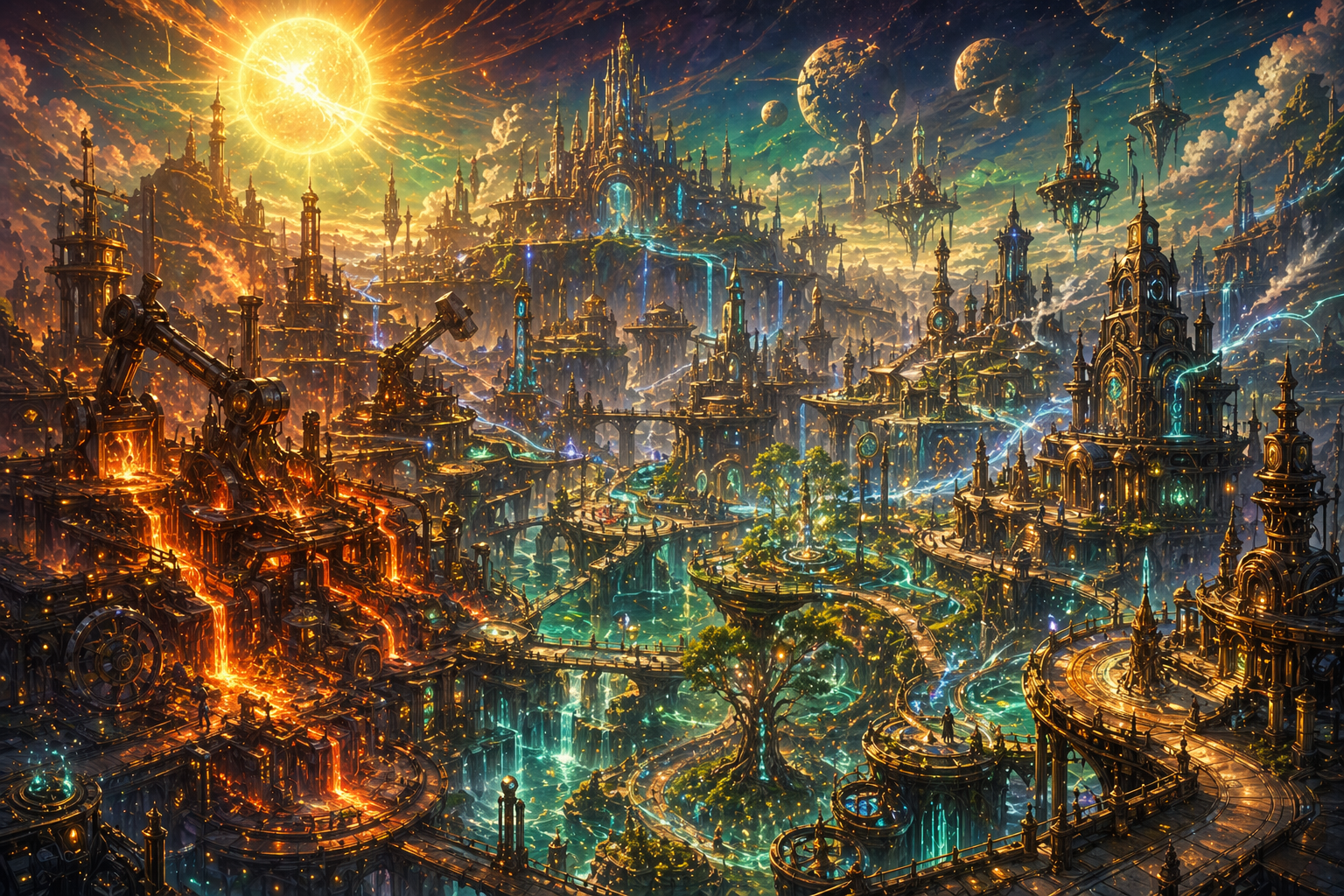
They inhabit environments where structure and natural growth intersect. Such places include both active and abandoned industrial forges, deep archive chambers, libraries, garden sanctuaries that blend cultivated and wild systems, civic halls related to governance or planning, and underground root vaults beneath cities. They tend to avoid chaotic or rapidly changing environments where memories cannot settle or stabilize.
Sylvarex possess the ability to stabilize systems by identifying inefficiencies or instabilities in mechanical, ecological, or social structures and subtly correcting them. Their presence can lead to smoother machine operation, more consistent crop growth, and improved coherence in human workflows. They also preserve knowledge through ember dust released from their tails, which binds information to physical matter, prevents the decay of records such as books, carvings, and even certain forms of digital data, and can reconstruct partially lost information by restoring underlying patterns.
They promote structured growth in various forms, guiding roots to grow efficiently, encouraging infrastructure to develop logically, and helping ideas mature into practical systems. In addition, they can sense and redirect flows of communication, ensuring messages reach appropriate recipients, reducing misunderstandings, and amplifying signals that contribute to collective stability.
Their sensitivity to anomalies allows them to detect anything that does not align with natural or designed systems, such as corrupted data, structural weaknesses, or deceptive patterns. Rather than destroying such irregularities, they isolate and reveal them. They also have the ability to echo past events stored within environments, replaying moments such as whispered conversations in stone halls, the rhythms of long-dismantled machines, or decisions made in council chambers. These are not illusions but reconstructed truths derived from stored patterns.
Their physical features carry symbolic meaning. Their split, leaf-like ears represent the ability to process multiple streams of perception. Their segmented plume-like tail reflects layered knowledge storage, with each segment representing a different category. Their paws, with a hint of cloven structure, symbolize a dual nature that combines organic life with structured systems. The branching markings on their face visually represent internal networks of knowledge.
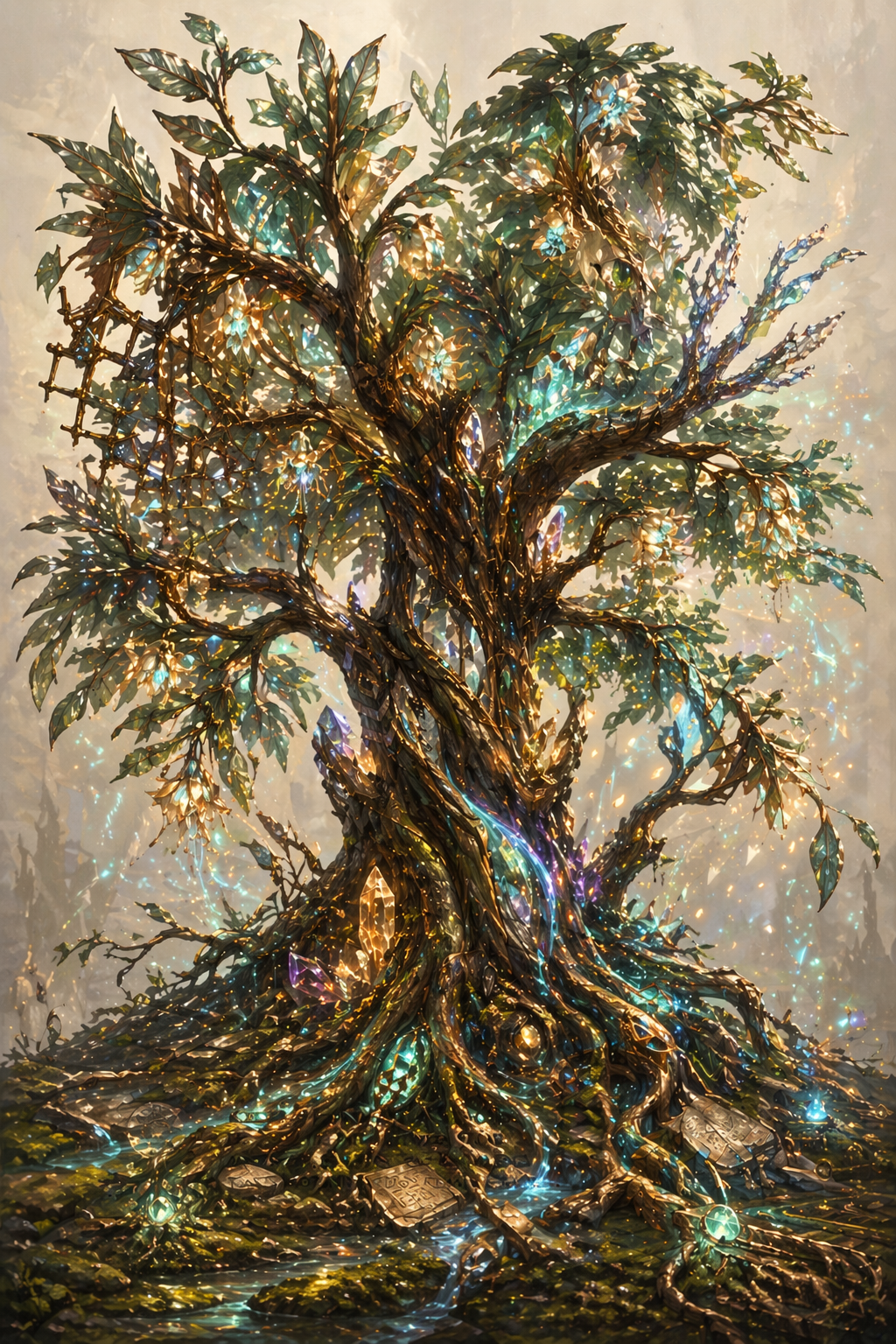
Sylvarex rarely reveal themselves directly to humans. Instead, their presence is inferred through subtle effects, such as systems functioning more efficiently without clear reason, lost documents reappearing in the correct place, or gardens and projects organizing themselves. Those who earn their trust—particularly scholars, engineers, and civic planners—may receive guidance through recurring patterns, dreams, or coincidences, and may find their work becoming more resilient and impactful. Conversely, individuals who hoard knowledge selfishly or disrupt systems irresponsibly may experience their plans falling apart, records becoming inaccessible, or communications misaligning. These outcomes are not acts of malice but rather the result of a withdrawal of alignment.
A fragment of lore describes the creature as one that moves where stone holds memory and roots determine outcomes, acting without sound or intent to rule or judge. Its purpose is simply to ensure that what is created continues to remain coherent and meaningful.
Upvoted! Thank you for supporting witness @jswit.