Why Semiconductor Stocks Just Fell 20% While the Rest of the Market Barely Blinked
The Headline Move:: While most of Wall Street had a rough week, one sector got hit far harder than the rest. Chips' plunge continued Friday morning, sending a shudder through the broader market and putting the semiconductor index on track for a 20% decline from its recent highs. That is a full-blown correction inside a single sector, happening while the overall market only dipped modestly.
For context on the scale of the pullback: stocks fell again Friday, with the S&P 500 losing 1.01% to close at 7,457.69, while the Nasdaq Composite dropped a sharper 1.4% to 25,520.24 as tech stocks came under scrutiny, and the Dow fell 406.55 points. Zoomed out to the full week, the S&P 500 was off 1.6%, the Nasdaq slid 2.9%, and the semiconductor ETF just posted its third straight weekly decline.
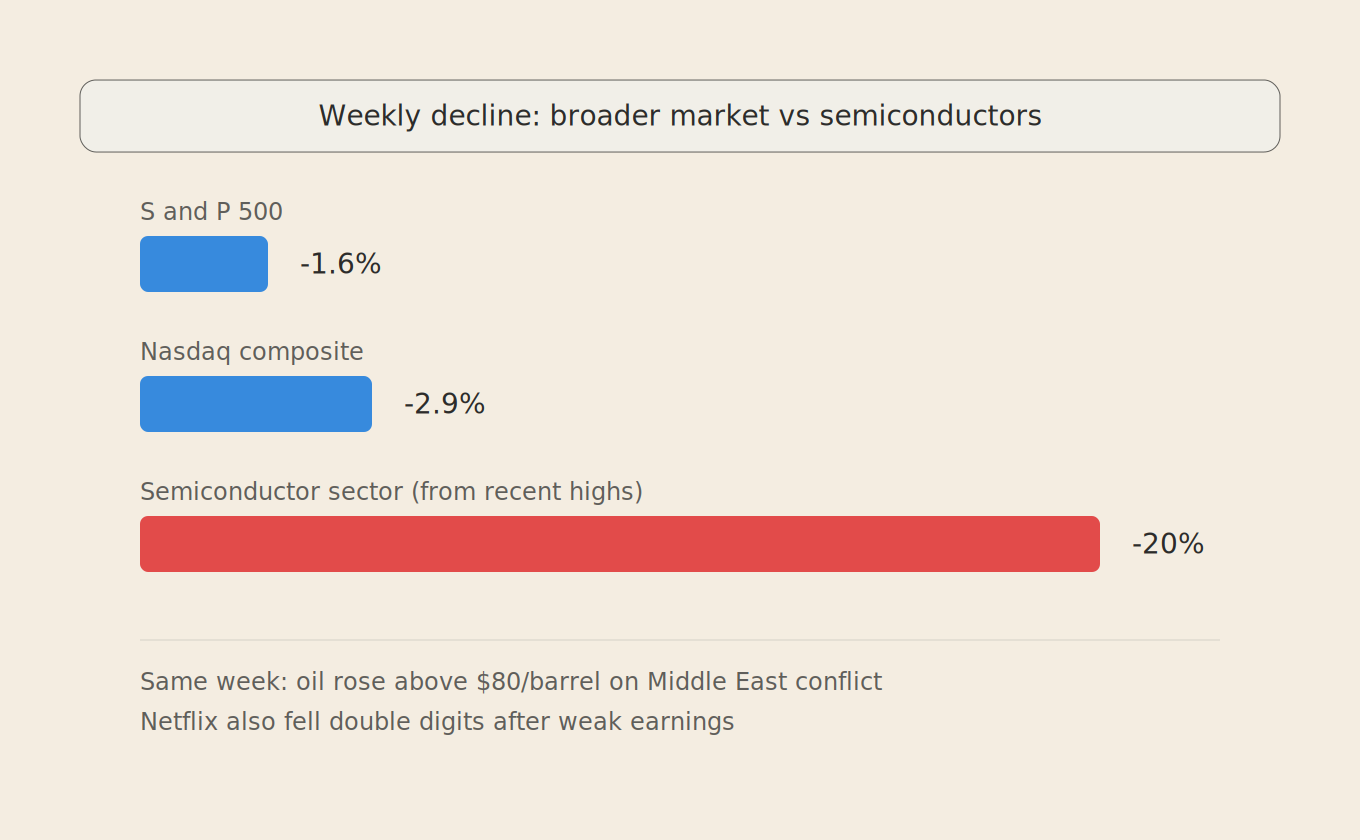
Three things collided at once::
A sector-specific unwind. Chip stocks had been on an extraordinary run in 2026, driven heavily by AI infrastructure spending. When a sector runs that far, that fast, profit-taking hits hardest exactly there — which is why chips are down 20% while the S&P is only off single digits.
Oil spiking on renewed Middle East conflict. The same week chips were falling, oil rose 2% to above $80 per barrel as conflict intensified in the Middle East — adding a second, unrelated pressure point onto risk assets at the same time.
A disappointing mega-cap earnings miss. Netflix suffered double-digit losses after earnings disappointed, adding to concerns about engagement pressure from competing platforms — a reminder that even "safe" mega-cap tech isn't immune when growth stories wobble.
Why This Matters for Traders (Not Just Investors)
This is a textbook example of sector rotation — money doesn't just enter or exit "the market," it rotates between sectors based on which story is working. When AI/chip stocks became overcrowded, the correction wasn't gentle; concentrated positioning made the drop faster and steeper than in the broader index.
For active traders, three lessons stand out from this week:
Watch relative strength, not just the headline index. The S&P 500 losing 1% tells you almost nothing about a sector falling 20% underneath it. The real story is always one layer beneath the index.
Correlated risk hits fast. Chips, oil-driven inflation fears, and a mega-cap earnings miss all landed in the same week — that's not coincidence, that's how risk-off periods actually happen: multiple pressures compounding, not one clean cause.
A "third straight weekly decline" is a trend, not a blip. One red week can be noise. Three in a row in the same sector is a pattern worth respecting, whether you're trading it or staying out of it.
Takeaway for Learners::
The market rarely falls or rises as one single block — it falls in layers, and the sector at the top of the last rally is usually the one that falls hardest first. If you only watch the S&P 500 number, you'll miss where the real move is happening. This week, that was semiconductors.
Let's learn together!