Tartary and Empire of Tartary's Flags as recorded in 18th Century.
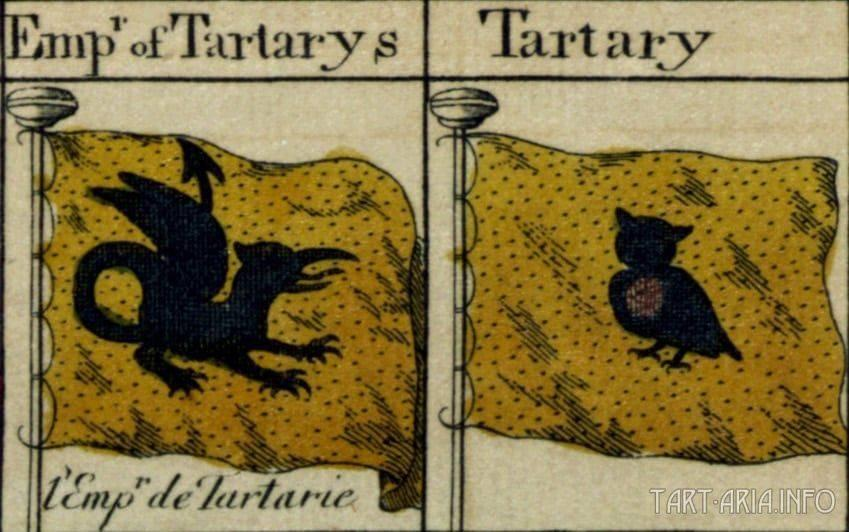
This
image depicts the historical flags of Tartaria as documented in an
18th-century maritime flag chart. Specifically, it originates from
Bowles's Universal Display of the Naval Flags of All Nations in the
World published in 1783.
The
Emperor of Tartary ("Emp' of Tartary s"): The left flag
displays a black dragon-like creature on a yellow field. This design
shares deep visual roots with the mythical Zilant (a winged dragon or
basilisk), the historical symbol of the Khanate of Kazan and
modern-day Kazan.
Tartary:
The right flag displays a black owl on a yellow background. Early
European geographers frequently attributed the owl symbol to
north-eastern Asian peoples.
In
recent years, these specific illustrations have circulated heavily
within the "Tartaria conspiracy theory" subculture online.
Believers often point to these 18th-century flag charts as supposed
"evidence" that a technologically advanced, globally
dominant empire was erased from mainstream history textbooks. In
factual history, the map and chart labels simply denote regional
geography and ethnic groupings rather than a single lost superpower.
The
widespread appearance of the Tartary flags across dozens of 18th and
19th-century charts is completely real, but it stems from a
widespread practice of historical plagiarism and copying rather than
multiple independent accounts from the ground.
During
the early modern print era, publishers continuously copied entries
directly from one primary source for over 150 years.
It
seems contradictory that a generic geographical term would possess
official state flags.
The
answer lies in understanding how 18th-century European mapmakers and
flag-chart publishers operated, which differed heavily from modern
vexillology:
1. Old Flag Charts Were Often Speculative or Outdated
Early
modern cartographers and printmakers did not have international
regulatory bodies to verify flags. When compiling a comprehensive
"Universal Display of Flags", publishers heavily relied on
centuries-old travelogues, heraldic rumours, or descriptions of
regional rulers.
The
Dragon Flag: This was actually an adaptation of the personal emblem
of the Khans of the Golden Horde and the Khanate of Kazan (a region
annexed by Russia in the 1500s). Publishers simply kept copying the
design onto charts for centuries.
The
Owl Flag: This stemmed from early European accounts attributing the
owl to various nomadic tribes of north-eastern Asia.
2. Attributing "Imperial" Trappings to Foreign Regions
European
vexillologists and mapmakers frequently forced foreign, non-Western
political systems into a European framework. If a vast region like
northern Asia existed, Westerners assumed it must have an "Emperor"
(the Grand Cham or Khan) and that this leader must fly an imperial
standard.
3. A Focus on Geography over Sovereignty
In
the 1700s and 1800s, flag charts frequently assigned symbols to broad
geographic or ethnic territories rather than strict, bordered
nation-states. You will regularly find flags for regions that were
never centralized countries on the same historic charts,
including:"Patagonia""California" (long before it
became a U.S. State or independent republic)"Lapland"Essentially,
the chart is not stating, "Here is a sovereign, unified
nation-state called Tartary." Rather, it is saying, "If you
sail to the vast coastlines of northern/central Asia, travellers and
old merchant records report these are the banners used by the local
populations or their historical regional rulers."
(I
SOMETIMES FEEL WE ARE BEING GIVEN A LOT EXCUSES AND A LOT ATTEMPTS TO
RATIONALIZE AND PLAY DOWN REAL HISTORICALLY ACCOUNTS).
https://payhip.com/ForgottenHistoryWM80
The Last of the Old World Giants looks at the hidden relatively recent history of Giants! Over 100 giants researched, named and remembered. Many more are remembered only due to photographs that exist and are sometimes hidden by archive vaults. Tartaria and Tartarian giants, Circus and Military Giants, Giants in 18th and 19th century newspapers, Giants remains found and reported by the media. Giant Warriors, Giants in Siberia, Giants in Asia, Magog and Gog, Gargantua AND MUCH MORE.. Over 800 pages, tons of photographs.
https://payhip.com/b/WT24o The Last of the Old World Giants.. Better quality unlimited shares.
The Last of the Old World Giants https://payhip.com/b/zX9oW
The Last of the Old World Giants looks at the hidden relatively recent history of Giants! Over 100 giants researched, named and remembered. Many more remembered only due to photographs that exist and are sometimes hidden by archive vaults. Tartaria and Tartarian giants, Circus and Military Giants, Giants in 18th and 19th century newspapers, Giants remains found and reported by media. Giant Warriors, Giants in Siberia, Giants in Asia, Magog and Gog, Gargantua AND MUCH MORE.. Over 800 pages, tons of photographs.