Unearthing Layers of Time: Three Essential History Tours of Moldova.
Nestled between Romania and Ukraine, Moldova is a nation where history is not merely recorded in books but etched into the very landscape, whispered in the cellars of its wineries, and carried in the memory of its people. For the traveler seeking to move beyond the surface, Moldova offers profound, thematic journeys into the chapters that have defined its complex identity. Three tours, in particular, are indispensable for understanding this resilient country: a Soviet-era exploration, a Jewish heritage pilgrimage, and a tour of its ancient fortresses. Each provides a unique lens on triumph, tragedy, and endurance.
- The Soviet Moldova Tour: Life Behind the Iron Curtain
This tour delves into the nearly five decades (1944-1991) when Moldova was the Moldavian Soviet Socialist Republic. It’s an exploration of how ideology shaped architecture, daily life, and the national psyche. Let us look at the Soviet Moldova tour.
What to Expect & See:
This is an immersive tour of contrasts, moving between grandiose monuments and stark reminders of control.
The Architecture of Power: Your tour will begin in the capital, Chișinău. You’ll see the monumental Government House on Stephen the Great Boulevard, a prime example of Stalinist architecture, and the vast, planned suburbs of Botanica and Râșcani, with their endless, identical Khrushchyovka apartment blocks. These represent the Soviet promise of modern housing and the reality of uniform, cramped living.
Sites of Control & Memory: A central stop is the former KGB headquarters, an unassuming building that was the heart of surveillance and repression. Guides will explain the pervasive fear it instilled. You’ll visit the Eternity Memorial Complex (Memorialul Eternitate) commemorating Soviet WWII victory, a site that remains politically charged. The tour often includes the massive Moldexpo exhibition grounds and the circus building, quintessential Soviet public works meant to showcase progress and provide state-sanctioned leisure.
Everyday Life & Underground Secrets: The experience deepens with a visit to the Moldova City Museum, which often has exhibits on Soviet daily life. The most unique element may be a descent into one of Chișinău’s mysterious underground shelters or a tour of the former secret bunkers near the airport, built for the political elite. Guides will paint a picture of the "queuing culture," the black market, and the subtle ways Moldovans preserved their language and traditions in private.
The Takeaway: This tour leaves you with a nuanced understanding of the era’s paradox: the security and predictability provided by the state versus the stifling oppression, cultural Russification, and economic stagnation that ultimately defined it.
- The Jewish Heritage Tour: From Vibrant Shtetl to Silent Memory
This poignant tour traces the arc of one of Europe’s most vibrant Jewish communities, from its flourishing in Bessarabia to its near-total annihilation in the Holocaust, and the fragile threads of memory that remain.
What to Expect & See:
This is often an emotional journey of discovery, uncovering traces in places where entire worlds were erased.
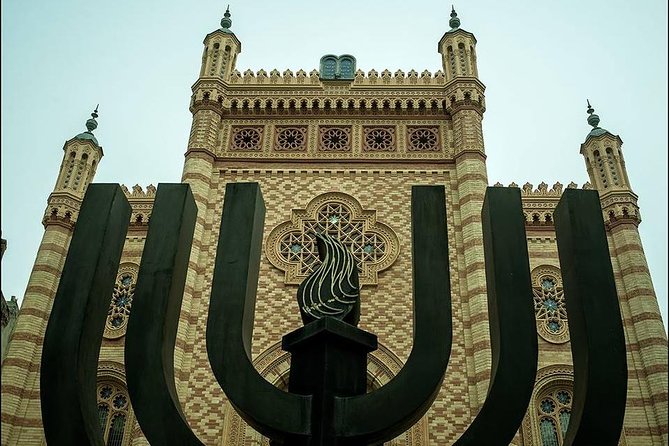
Chișinău’s Lost "Little Jerusalem": The jewish Heritage Moldova tour begins by reconstructing the pre-war Jewish district. You’ll visit the magnificent Choral Synagogue, a working synagogue that survived both the war and Soviet era as a theatre. The adjacent Jewish Community Center and Holocaust Museum houses vital artifacts, photographs, and maps that tell the story of a community that once made up nearly 50% of the city. Your guide will point out the empty spaces where dozens of other synagogues, schools, and markets once stood.
Memorials to Tragedy: A solemn visit is made to the Holocaust Memorial on Ierusalim Street—a shattered menorah sculpture on the site of the WWII ghetto. The tour may then travel to the outskirts, to the Pădurea Domnească (The Princely Forest), a chillingly beautiful place where thousands of Chișinău’s Jews were massacred in 1941. The quiet of the forest is the most powerful testament.
The Heritage in Stone: The Cemeteries: No Jewish heritage tour is complete without visiting the vast, hauntingly beautiful Chișinău Jewish Cemetery, one of Europe’s largest. Walking among the elaborate, sometimes crumbling tombstones inscribed in Hebrew, Yiddish, and Russian is to walk through a silent city, a tangible archive of a once-great civilization.
The Takeaway: This tour is an act of witnessing. It balances deep sorrow with a celebration of the immense cultural and economic contributions of Moldovan Jewry. It leaves you with a profound sense of loss but also a respect for the dedicated few working to preserve this vital history.
- The Medieval Fortresses Tour: The Bones of the Nation
To understand Moldova’s origins and its historic role as a borderland between empires, a tour of its medieval fortresses is essential. These stone sentinels tell tales of the Moldavian Principality, Ottoman invasions, and Polish ambition.
What to Expect & See:
This tour takes you into the countryside, to the strategic points that defended the ancient state.
Orheiul Vechi (Old Orhei): More than a fortress, this is an open-air museum complex and Moldova’s most stunning historical site. You’ll hike a ridge overlooking the Răut River’s dramatic meander to see the ruins of a 14th-century Tatar-Mongol fortress, later used by Moldavian voivodes. The site also includes a perfectly preserved 15th-century Orthodox monastery carved directly into the cliff face and an ethnographic museum in a traditional village. The views are breathtaking, connecting landscape to history.
Soroca Fortress: Known as the "Gypsy Hill" fortress for its location in a prominent Roma community, this is a perfectly preserved 16th-century stone fort built by Stephen the Great’s successor. Its unique concentric circular design is a masterpiece of late medieval military architecture, built to withstand Ottoman cannon fire. Standing on its walls overlooking the Dniester River and the breakaway region of Transnistria offers a powerful lesson in Moldova’s enduring role as a frontier.
Tighina (Bender) Fortress: Located in the pro-Russian separatist region of Transnistria (access requires a separate border crossing and local guide), this is one of Eastern Europe’s most formidable Ottoman-era fortifications. Its massive earthworks and stone bastions, built in the 16th century on older Moldavian foundations, speak to centuries of violent contest over this territory. Visiting here is a direct immersion into the geopolitical tensions that still simmer today.
The Takeaway: This tour provides the foundational narrative of Moldova as a medieval state fighting for its sovereignty. The physical endurance of these fortresses, set in dramatic landscapes, instills a deep appreciation for the nation’s ancient roots and its long history of resilience against powerful neighbors.
Together, these three tours form a complete historical tapestry. The Fortress Tour reveals the medieval genesis, the Jewish Heritage Tour exposes the devastating fractures of the 20th century, and the Soviet Tour explains the modern mold from which today’s independent Moldova is still emerging. To take them is to earn a graduate-level understanding of a country whose past is as rich and complex as its famous wine.