UAE Corporate Tax in 2026: What Free Zone Companies Actually Pay (Beyond the 0% Tax Claim)
Beyond the 0% tax promise — what every UAE founder should know.
Surely you must have heard of the following statement at least once when researching about setting up your business in UAE:
"Set up your business in UAE Free Zone and pay 0% Corporate Tax."
This is definitely an attractive statement – but it is also one of the most misunderstood aspects of business formation in UAE.
Now that Corporate Tax has been introduced by the government of UAE, commencing from 1 June 2023, innumerable entrepreneurs in UAE have been asking only one question:
Will my Free Zone Company pay 0% Corporate Tax?
While some articles clearly state the answer as "Yes," others take the opposite view and say that there is no tax exemption now. None of these answers depict the law accurately.
In essence, however, it is quite pragmatic. The United Arab Emirates still ranks among the nations with one of the most competitive tax systems, although the 0% tax rate applies only conditionally. In other words, whether or not your company enjoys the lower tax rate depends on many factors, among others the kind of revenue you generate, where your clients are based, and whether or not your company meets all the requirements that make it qualify as a QFZP (Qualifying Free Zone Person). By understanding your UAE Corporate Tax obligations prior to establishment, you are able to pick the appropriate business entity from the get-go.
This guide aims at presenting the rules in plain language. Whether you are thinking of setting up a consulting firm, engaging in international trade, starting a SaaS company or investing via a holding company, you will understand the real taxes payable by free zone companies in 2026.
Why the "0% Corporate Tax" Claim Creates So Much Confusion
Prior to the implementation of Corporate Tax, a lot of businesses felt that being situated in a UAE Free Zone automatically meant that they do not have to pay corporate income tax.
That assumption now no longer reflects the current framework.
Today, there are three important facts every entrepreneur should know.
Fact 1: Free Zone companies are part of the UAE Corporate Tax system
Just because a company is registered in a free zone does not mean that it is exempt from corporate tax. Generally speaking, free zone companies are required to comply with the corporate tax law and need to determine whether they are eligible for the privilege of a special 0% rate available for the Qualifying Free Zone Persons.
Fact 2: The 0% rate applies only in specific situations
The UAE continues offering considerable tax benefits for free zone businesses which are eligible for this savings option. However, to benefit from this option, businesses are required to meet legal requirements and generate Qualifying Income.
Income that falls outside those rules may be taxed differently.
Fact 3: Compliance matters more than ever
More and more entrepreneurs concentrate just on the tax rate.
Experienced accountants focus on something else:
Proper bookkeeping
Accurate financial records
Transfer pricing compliance
Meeting free zone requirements
Filing corporate tax returns on time
These compliance obligations play a major role in preserving eligibility for the 0% regime.
Understanding UAE Corporate Tax in Simple Terms
The UAE Corporate Tax system is purposely designed to be simple in comparison to other regions.
There are three main headline rates of UAE Corporate Tax:
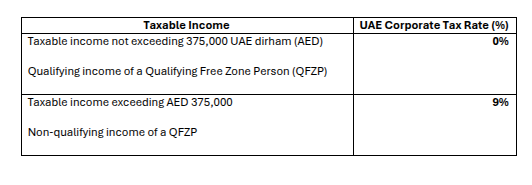
This is the usual rate of corporate tax for businesses in the UAE under the federal system. And then there is also the issue of businesses operating in free zones being able to pay the 0% corporate tax on Qualifying Income if the QFZP requirements are met.
The common misconception about free zones is that since companies earn profits in them, they don’t have to pay taxes. However, in truth, you need to first determine if your company falls under the free zone system and if the income you earn is qualified income.
What Is a Qualifying Free Zone Person (QFZP)?
The most essential notion in the free zone corporate tax regulation in the UAE.
There are more than 40 Free Zones working in the UAE, and every one of them was set up for certain industrial and commercial purposes. The most popular include the Dubai International Financial Centre (DIFC), Jebel Ali Free Zone (JAFZA), Dubai Airport Free Zone (DAFZA) and Ras Al Khaimah Economic Zone (RAKEZ). Despite the fact that every Free Zone has its own licensing authority and regulations, the rules of Qualified Free Zone Persons under UAE Corporate Tax system are used according to the federal Corporate Tax system.
A Qualified Free Zone Person (QFZP) is a free zone company which meets certain legal conditions established by the Corporate Tax Law and decisions.
Only those companies that comply with all these conditions are able to enjoy 0% Corporate Tax rate on qualifying income.
While legal texts are quite long, the requirements can be clearly presented as five basic principles.
- The company must genuinely operate in a free zone
Simply incorporating the business is not enough. The firm needs to make sure that it runs its operations as a free zone business and remains in compliance with the regulations laid out by the free zone authority within which the firm operates. The trade license must be kept valid and renewed on time. Further, it should maintain appropriate office facilities (where applicable) and perform activities as listed in the trade license. In essence, what is expected by the UAE from those businesses that enjoy the benefits of the free zone tax system is that they maintain a commercial presence rather than being a shell company. Additionally, continued compliance with the free zone authority requirements would enable them to qualify as QFZP.
- The company must have adequate substance
The UAE wants businesses benefiting from Free Zone incentives to carry out genuine commercial activities.
Depending on your business, this may involve:
Office facilities
Employees
Operational expenses
Active management
Day-to-day business activities
The level of substance expected varies depending on the nature of the business.
- The business must earn Qualifying Income
This is precisely where most people get confused with the tax laws. Running a company within a Free Zone doesn't necessarily imply that all the income generated by your company is exempt from Corporate Tax at 0%.
The corporate tax rate will depend on the kind of income generated by your business and its source and not only on the location where the company is registered. According to the UAE Corporate Tax law, there is a difference between Qualifying Income, which may possibly be exempt from Corporate Tax at 0% for QFZP, and the non-qualifying income, which could be taxable based on the Corporate Tax Law.
Let's discuss this a bit more later.
- The company must comply with transfer pricing requirements
Transactions between your business and any related party or connected person will generally be based on the arm's length rule. That means that the pricing is based on what independent enterprises would agree under comparable circumstances.
It is not going to necessitate any complicated restructurings for small businesses but only proper documentation is required.
- The business must meet corporate tax compliance obligations
Qualifying for 0% doesn't mean ignoring tax administration.
Eligible businesses may still need to:
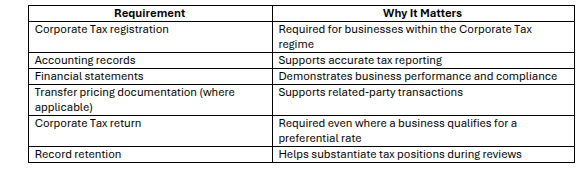
Register for Corporate Tax
Maintain accounting records
Prepare financial statements
File Corporate Tax returns
Keep supporting documentation
The UAE's tax incentives reward compliant businesses—not businesses that ignore reporting obligations.
What Counts as Qualifying Income?
This is where the discussion becomes far more practical.
Instead of asking:
“Is my business located in a free zone?”
the more pertinent question should be:
"What type of income is my business earning?"
The legal distinction is made between Qualifying Income and Non-Qualifying Income which do not have a preferential tax rate of 0%. The segments of income classified as such are provided in the rulings of the Cabinet and the Minister of Financial Affairs, and elaborated upon by the Federal Tax Authority.
Some of the most common ones are listed below.
International Trading Company
To fall under the category of income-qualifying activities when a free zone company purchases items from one country and then resells them in another, the company needs to meet specific requirements.
Holding Company
Generally, holding company structures in UAE generate dividends and capital gains through investments in permissible areas. Based on the facts and regulations that apply, such structures can keep benefiting from the tax-favorable environment in UAE. The assessment will have to be conducted on a case-by-case basis.
Software-as-a-Service (SaaS)
A SaaS firm with an international clientele can be eligible for favorable conditions if it meets the QFZP criteria and the income generated is permissible. Ultimately, it all depends on the business model rather than being just a technology business.
Business-to-Business Services
There are many consulting, technology, engineering, logistics, and other professional services companies which have businesses in Free Zones.
The qualification of the income received by such companies would depend on:
Customer identity
Location of the customer
Qualification of the activity itself
Excluded activities
That is why even two companies with similar licenses might not receive the same Corporate Tax treatment.
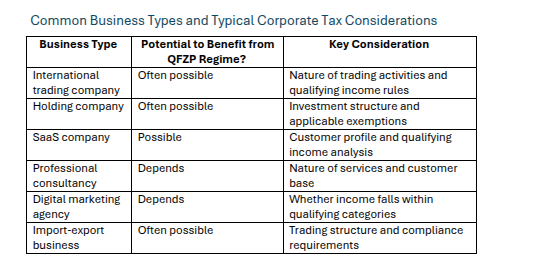
Each and every business should be assessed based on its actual activities rather than its licence name alone.
When Does a Free Zone Company Actually Pay 9% Corporate Tax?
This is the question that every businessperson faces sooner or later.
The answer is quite simple:
A Free Zone company does not automatically lose its tax benefits simply because Corporate Tax exists. However, not every dirham of income necessarily qualifies for the 0% rate.
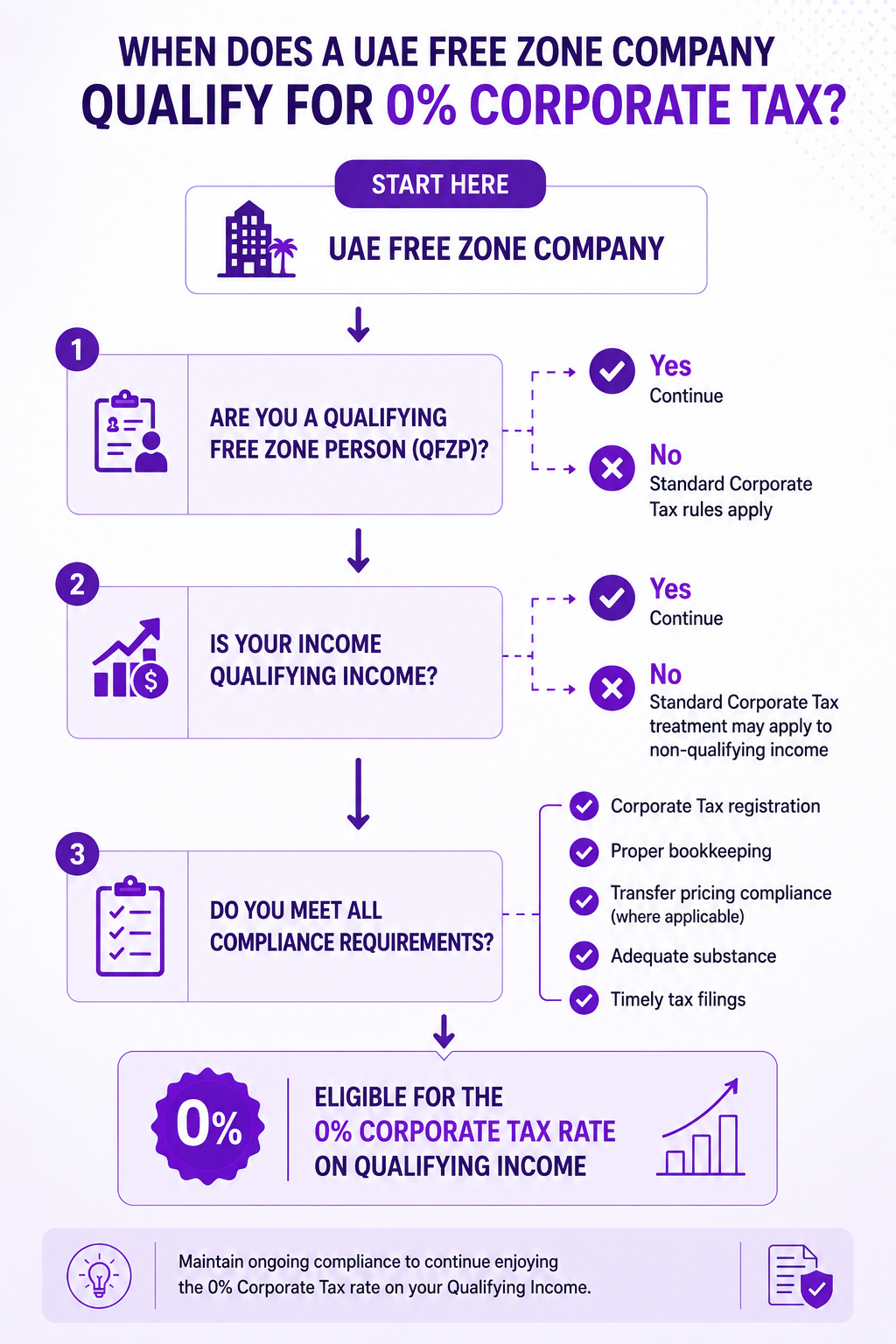
The three aspects of the tax position of a business firm are:
If it is a QFZP
If it earns qualified income
If it satisfies all the criteria throughout the tax period
When any one of the above criteria is not fulfilled, the company will be required to adhere to the UAE Corporate Tax Laws.
It is now time for us to discuss the situations where the companies interpret the laws wrongly.
Scenario 1: You mainly sell to overseas customers
In the case of the software development company working in an UAE Free Zone.
The customer base is situated in:
Germany
Singapore
Australia
Canada
And the business carries out the software development process in Dubai and charges from the non-UAE customers. Such business can still qualify for the 0% tax if the requirements of QFZP are met.
It should be noted that it is immaterial where the business owners live but what kind of revenue the business earns.
Scenario 2: Your Customers Are UAE Mainland Businesses
Some advisors still advise their clients:
"You can’t trade with the mainland."
This is incorrect.
The entities that are established within the Free Zones are eligible for doing business with the companies that are located on the mainland.
But the implications of the Corporate Tax would depend on the type of activity being done and its qualification under the Qualifying Income.
That’s why the very same consultants may have completely different results under the Corporate Tax, despite having the very same licenses.
Scenario 3: You Earn Non-Qualifying Income
In case there is a hypothetical situation wherein there are profits made by an enterprise from Free Zones which cannot be considered to fall under exemption status.
Analysis needs to be done by the firm on how that profit is going to be treated in terms of the Corporate Tax. This is the reason why many entrepreneurs hire professional advice for UAE business structuring before setting up their businesses. In this way, they will be able to select the right jurisdiction and the tax treatment of different business activities.
Apart from this, companies have to adhere to de minimis criteria as laid down by the Corporate Tax rate. Failing to do so might mean getting QFZP status for some businesses.
This is the reason why it is important for companies to constantly analyse their income profile rather than waiting for the period of filing the tax return.
The "0% Tax Forever" Myth
Possibly one of the greatest misconceptions is the idea that once you have obtained the free zone license you will definitely be having a 0% corporate tax. It is not the case at all since your qualification for this benefit is determined continually based on your level of compliance with the corporate tax rules.
You should keep:
Accounting books properly
Timely submission of Corporate Tax Returns
Comply with transfer pricing rules
Performing qualifying activities
Substance test requirements
Follow Free Zone rules
This benefit is provided to companies which really operate and comply with tax laws in the UAE and not simply the ones which have this license.
Real Business Examples
Rather than looking into tax jargon, we can try to see how different business models may be accommodated within the scope of Corporate Tax.
Please note that the following examples are provided for illustrative purposes only and do not constitute tax advice.
Example 1: A Digital Marketing Agency
The marketing firm is operating from the Free Zone. The clients are:
Companies from the UK;
Startups from the USA;
Technology firms from Singapore;
The firm hires staff from Dubai, rents office space, maintains account books, and pays corporate tax. Whether it can qualify for the 0% rate depends upon the nature of its income.
Example 2: An International Trading Company
The organization buys electronic items from South Korea and sells them to distributors located in Africa.
These products are never sold in the UAE domestic market.
International trading organizations are some of the companies that stand to gain from the Free Zone regime if they meet the qualifying income legislation criteria.
Example 3: A Holding Company
The holding company is a firm with interests in operating firms distributed in different countries.
The major income-generating resources of such a company are:
Dividends
Capital gains
Investment income
In spite of the restrictions concerning participation exemptions and free zones, holding companies still enjoy all the advantages of their tax benefits.
Since investment schemes can be rather complicated, it is especially helpful to consult professionals in this matter.
Example 4: A Business Consultant
The consultant works from the free zone office and serves companies from abroad as well as from the United Arab Emirates. As opposed to the common misconception found in various online publications, there is no universal solution here.
The result of the Corporate Tax depends on:
The type of services
The client’s profile
Whether the revenue is eligible
Compliance with QFZP requirements
This proves that tax planning is very important prior to billing the clients.
Common Compliance Requirements for Free Zone Companies
Understanding the Costs Beyond Corporate Tax
Corporate Tax forms only a small part of the overall finances of entrepreneurs. Additionally, there are the expenses associated with the maintenance of compliance of the UAE company.
There are expenses which are required by government and regulations, and then there are those which will depend on the free zone and the size of the company.
Typical Ongoing Business Cost Components
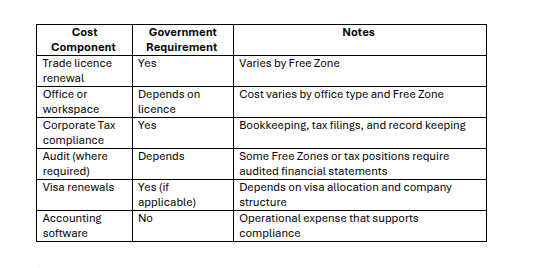
It is worth noting that licensing fees, visa fees and office expenses will vary in different free zones. Founders are advised to acquire up-to-date quotes from the respective Free Zone authority since prices are subject to change.
Choosing the Right Office Setup
One question often posed by founders is:
"Is it possible to rent the cheapest desk possible?"
This is dependent on the structure of your business.
Despite the popularity of flexible space solutions, companies must take care to make sure their office layout align with economic substance requirements.
Office Options
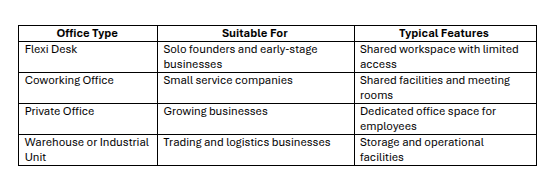
What's best for your company isn't necessarily what's cheapest. It's the one that supports your business activities and regulatory obligations.
Five Questions Before Choosing a Free Zone Structure
Instead of asking if the Free Zone is “tax-free,” consider these five questions first.
- Who are my customers?
Are they mostly foreign?
Are they mostly UAE-based?
Or is it a mix of the two?
- What type of income will I earn?
Software?
Consulting?
Trading?
Holding investments?
Different activities may receive different treatment.
- Will I maintain proper accounting records?
Tax compliance for corporations starts with good record keeping, not at the end of the financial year.
- Does my business have genuine operations?
Factors like office space, staffing, management and commercial activity help prove that a business is genuinely operating.
- Can I continue complying as my company grows?
Many founders concentrate on setting up.
Successful businesses focus on long-term compliance.
Common Mistakes to Avoid
After speaking with business owners and reviewing public guidance, several recurring misconceptions stand out.
Believing every Free Zone company automatically pays 0%
The preferential rate is available only where the legal conditions are satisfied.
Ignoring bookkeeping
Good accounting isn't just useful for investors—it is fundamental to corporate tax compliance.
Assuming tax planning ends after incorporation
Business models evolve
Customer locations change
Revenue streams expand
Your corporate taxation situation may need to be reassessed as your business expands.
Copying another company's structure
Just because another software company qualifies for a particular tax treatment doesn't mean yours will.
The facts always matter.
Financial Transparency Is Now a Competitive Advantage
Among the most significant changes that have come with the UAE Corporate Tax system is not the implementation of a tax rate.
What's important is the new financial transparency.
Organizations that have:
accounting practices,
financial statements,
competent governance framework,
commercial documentation,
will find tax compliance easier than organizations struggling to recreate years worth of records based on a tax notice.
For many founders, this has been a positive development. Better financial records don't just support tax compliance, they stand to improve budgeting, fundraising, business valuation and banking relationships in UAE.
Putting the 0% Promise into Perspective
The UAE is still considered one of the best places to do business when it comes to entrepreneurs, foreign investment and expanding enterprises. The corporate tax rate of 9% is low compared to the world standards, while the free zone regime continues to provide its benefits for businesses meeting the criteria.
However, it is no longer advisable to rely on the expression "0% tax" without actually looking into the details of the process.
The better question isn't:
"Will my Free Zone company pay tax?"
It's:
"Is my business structured and operated in a way that allows it to benefit from the UAE's Corporate Tax framework?"
For founders who understand that distinction—and who invest in proper compliance from the beginning—the UAE continues to provide a stable, transparent and internationally competitive environment for long-term business growth.
What has been your biggest challenge in understanding UAE Corporate Tax? Share your thoughts or questions in the comments below — we’d love to hear your perspective.
For more information, visit: https://www.aziend.com/corporate-tax