How US Automotive OEMs Can Reduce Warranty Reserve Costs

Introduction
Warranty reserves sit quietly on OEM balance sheets, but they are anything but passive. The moment a product leaves the factory floor, the warranty clock starts, and so does the financial exposure. For US automotive OEMs, warranty accruals have become one of the most scrutinized line items in the aftermarket P&L and for good reason.
According to Warranty Week's 2024 report, US passenger car OEMs paid out over $57.9 billion in warranty claims globally, with General Motors alone absorbing $4.47 billion and Tesla reporting $1.45 billion. These are not anomalies; they are the result of structural gaps in how warranty costs are estimated, tracked, and controlled.
The problem is not just the magnitude of the spend but how much of it is avoidable. Warranty reserves that are set too high lock up capital unnecessarily. Reserves set too low create sudden, unplanned liability exposure when actual claims outpace projections. And throughout the claims cycle, leakage from invalid approvals, missed supplier recoveries, and undetected fraud silently inflates the final number.
This blog examines where warranty reserve costs are being made, what is driving them higher in US automotive OEM operations, and how AI-powered warranty management software provides the tools to bring those numbers under meaningful control.
Key Takeaways
| Key Takeaway | Insight |
|---|---|
| Warranty reserves are growing | US automotive OEMs paid $57.9B+ in warranty claims in 2024, an 11% YoY increase |
| Manual processes inflate reserves | Without automation, OEMs over-reserve to cover unpredictability in claims volume and quality |
| Leakage is the silent cost driver | Invalid claims, missed supplier recoveries, and fraud together represent 15–30% of avoidable warranty spend |
| Predictive analytics changes the equation | AI-driven failure forecasting allows OEMs to set reserves based on real data, not conservative guesses |
| Automation shrinks settlement timelines | AI-powered claim processing reduces cycle time by 30–50%, reducing the reserve period needed |
| Intelli Warranty delivers measurable results | OEMs using Intelli Warranty report a 20% reduction in avoidable liability payouts and 60% faster dispute closure |
What Are Warranty Reserves, and Why Do They Fluctuate?
A warranty reserve is the amount an OEM sets aside on its balance sheet to cover the expected cost of future warranty claims on products already sold. Accounting standards including ASC 450 in the US, require manufacturers to accrue this liability at the time of sale, before any claim is actually filed.
The reserve calculation depends on three variables: the number of units in the field, the expected failure rate, and the average cost per repair. When any of these variables is uncertain or poorly measured, the reserve estimate drifts either too high, locking up capital that could be deployed elsewhere, or too low, exposing the finance team to a sudden accrual adjustment that disrupts quarterly results.
For US automotive OEMs, reserves fluctuate for several compounding reasons:
• New vehicle models introduce components whose failure behavior is not yet established in warranty data
• Supplier quality variation creates unpredictable defect rates across production runs
• Dealer claim behavior across large networks is inconsistent, making historical patterns noisy
• Extended warranty offerings and goodwill claims expand liability beyond the standard coverage window
• Manual claims processing makes it difficult to distinguish real claims from inflated or invalid ones, causing OEMs to reserve conservatively for worst-case scenarios
The practical consequence is that most OEMs carry higher reserves than necessary, because the downside of under-reservation, a sudden hit to earnings, is more visible and politically damaging than the quiet cost of over-reservation.
The Hidden Cost Drivers Inside Warranty Reserve Growth
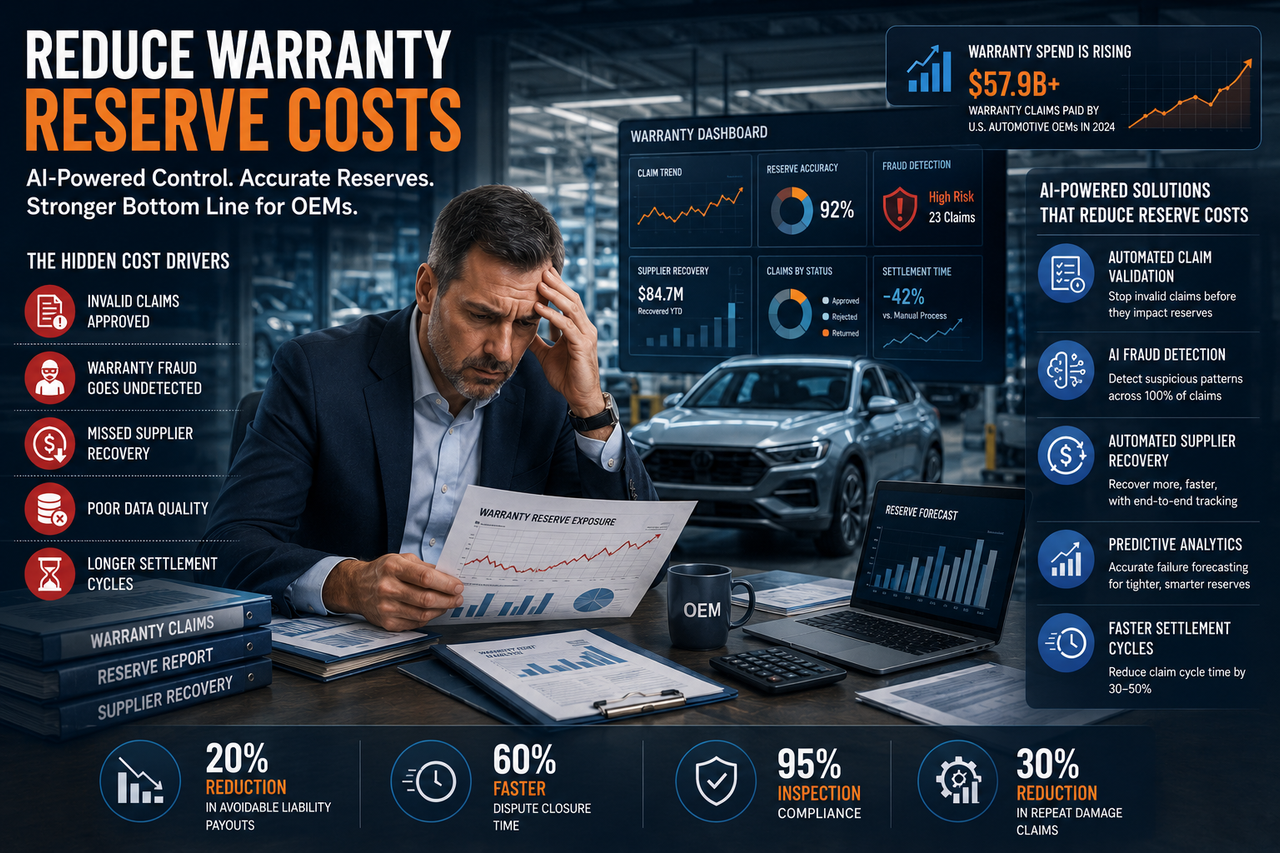
Reducing warranty reserve costs requires understanding where the actual financial exposure is being generated. Most OEM warranty teams track total claims spend. Fewer can break down precisely how much of that spend was avoidable.
Invalid Claims Approved Without Adequate Validation
In dealer networks where warranty claim validation is manual or superficial, a predictable portion of approved claims should not have been approved at all. Out-of-warranty vehicles, expired coverage windows, non-covered components, and claims with documentation gaps all pass through when review teams are processing high volumes without structured validation tools.
Each invalid claim that is approved becomes real warranty spend and it inflates the historical data that future reserve calculations are built on. Over time, invalid claims embedded in historical patterns cause reserves to be set higher than the legitimate failure rate actually demands.
Warranty Fraud That Goes Undetected
Warranty Week estimates that warranty fraud accounts for 3% to 15% of total warranty costs. At the scale of US automotive OEM operations, the midpoint of that range represents hundreds of millions of dollars annually. Common fraud patterns include inflated labor hours, duplicate submissions on the same VIN, claims filed suspiciously close to warranty expiry, and altered supporting documents.
Manual review processes cannot catch these patterns at scale only a small fraction of claims receive detailed scrutiny, and sophisticated fraud patterns span multiple claims across different dealers, making them invisible to individual reviewers. Undetected fraud enters the claims history and drives reserves higher.
Missed Supplier Recovery
When a component fails under warranty, the OEM pays the dealer and should recover that cost from the responsible supplier. In practice, supplier recovery is frequently incomplete. Recovery timelines are missed because claims are not linked to supplier codes automatically. Recovery cases lack sufficient documentation to compel suppliers to pay. And recovery workflows are often handled manually, meaning high-volume environments cause deadlines to slip and costs to be absorbed.
Unrecovered supplier costs are a direct hit to warranty reserve utilization. The OEM pays out from the reserve and does not get the offset back.
Poor Claims Data Quality Driving Conservative Reserve-Setting
Finance teams building reserve models work with the data the warranty system provides. When that data is fragmented across disconnected systems, inconsistently formatted across dealer submissions, or contaminated by invalid claims that were approved, the model output is unreliable. The response to unreliable data is predictable: add a buffer. That buffer is an excess reserve.
The better the underlying claims data, the tighter the reserve estimate can be. Cleaning up the data through automated validation, structured submission workflows, and centralized claims management is one of the highest-leverage actions available to warranty finance teams.
Reactive vs. Proactive Warranty Reserve Management: A Comparison
| Dimension | Reactive (Manual) Approach | Proactive (AI-Powered) Approach |
|---|---|---|
| Reserve calculation basis | Historical averages with conservative buffer | Predictive failure modeling by part, region, and cohort |
| Invalid claim detection | Sampling after payment | Automated validation before approval |
| Fraud detection | Manual audit of a small % of claims | AI screening on 100% of claims before payment |
| Supplier recovery | Manual follow-up, frequent missed deadlines | Automated recovery initiated at claim approval |
| Settlement timeline | Days to weeks, increasing reserve hold period | Hours, reducing the window of reserve exposure |
| Data quality for forecasting | Fragmented, noisy, inconsistent | Structured, centralized, analytics-ready |
| Reserve accuracy | Over-reserved by 10–20% to manage uncertainty | Tight to actual expected exposure |
Five Strategies US Automotive OEMs Can Use to Reduce Warranty Reserve Costs
1. Replace Sampling With 100% Automated Claim Validation
Every claim that passes through without full validation is a potential reserve inflation event. Automated claim validation checks every submission against coverage rules, VIN history, service records, and entitlement criteria, stopping invalid claims before they reach the approver and before they enter the historical data.
When validation is automated, the historical claims dataset becomes a more accurate picture of legitimate failure rates. Reserve models built on clean data carry less uncertainty, which means smaller buffers and lower reserves.
Intelli Warranty's AI-powered validation engine checks every submitted claim against warranty coverage rules, vehicle registration data, and service history automatically. Claims that do not meet entitlement criteria are flagged before approval not after payment.
2. Deploy AI-Powered Fraud Detection Across the Full Claims Volume
The move from sampling to complete fraud screening is one of the most impactful reserve-reduction levers available to US automotive OEMs. AI-based fraud detection analyzes every claim for behavioral indicators unusual repair durations, labor charges that deviate from published repair time guides, submission timing anomalies, duplicate images in supporting documents, and dealer-level billing patterns that fall outside peer benchmarks.
When fraud is caught before payment, it never enters the reserve drawdown. When fraud patterns are identified early, dealer behavior can be corrected before the pattern compounds into a large-scale leakage problem.
Intelli Warranty's machine learning algorithms monitor claim patterns across the entire dealer network in real time, flagging high-risk submissions before they reach the approval queue. Dealers with systematic overbilling patterns are identified early, allowing OEM warranty teams to intervene before the cost accumulates.
3. Automate Supplier Recovery from the Moment of Claim Approval
Supplier recovery is the most consistently under-captured area of warranty cost control in US automotive OEM operations. The solution is structural: supplier recovery should begin automatically when a claim linked to a supplier-caused defect is approved, not as a separate manual process initiated days or weeks later.
Automated recovery means no deadlines are missed, every eligible claim generates a recovery filing, and the OEM's reserve drawdown is offset more completely by inbound supplier payments. For OEMs spending hundreds of millions annually on warranty, even a modest improvement in recovery rate translates directly to reserve reduction.
Intelli Warranty's integrated supplier recovery module links approved claims to responsible supplier codes automatically, initiates the recovery workflow, and tracks recovery status giving warranty finance teams full visibility into what has been recovered and what is still outstanding.
4. Use Predictive Analytics to Forecast Failure Rates More Accurately
Reserve accuracy depends entirely on how well the OEM can predict future claim volume and cost. Traditional models use historical averages, which inherently lag behind the actual failure behavior of the current fleet. When a new model year introduces a component with a different failure profile, the reserve model built on previous history will be wrong sometimes significantly.
Predictive warranty analytics addresses this by linking claims to part-level data, supplier codes, production batches, and regional deployment conditions. When this data is unified, OEM finance teams can build reserve models that reflect what is actually happening in the field, emerging failure trends, supplier-linked defect clusters, and regional anomalies, rather than what happened in prior years.
McKinsey research on advanced warranty analytics indicates that OEMs applying predictive models to warranty data can reduce total warranty costs by approximately 15%, with a near 50% reduction in the time needed to identify systemic field issues. The reserve implication is direct: better failure forecasting means tighter reserves with smaller buffers.
5. Shorten the Claims Settlement Cycle to Reduce the Reserve Hold Period
The length of time a claim sits in process has a direct relationship to the reserve exposure that must be maintained. Unresolved claims represent outstanding liability, and the longer they stay open, the longer the reserve must be held at full value.
Automating claim routing, validation, and approval for 75–85% of claims that are routine significantly compresses settlement timelines. Industry data from MSX International suggests that only around 10% of warranty claims are thoroughly reviewed under manual processes, the rest move through with limited scrutiny. Flipping that ratio through automation means more claims are validated correctly and settled faster.
Intelli Warranty's configurable work queue assigns claims automatically based on over 40 dynamic parameters, routing routine claims for auto-processing and complex or high-risk claims to appropriate reviewers. The result is settlement timelines that compress from days or weeks to hours for the majority of claims.
How Intelli Warranty Helps US Automotive OEMs Control Reserve Costs
Intelli Warranty is an AI-powered warranty management system built for the operational complexity of OEMs with large dealer networks across the US and globally. It is purpose-built for the workflows that matter most to warranty finance teams: claim validation accuracy, fraud detection coverage, supplier recovery completeness, and the data quality required for defensible reserve calculations.
The platform delivers measurable outcomes:
• 20% reduction in avoidable liability payouts validated through OEM deployments across automotive, construction, and agriculture sectors
• 60% reduction in dispute closure time, compressing the settlement cycle and reducing reserve hold periods
• 95% inspection completion compliance, ensuring that field data feeding warranty models is accurate and complete
• 30% reduction in repeat damage claims reflecting the product improvement feedback loop that warranty analytics enables
For US automotive OEM warranty and finance leaders, the combination of these outcomes has a direct and measurable impact on the reserve line.
| Intelli Warranty's dashboard shows live claim pipeline, reserve exposure, fraud scores, and dealer performance all in one view. Book a Demo to see Intelli Warranty running on your claim data → |
|---|
Warranty Reserve Cost Reduction Across US Automotive Segments
Passenger Car OEMs
For high-volume passenger car manufacturers, warranty reserves are driven by the scale of the fleet in service, the complexity of modern electronic components, and dealer networks that span thousands of service locations. Automated validation at scale processing tens of thousands of claims monthly without proportional headcount growth is the primary lever. Fraud detection across the full dealer network is the secondary one.
Commercial Vehicle and Heavy-Duty Manufacturers
Commercial vehicle warranty reserves are amplified by the high cost-per-repair and the extended operational lives of vehicles in service. A single systemic defect in a high-hours component can generate a six-figure warranty event across a relatively small fleet population. Predictive failure analytics and early supplier recovery are the highest-value reserve reduction strategies in this segment.
EV Manufacturers
US EV OEMs face a specific reserve challenge: new battery, powertrain, and electronics components with limited failure history make forward-looking reserve models particularly uncertain. Predictive analytics that draw on telematics data, field service patterns, and real-time claims behavior can significantly improve reserve accuracy in segments where historical models simply do not have enough data to work from.
Conclusion: Warranty Reserves Are a Controllable Variable
Warranty reserve costs are not a fixed feature of OEM financial operations. They are a product of how accurately failure rates are predicted, how well invalid claims are screened out, how completely supplier recovery is captured, and how quickly the claims cycle resolves.
For US automotive OEMs, the reserve line represents both a compliance obligation and a capital management decision. OEMs that treat it as a passive accounting entry will continue to over-reserve, absorb unnecessary leakage, and miss recovery opportunities. OEMs that manage it actively with the right data, the right automation, and the right analytics carry a structural financial advantage that compounds over every model year.
The technology to manage warranty reserves this way exists now. Intelli Warranty gives US automotive OEM warranty and finance teams the platform to make it operational.
| Take Control of Your Warranty Reserve Costs
| Intelli Warranty helps US automotive OEMs reduce warranty leakage, improve supplier recovery, and set more accurate reserves measurably and at scale. Schedule a Free Demo |
|---|
Frequently Asked Questions
What is a warranty reserve, and how is it calculated by automotive OEMs?
A warranty reserve is a liability accrual set aside at the time of vehicle sale to cover the estimated cost of future warranty claims. US automotive OEMs calculate it by multiplying the number of units sold by the expected claim rate and the average cost per repair typically drawn from historical claims data. The accuracy of this model depends on the quality of the underlying claims data and the predictability of the failure rates being modeled.
What percentage of revenue do US automotive OEMs typically spend on warranty?
US automotive OEMs generally spend between 1.5% and 2.5% of annual revenue on warranty claims. In 2024, global automotive warranty accruals reached $72.5 billion, an 11% increase from the prior year, reflecting both rising vehicle complexity and growing dealer network scale. For large OEMs, this translates to warranty spend measured in the billions of dollars annually.
How does warranty fraud inflate warranty reserve costs?
Warranty fraud including inflated labor hours, duplicate submissions, claims filed near warranty expiry, and altered documentation directly increases warranty spend. This fraudulent spend enters the historical data that reserve models are built on, causing future reserves to be set higher than the legitimate failure rate requires. Warranty Week estimates that fraud accounts for 3% to 15% of total warranty costs, representing significant unnecessary reserve exposure for US automotive OEMs.
What is warranty leakage, and how does it affect reserves?
Warranty leakage refers to payments made outside policy terms for ineligible claims, claims with missing documentation, or claims that should have been charged back to suppliers. Leakage inflates actual warranty spend beyond what a properly managed system would produce, which in turn causes finance teams to build larger buffers into future reserve calculations. Reducing leakage through automated validation and supplier recovery automation directly reduces both current spend and future reserve requirements.
How does predictive warranty analytics improve reserve accuracy?
Predictive warranty analytics links claims data to part-level identifiers, supplier codes, production batches, and operational conditions, enabling OEMs to model failure rates at a much more granular level than historical averages allow. When OEMs can detect emerging defect clusters early before they generate large claim volumes reserves can be adjusted proactively rather than reactively, reducing the over-reservation buffer that uncertainty currently demands.
Can Intelli Warranty integrate with our existing ERP or DMS systems?
Yes. Intelli Warranty integrates with ERP systems including SAP and Oracle, as well as dealer management systems and dealer portals. ERP integration ensures supplier recovery workflows are linked to approved claims automatically, and DMS integration allows claims data to be validated against vehicle and service history in real time. This integration is central to the platform's ability to improve both claims accuracy and reserve data quality.
How quickly can we see results after deploying Intelli Warranty?
Intelli Warranty is a cloud-based SaaS platform with a go-live timeline as short as seven days for initial deployment. Measurable outcomes including reductions in dispute closure time, improvements in claim validation accuracy, and the initiation of automated supplier recovery workflows are typically visible within the first full claims cycle after deployment. Longer-term reserve improvements build as the analytics layer accumulates cleaner, more structured claims data.