How Wine Traceability Software Improves Transparency, Compliance, and Quality Across the Wine Supply Chain
Introduction
The global wine industry has evolved into a highly interconnected ecosystem where grapes may be cultivated in one region, processed in another, bottled at a separate facility, distributed across multiple countries, and ultimately purchased by consumers through retailers, restaurants, or e-commerce platforms. While this global expansion has created new market opportunities for wineries and wine brands, it has also introduced greater complexity into supply chain management. Every stage from vineyard operations and grape harvesting to fermentation, aging, bottling, warehousing, transportation, and retail distribution generates valuable data that must be accurately recorded and maintained. At the same time, consumers have become increasingly interested in knowing where their wine comes from, how it was produced, and whether it meets sustainability and quality standards. Regulatory authorities across global markets are also strengthening food safety, product labeling, and traceability requirements, making accurate recordkeeping more important than ever.
Traditional paper-based documentation and disconnected spreadsheets often struggle to provide the speed, accuracy, and visibility needed in today's wine industry, leading to data inconsistencies, delayed audits, inventory discrepancies, and inefficient product recalls. Wine Traceability Software addresses these challenges by creating a centralized digital platform that captures every event throughout the wine lifecycle, providing real-time visibility from vineyard to bottle. By connecting production, inventory, quality, compliance, and distribution data into a single system, wineries can improve operational efficiency, reduce business risks, strengthen regulatory compliance, enhance product quality, and build lasting consumer trust.
What Is Wine Traceability Software?
Wine Traceability Software is a centralized digital platform that records, tracks, and manages every activity associated with wine production and distribution, creating a complete digital history for every harvest, batch, lot, and finished bottle. Rather than relying on paper documentation or isolated business systems, the software connects vineyard operations, production records, laboratory testing, bottling activities, inventory management, warehouse operations, logistics, compliance documentation, and retail distribution into one integrated platform. Every movement of grapes, wine batches, packaging materials, and finished products is digitally recorded, allowing wineries to monitor product genealogy in real time. This end-to-end visibility helps organizations improve production planning, maintain consistent product quality, simplify regulatory reporting, and respond quickly to quality issues or recalls. Advanced Wine Traceability Software also integrates with ERP systems, warehouse management platforms, IoT sensors, barcode scanners, QR codes, and RFID technologies to automate data collection while reducing manual errors. The result is a smarter, more connected wine supply chain that supports efficiency, compliance, transparency, and long-term business growth.
Core capabilities of Wine Traceability Software include:
- Vineyard and vineyard block management.
- Grape harvest tracking.
- Batch and lot traceability.
- Fermentation and aging records.
- Laboratory quality testing.
- Bottling and packaging management.
- QR code and barcode generation.
- Inventory and warehouse management.
- Shipment and logistics tracking.
- Regulatory documentation.
- Digital audit trails.
- Recall management.
- ERP integration.
- Real-time dashboards and analytics.
- Cloud-based data accessibility
Understanding the Wine Supply Chain
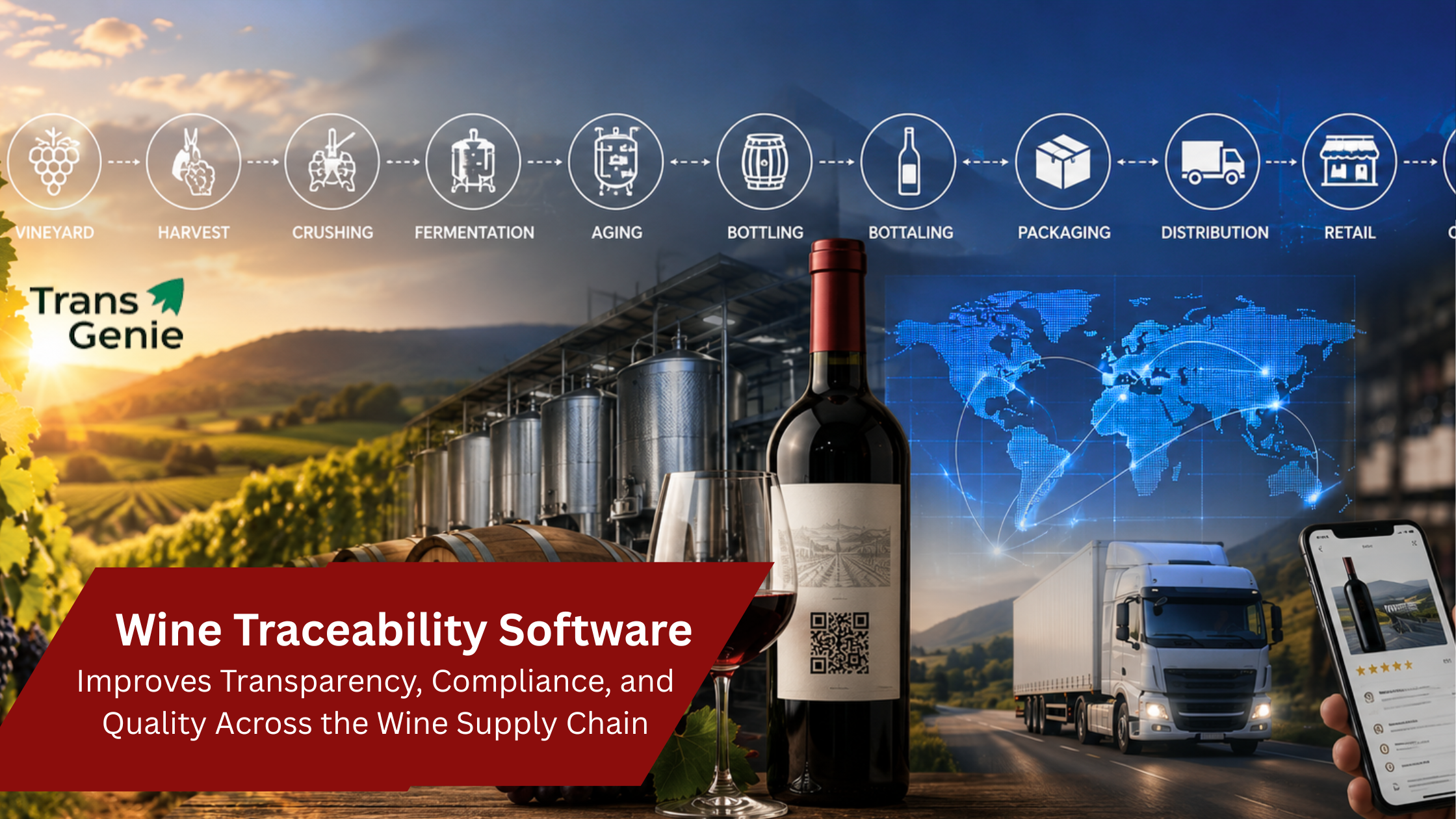
Wine production involves a complex sequence of interconnected processes where maintaining accurate records is essential for ensuring quality, compliance, and operational efficiency. The journey begins in the vineyard, where grape varieties, cultivation methods, irrigation, pesticide applications, weather conditions, and harvest dates are documented. Harvested grapes are transported to wineries for crushing, fermentation, blending, maturation, filtration, laboratory testing, and aging. Once production is complete, the wine is bottled, labeled, packaged, and transferred to warehouses before being shipped through distributors, wholesalers, retailers, restaurants, and export channels. Throughout this journey, every movement, quality inspection, storage condition, and inventory transaction contributes to the product's traceability record. Wine Traceability Software creates a continuous digital chain of information that connects each stage of production, enabling wineries to monitor products in real time, verify authenticity, maintain regulatory compliance, and provide consumers with complete product transparency through QR codes or digital product histories.
Information captured throughout the supply chain includes:
Vineyard location and grape variety.
Harvest dates and production lots.
Fermentation and aging records.
Laboratory testing results.
Quality inspection reports.
Bottling and packaging information.
Inventory movements.
Warehouse storage conditions.
Shipment and transportation records.
Distributor and retailer information.
Consumer authentication through QR codes.
Common challenges faced without Wine Traceability Software include:
- Manual documentation and paperwork.
- Spreadsheet errors and duplicate records.
- Limited supply chain visibility.
- Missing batch and lot information.
- Slow product recalls.
- Inventory inaccuracies.
- Compliance and audit difficulties.
- Counterfeit product risks.
- Inconsistent quality management.
- Poor warehouse coordination.
- Limited production insights.
- Delayed decision-making.
- Higher operational costs.
- Reduced customer confidence.
- Inefficient communication across departments.
`
How Wine Traceability Software Improves Supply Chain Transparency
Transparency has become one of the most valuable assets in today's wine industry, enabling wineries, distributors, retailers, and consumers to access accurate information about every bottle throughout its lifecycle. Wine Traceability Software creates a unique digital identity for every harvest, production batch, and finished product, allowing businesses to monitor product movements from vineyard to consumer in real time. Every operational event—including grape harvesting, crushing, fermentation, aging, laboratory testing, bottling, packaging, warehousing, shipping, and retail distribution—is automatically recorded within a centralized platform. This continuous digital record eliminates information gaps, improves collaboration between supply chain partners, and ensures that all stakeholders have access to reliable product data whenever needed. Real-time visibility also enables organizations to quickly identify production bottlenecks, monitor inventory movements, verify product authenticity, and respond rapidly to quality concerns or customer inquiries. By replacing fragmented records with an integrated digital traceability system, wineries can strengthen operational transparency, improve customer confidence, and build a more resilient supply chain.
Wine Traceability Software improves transparency by enabling:
- Complete vineyard-to-bottle product genealogy.
- Real-time tracking of batches and lots.
- Digital harvest and production records.
- QR code-based product verification.
- Barcode and RFID integration.
- Centralized product history.
- Warehouse and inventory visibility.
- Shipment and logistics tracking.
- Retail distribution monitoring.
- Consumer access to product origin information.
- Faster internal collaboration.
- Accurate reporting across the supply chain.
Improving Regulatory Compliance
Food safety regulations and international trade requirements continue to evolve, making compliance an essential responsibility for wineries of every size. Wine Traceability Software simplifies regulatory compliance by automatically recording production activities, quality inspections, laboratory results, ingredient information, packaging records, labeling data, and shipment histories in a centralized digital platform. Instead of manually compiling documents during inspections, wineries can instantly generate audit-ready reports that demonstrate complete product traceability and regulatory adherence. Digital recordkeeping reduces administrative workload, minimizes documentation errors, and improves consistency across departments. In the event of a product recall, organizations can rapidly identify affected batches, determine distribution locations, notify stakeholders, and remove products from the market while minimizing disruption and financial loss. Automated compliance management not only reduces operational risks but also strengthens customer confidence and supports international market expansion.
Compliance capabilities include:
- Automated digital documentation.
- Audit-ready production records.
- Batch and lot verification.
- Label and packaging compliance.
- Export documentation management.
- Laboratory and quality records.
- Recall-ready product history.
- Regulatory reporting automation.
- Reduced compliance risks.
- Faster internal and external audits.
Enhancing Wine Quality Management
Maintaining consistent wine quality requires careful monitoring throughout every stage of production. Wine Traceability Software provides wineries with complete visibility into vineyard activities, grape quality, fermentation parameters, aging conditions, laboratory testing, bottling operations, and storage environments. Every production variable is digitally recorded, enabling winemakers to compare historical production data, identify quality trends, and optimize future production cycles. Integrated quality management helps detect issues before they affect finished products, reducing waste while maintaining consistent flavor, aroma, color, and overall product integrity. When quality deviations occur, digital traceability allows wineries to quickly isolate affected batches, investigate root causes, and implement corrective actions without disrupting unaffected inventory. Continuous monitoring supports better decision-making, improved operational consistency, and stronger brand reputation across domestic and international markets.
Inventory and Warehouse Optimization
Inventory accuracy plays a critical role in ensuring efficient wine production and distribution. Wine Traceability Software provides real-time visibility into raw materials, work-in-progress inventory, bottled wine, packaging materials, and finished products across multiple storage locations. Automated inventory updates reduce manual counting, improve stock accuracy, and help wineries maintain optimal inventory levels throughout seasonal production cycles. Warehouse teams can efficiently manage lot movements, shipping schedules, and stock rotation using FIFO (First In, First Out) and FEFO (First Expired, First Out) principles where applicable. Real-time inventory insights also improve production planning, reduce storage costs, minimize spoilage, and prevent stock shortages that may disrupt customer deliveries.
Inventory optimization benefits include:
- Real-time stock visibility.
- Batch-specific inventory tracking.
- Warehouse movement automation.
- FIFO and FEFO inventory management.
- Reduced product spoilage.
- Improved inventory accuracy.
- Better production planning.
- Lower warehouse operating costs.
- Faster order fulfillment.
- Improved supply chain coordination.
Protecting Brand Reputation Through Product Authentication
Counterfeit wines and unauthorized product substitutions can significantly damage brand reputation and reduce consumer confidence. Wine Traceability Software protects product authenticity by assigning every bottle a unique digital identity that can be verified throughout the supply chain. QR codes, barcodes, serial numbers, and RFID technologies enable distributors, retailers, and consumers to confirm product origin, production history, bottling details, and authenticity with a simple scan. This level of transparency discourages counterfeiting while reinforcing consumer trust in premium wine brands. Product authentication also provides wineries with valuable insights into product movement, market distribution, and customer engagement, supporting stronger brand protection strategies and long-term business growth.
Authentication capabilities include:
- Unique bottle identification.
- QR code verification.
- Barcode and RFID support.
- Digital authenticity validation.
- Counterfeit prevention.
- Product history transparency.
- Consumer confidence.
- Brand reputation protection.
Data-Driven Decision Making
Modern wineries generate enormous volumes of operational data every day. Wine Traceability Software transforms this information into actionable insights through real-time dashboards, analytics, and business intelligence tools. Production managers can monitor key performance indicators, identify operational inefficiencies, forecast demand, optimize inventory levels, and improve resource utilization using accurate, centralized information. Data-driven decision-making helps wineries reduce costs, improve productivity, and respond more effectively to changing market conditions while supporting long-term strategic planning.
Analytics capabilities include:
- Live operational dashboards.
- Production performance monitoring.
- Inventory analytics.
- Demand forecasting.
- Supply chain reporting.
- Quality trend analysis.
- KPI tracking.
- Executive business intelligence.
Business Benefits of Wine Traceability Software
Wine Traceability Software delivers measurable business value beyond regulatory compliance. By connecting production, quality, inventory, warehousing, logistics, and customer data within one platform, wineries can streamline operations, reduce manual work, improve communication, and make faster business decisions. Digital traceability strengthens operational efficiency while helping organizations minimize waste, reduce recall costs, increase customer satisfaction, and protect long-term brand value. As wineries continue expanding into new domestic and international markets, digital traceability becomes a strategic investment that supports sustainable growth and competitive advantage.
Key business benefits include:
- Greater operational efficiency.
- Reduced paperwork.
- Faster reporting.
- Improved collaboration.
- Lower operating costs.
- Better inventory utilization.
- Reduced waste.
- Faster product recalls.
- Stronger compliance.
- Enhanced customer trust.
- Increased brand loyalty.
- Scalable business growth.
Future Trends in Wine Traceability
Digital transformation is reshaping the future of wine production through intelligent technologies that provide greater visibility, automation, and predictive capabilities. Artificial intelligence, machine learning, blockchain, IoT sensors, cloud computing, and predictive analytics are enabling wineries to improve quality control, automate compliance, monitor environmental conditions, and enhance sustainability reporting. These innovations will continue strengthening supply chain transparency while helping wineries respond more efficiently to changing consumer expectations and regulatory requirements.
Emerging technologies include:
- Artificial Intelligence (AI).
- Machine Learning.
- Blockchain verification.
- IoT-enabled vineyards.
- Smart environmental sensors.
- Predictive quality analytics.
- Sustainability monitoring.
- Digital wine passports.
- Cloud-based collaboration.
- Advanced business intelligence.
Why Choose TransGenie Wine Traceability Software?
TransGenie Wine Traceability Software provides wineries with a comprehensive digital platform designed to manage every stage of the wine lifecycle from vineyard operations and grape harvesting to production, bottling, warehousing, distribution, and consumer engagement. The platform delivers real-time visibility, automated compliance, intelligent inventory management, quality monitoring, and advanced analytics within a single cloud-based solution. By digitizing traceability processes, TransGenie enables wineries to improve operational efficiency, accelerate recall readiness, protect product authenticity, and strengthen customer confidence while supporting long-term business growth and regulatory compliance.
TransGenie delivers:
- End-to-end vineyard-to-bottle traceability.
- Real-time batch and lot tracking.
- QR code-based product authentication.
- Automated compliance management.
- Inventory and warehouse integration.
- Recall-ready digital records.
- ERP integration.
- Cloud-based dashboards and reporting.
- Scalable architecture for wineries of all sizes.
- Advanced analytics and operational insights.
Conclusion
Wine Traceability Software has become an essential technology for modern wineries seeking to improve transparency, ensure regulatory compliance, maintain consistent product quality, and optimize operational performance across increasingly complex supply chains. By replacing manual recordkeeping with centralized digital traceability, wineries gain complete visibility into every stage of the wine journey—from vineyard cultivation and grape harvesting to production, bottling, warehousing, distribution, and consumer engagement. This enhanced visibility enables faster recalls, stronger compliance, better inventory management, improved quality control, and greater protection against counterfeit products. As consumer expectations and regulatory requirements continue to evolve, digital traceability is no longer simply a compliance tool—it is a strategic business investment that drives operational excellence, strengthens brand reputation, and supports sustainable growth. TransGenie Wine Traceability Software empowers wineries to build a connected, intelligent, and future-ready supply chain by delivering real-time traceability, actionable insights, and complete vineyard-to-bottle transparency.