# Best YouTube Channel Ideas to Start in 2026: A Complete Guide for New Content Creators
Best YouTube Channel Ideas to Start in 2026: A Complete Guide for New Content Creators
Starting a YouTube channel in 2026 is easier than ever,
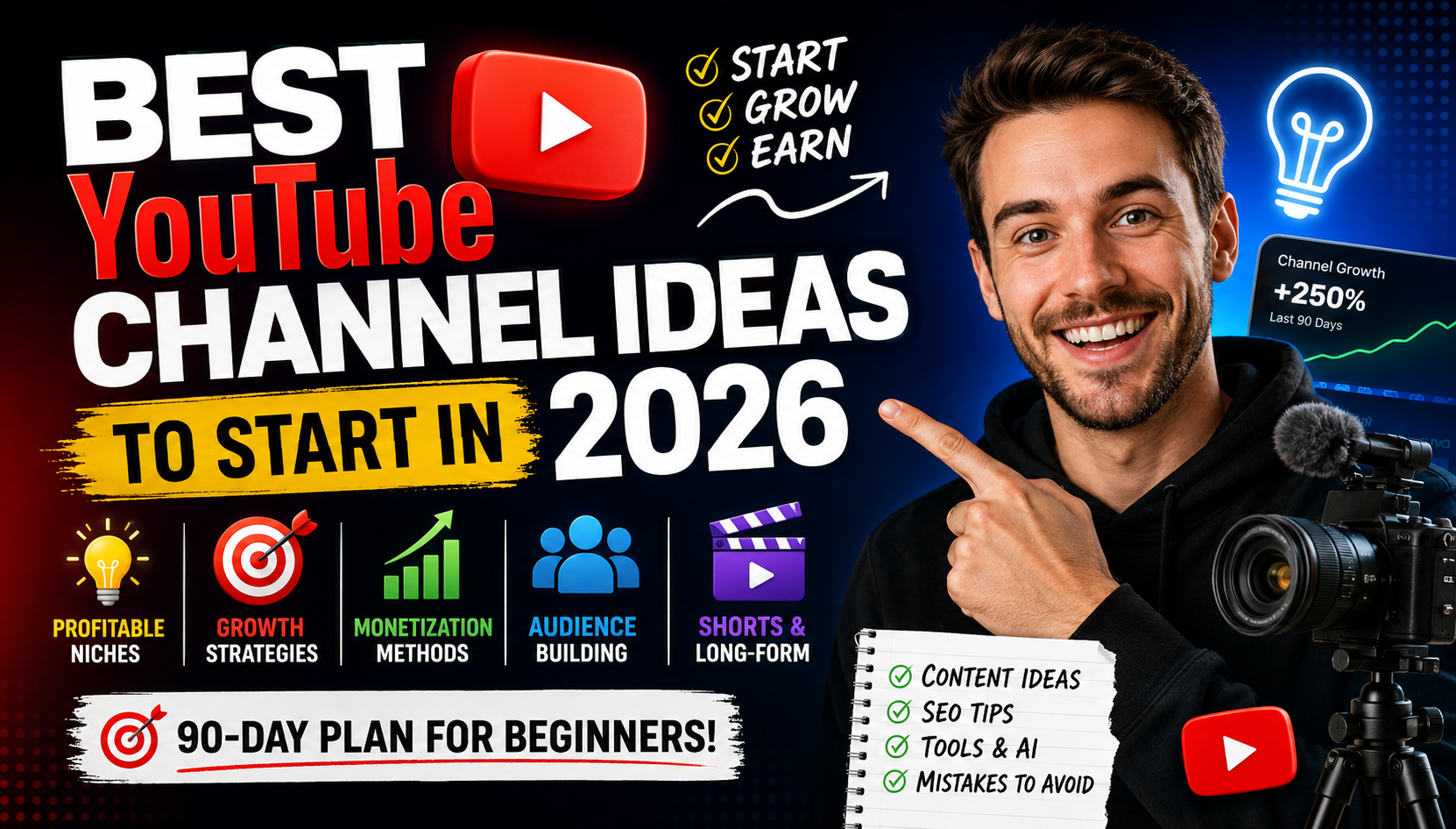
but growing one requires more than uploading random videos and hoping the algorithm notices. Successful creators now combine a clear niche, strong storytelling, search optimization, consistent publishing, and multiple revenue streams.
The biggest opportunity is that YouTube supports several content formats at once: Shorts for discovery, long-form videos for trust and watch time, livestreams for community, podcasts for deeper engagement, and memberships or products for monetization.
This guide covers the best YouTube channel ideas for 2026, including fast-growing niches, evergreen topics, AI-powered opportunities, Shorts versus long-form strategies, monetization methods, audience-building tactics, common mistakes, and a practical 90-day plan.
Research note: YouTube trends change quickly. This guide reflects current creator-economy direction, YouTube’s published creator guidance, and industry research from sources including YouTube Culture & Trends, Google/Think with Google, IAB, and major creator-platform reports. Always confirm current YouTube Partner Program requirements and platform policies before publishing.
Why Start a YouTube Channel in 2026?
YouTube remains one of the most versatile platforms for building a personal brand or online business. Unlike many social networks, YouTube content can continue attracting viewers through search and recommendations months or years after publication.
Several trends make 2026 a strong time to start:
- Video is now a primary way people learn, compare products, and make decisions.
- Short-form video creates rapid discovery opportunities.
- Long-form content builds credibility and watch time.
- YouTube is increasingly used for podcasts, livestreams, education, and shopping.
- AI tools reduce the time required for research, editing, captions, thumbnails, and repurposing.
- Small niche channels can monetize through specialized audiences rather than massive subscriber counts.
- Viewers increasingly reward useful, authentic, personality-driven content.
The best strategy is not to copy the largest channels. It is to identify a specific audience, solve recurring problems, and create a repeatable content system.
How to Choose the Best YouTube Channel Idea
Before selecting a niche, evaluate each idea using five questions:
1. Can you create at least 50 videos about it?
A niche may sound exciting but become difficult after five uploads. Choose a topic with recurring questions, news, problems, comparisons, or stories.
2. Do people actively search for it?
Use YouTube autocomplete, Google Trends, competitor channels, Reddit discussions, and audience comments to identify demand. Search-driven topics are particularly helpful for new channels.
3. Do you have a unique advantage?
Your advantage could be:
- Professional experience
- A distinctive personality
- Access to a location or community
- A specific teaching style
- Original research
- A strong visual format
- A personal transformation story
4. Can the niche support monetization?
Consider whether viewers buy products, services, software, courses, memberships, or event tickets related to the topic.
5. Can you publish consistently?
A sustainable channel idea is better than a theoretically profitable idea you cannot maintain.
Fastest-Growing YouTube Niches and Channel Ideas for 2026
1. Artificial Intelligence Tutorials and Workflows
AI remains one of the strongest opportunities for creators, but generic “AI news” is becoming crowded. The better opportunity is practical implementation.
Channel ideas include:
- AI tools for small businesses
- AI workflows for students
- AI for video editing and content creation
- AI automation for freelancers
- Prompt engineering tutorials
- AI productivity experiments
- Comparisons of AI software
- Industry-specific AI tutorials for lawyers, marketers, designers, or teachers
The most valuable videos demonstrate a result. Instead of making a video titled “Ten New AI Tools,” show how to save three hours using one tool in a realistic workflow.
2. Personal Finance and Financial Education
Finance content continues to attract strong search demand, although creators must be careful with accuracy and financial disclaimers.
Potential channel ideas include:
- Budgeting for beginners
- Debt repayment journeys
- Financial planning for young professionals
- Investing concepts explained simply
- Side-hustle income reports
- Frugal living experiments
- Small-business finance
- Credit scores and personal banking
- Tax organization and financial literacy
Trust is especially important in this niche. Avoid exaggerated promises, unsupported claims, and “get rich quickly” messaging.
3. Health, Fitness, and Wellness
Health content performs well when it is specific, practical, and evidence-informed.
Examples include:
- Home workouts for beginners
- Strength training for people over 40
- Mobility and posture routines
- Healthy meal preparation
- Walking and low-impact fitness
- Sleep-improvement experiments
- Mental wellness habits
- Fitness for busy professionals
Creators should avoid presenting themselves as medical professionals unless appropriately qualified. Make it clear when content is educational rather than medical advice.
4. Educational Explainers
Educational channels have strong evergreen potential. Viewers search YouTube to understand difficult topics quickly.
Channel ideas include:
- Science explained visually
- History documentaries
- Language learning
- Career skills
- Mathematics for students
- Coding and software tutorials
- Book and research summaries
- Public speaking
- Study techniques
- Digital literacy
A strong educational video usually has one clear promise, a logical structure, visual examples, and a practical takeaway.
5. Career, Employment, and Business Content
Work-related uncertainty creates continuing demand for useful career advice.
Possible topics include:
- Resume and interview advice
- Remote-work systems
- Freelancing tutorials
- Career changes
- Salary negotiation
- LinkedIn strategies
- Small-business operations
- Entrepreneurship case studies
- Workplace communication
- Portfolio-building tutorials
A particularly effective format is the “from beginner to result” series, such as documenting a job search, freelance challenge, or business experiment.
6. Product Reviews and Buying Guides
Product content can earn both advertising revenue and affiliate commissions. However, viewers increasingly expect honest testing rather than promotional summaries.
Ideas include:
- Affordable technology reviews
- Home office equipment
- Creator gear
- Budget smartphones
- Kitchen appliances
- Travel products
- Software comparisons
- “Best versus worst” testing
- Long-term ownership reviews
Show the product in use. Include limitations, alternatives, and who should not buy it.
7. Gaming and Interactive Entertainment
Gaming remains competitive, so new creators need a specific angle.
Potential formats include:
- Beginner guides
- Challenge videos
- Lore and story analysis
- Strategy tutorials
- Speedrunning
- Game development
- Gaming news explained
- Reviews of indie games
- Livestream highlights
- Community tournaments
Personality and editing matter, but a clear premise is equally important. “Playing games” is broad; “Helping new players master difficult strategy games” is more focused.
8. Travel, Local Discovery, and Cultural Content
Travel channels can succeed without expensive international trips. Local content can be highly searchable and easier to produce.
Ideas include:
- Affordable weekend trips
- City guides
- Hidden local businesses
- Public transportation guides
- Solo travel advice
- Digital-nomad experiments
- Food tours
- Cultural history
- Accessible travel
- Hotel and itinerary reviews
Use specific titles such as “A Three-Day Budget Guide to Lisbon” rather than vague titles like “My Travel Vlog.”
9. Cooking, Food, and Recipe Channels
Food is highly visual and shareable. A niche makes it easier to stand out.
Examples include:
- Five-ingredient meals
- High-protein recipes
- Budget cooking
- Regional cuisine
- Meal prep
- Baking science
- Air fryer recipes
- Cooking for one
- Restaurant recreations
- Cultural food documentaries
Shorts can attract viewers with quick recipes, while long-form videos can build loyalty through complete meal plans or cooking lessons.
10. Home Improvement, DIY, and Organization
Practical transformation content performs well because viewers can immediately see the result.
Channel ideas include:
- Small-space organization
- DIY repairs
- Budget renovations
- Interior design
- Gardening
- Decluttering
- Tool reviews
- Sustainable home projects
- Furniture restoration
- Rental-friendly upgrades
Before-and-after visuals are powerful, but explain the process clearly so viewers can reproduce the result.
Evergreen YouTube Content Ideas
Trending videos can bring quick attention, but evergreen content creates a durable library. Good evergreen topics answer questions that remain relevant.
Examples include:
- Beginner tutorials
- Step-by-step guides
- Frequently asked questions
- “Mistakes to avoid” videos
- Best tools for a specific task
- Comparisons
- Checklists
- Case studies
- Definitions and explanations
- Troubleshooting videos
- Templates and examples
- Beginner roadmaps
A useful content mix is:
- 70% evergreen content
- 20% timely or trend-based content
- 10% experiments
This is not a strict rule, but it prevents a channel from depending entirely on short-lived trends.
AI-Powered YouTube Content Opportunities
AI can help creators work faster, but viewers still want originality, accuracy, and human judgment. Using AI to mass-produce generic videos can result in low retention, weak audience trust, and potential monetization concerns.
Useful AI applications include:
Research and planning
AI can help organize questions, identify subtopics, summarize source material, and create an initial outline. Verify every factual claim independently.
Script development
Use AI to generate hooks, alternative explanations, examples, and transitions. Rewrite the output in your own voice and add personal insight.
Editing
AI-assisted tools can help with:
- Silence removal
- Caption generation
- Audio cleanup
- Scene detection
- Automatic reframing
- Transcript-based editing
- Short-form clipping
Thumbnail and title testing
AI can suggest multiple title variations and thumbnail concepts. The final creative should remain clear, accurate, and consistent with the video.
Localization
Dubbing, translation, and caption tools can help a creator reach international viewers. Review translations carefully, particularly for technical or culturally sensitive content.
Personalized learning and interactive formats
Creators can use AI to build quizzes, practice exercises, customized study plans, or interactive demonstrations around their videos.
The best principle is simple: use AI to increase your creative capacity, not to replace your perspective.
YouTube Shorts vs. Long-Form Videos
Why Shorts matter
Shorts are excellent for discovery. They can introduce your personality or topic to viewers who would never initially find a 15-minute video.
Effective Shorts include:
- Quick tips
- Strong opinions
- Before-and-after transformations
- Mini tutorials
- Surprising facts
- Mistakes and corrections
- Clips from longer videos
- Audience questions
- Fast product demonstrations
A Short should usually deliver one idea quickly. Avoid cramming five unrelated points into one video.
Why long-form matters
Long-form videos are better for:
- Building trust
- Explaining complex subjects
- Increasing session depth
- Developing loyal viewers
- Selling products or services
- Creating podcast-style content
- Demonstrating expertise
Long-form does not mean unnecessarily long. The ideal duration depends on the topic and viewer intent.
A practical format strategy
For many beginners, a useful publishing system is:
- One long-form video per week
- Three to five Shorts per week
- One community post or poll per week
- One livestream or premiere each month, if appropriate
Turn each long-form video into several Shorts, a community question, a newsletter topic, and a social-media post. This creates efficiency without requiring entirely new ideas every day.
YouTube Monetization Methods in 2026
Advertising revenue is only one part of the creator business. Depending on eligibility and region, monetization options may include:
YouTube Partner Program revenue
Creators may earn from advertising, YouTube Premium watch time, fan-funding features, and other platform tools. Requirements and available features can change, so check YouTube’s official Partner Program documentation.
Channel memberships
Memberships work best when they offer real community value, such as:
- Members-only livestreams
- Behind-the-scenes content
- Private Q&A sessions
- Early access
- Downloadable resources
- Custom badges or emojis
Super Chat, Super Stickers, and fan support
These are especially useful for livestreamers, educators, commentators, and community-focused channels.
Affiliate marketing
Recommend products that genuinely fit the audience. Explain who should buy the product, who should not, and how it compares with alternatives.
Sponsorships
Brands typically care about audience fit, engagement, trust, and conversion—not only subscriber count. Create a simple media kit with audience demographics, average views, and examples of successful content.
Digital products
Examples include:
- Templates
- Online courses
- E-books
- Presets
- Meal plans
- Study guides
- Notion systems
- Downloadable checklists
Services and consulting
A YouTube channel can generate leads for coaching, freelance work, design, editing, training, or professional services.
Merchandise and physical products
Merchandise works best when the audience identifies strongly with a community, phrase, visual style, or mission.
YouTube Growth Tips for New Creators
Define one audience and one promise
A channel should answer: “Who is this for, and what will they consistently get?”
Improve the title and thumbnail before improving the camera
Packaging determines whether people click. Use specific titles that communicate a benefit or curiosity gap without misleading the viewer.
Win the first 30 seconds
Start with the outcome, conflict, question, or demonstration. Avoid long animated intros and unnecessary greetings.
Track audience retention
Retention shows where viewers lose interest. Look for patterns:
- A slow opening
- Repetitive explanations
- Weak transitions
- Excessive introductions
- Poor audio
- A mismatch between title and content
Study returning viewers
Views are useful, but returning viewers indicate stronger channel loyalty. Create recurring series and make it easy for viewers to watch the next related video.
Build an email list
YouTube is valuable, but your relationship with viewers should not depend entirely on an algorithm. Offer a useful free resource and invite interested viewers to subscribe to an email list.
Respond to comments strategically
Comments reveal questions, objections, and future video ideas. Pin useful comments and turn recurring questions into follow-up videos.
Common Mistakes to Avoid
- Choosing a niche only because it appears profitable
- Uploading unrelated topics on one channel
- Copying another creator’s personality or format
- Prioritizing expensive equipment over useful content
- Using clickbait that does not match the video
- Making AI-generated videos with little original value
- Ignoring copyright and licensing rules
- Publishing inconsistently without a realistic schedule
- Quitting after a few low-performing videos
- Focusing only on subscribers instead of watch behavior
- Making videos too broad for a new channel
- Failing to disclose affiliate links or sponsorships
- Giving medical, legal, or financial advice irresponsibly
- Never reviewing analytics or viewer feedback
A 90-Day YouTube Content Plan for Beginners
Days 1–7: Establish your foundation
- Choose one audience and niche
- Write a one-sentence channel promise
- Research 30 video ideas
- Study 10 successful channels in your category
- Create basic branding
- Set up your channel page and About section
- Prepare a simple filming and editing workflow
Do not spend weeks perfecting your logo. Your first priority is publishing and learning.
Days 8–30: Publish and test
Publish:
- Four long-form videos
- Twelve to fifteen Shorts
- Four community posts
Test different:
- Titles
- Thumbnail styles
- Video lengths
- Hooks
- Topics
- Calls to action
At the end of the month, identify which videos achieved the strongest combination of clicks, retention, comments, and returning viewers.
Days 31–60: Develop repeatable series
Choose your two or three strongest topics and create recurring formats.
For example:
- “Beginner’s Guide to…”
- “I Tested…”
- “Common Mistakes in…”
- “One Tool, Three Workflows”
- “Weekly Case Study”
- “Budget versus Premium”
Publish:
- Four to six long-form videos
- Fifteen to twenty Shorts
- Weekly community posts
- One livestream or Q&A
Start building a basic email list or free resource if appropriate.
Days 61–90: Optimize and monetize
Review your top-performing videos and create related follow-ups. Improve the weakest part of your process—usually the hook, thumbnail, audio, or editing pace.
Publish:
- Four to six long-form videos
- Fifteen to twenty Shorts
- One collaboration
- One livestream or premiere
- A simple affiliate or sponsorship test, where relevant
By day 90, you should know:
- Which audience responds best
- Which topics generate the most interest
- Which formats retain viewers
- Which production tasks consume the most time
- Which monetization method fits your channel
FAQ: Starting a YouTube Channel in 2026
What is the best YouTube channel idea for beginners?
The best idea combines personal knowledge, audience demand, repeatable topics, and a clear monetization path. Educational tutorials, product reviews, personal finance basics, fitness, cooking, local guides, and career content are strong starting points.
Is it too late to start YouTube in 2026?
No. Competition is high, but demand is also high. New creators can succeed by serving narrower audiences, creating better explanations, and publishing consistently instead of trying to appeal to everyone.
Should I start with Shorts or long-form videos?
Use both if possible. Shorts can help discovery, while long-form videos build deeper relationships and authority. If your time is limited, begin with one sustainable long-form video and repurpose it into multiple Shorts.
Can I use AI to create my entire YouTube channel?
You can use AI for research, scripting support, editing, captions, translation, and ideation. However, fully automated, repetitive, or low-value content may perform poorly and create monetization or trust problems. Add original expertise, commentary, testing, or storytelling.
How often should I upload?
Consistency matters more than volume. One high-quality video per week is a realistic goal for many beginners. A sustainable schedule is better than uploading daily for two weeks and then stopping.
How long does it take to grow on YouTube?
There is no universal timeline. Some channels gain traction quickly through search or Shorts, while others take many months to build a library and loyal audience. Treat the first 90 days as a testing and learning period.
Conclusion
The best YouTube channel ideas for 2026 are not necessarily the most fashionable topics. They are focused ideas that solve real problems, create repeatable content, and serve a clearly defined audience.
Start with one niche, one audience, and one promise. Use Shorts to attract attention, long-form videos to build trust, and analytics to improve your decisions. Apply AI where it saves time, but keep your judgment, experience, and personality at the center of the channel.
If you consistently publish useful content for 90 days, study what viewers respond to, and build more than one revenue stream, you will have a much stronger foundation for long-term YouTube growth.