July wildlife in southeastern Pennsylvania: Mammals and small birds
Continuing the series providing an overview of my backyard photography practice during July, today we are looking at 10 species that I only reported to iNaturalist once during the month. With only 21 species in total for the month, I am expecting that this will be the first of three photography posts. Maybe I'll add a new touch, with a fourth post rounding up the birds that were reported by Merlin during my walks, too (based on audible detections).
As mentioned in my previous article, one of the July surprises was a Northern Cardinal hunting Spotted Lanternflies. While I was putting this post together, I realized I had evidence of another bird who has learned to eat this invasive species of insects. We'll see more about that, below.
Overall, here, we see some species who have made regular appearances in these posts like the American Red Squirrel, and the Blue Jay along with some others that have been seen less frequently like the European Starling and the Eastern Kingbird.
As usual, let's start with a summary table of the observations on iNaturalist.
| Common Name | Total Observations | July Observations | First Seen | Observed On |
|---|---|---|---|---|
| American Red Squirrel | 13 | 1 | 2026-03-22 | 2026-07-17 |
| Blue Jay | 15 | 1 | 2026-03-21 | 2026-07-17 |
| Eastern Cottontail | 6 | 1 | 2026-05-26 | 2026-07-01 |
| Eastern Kingbird | 4 | 1 | 2026-05-15 | 2026-07-31 |
| European Starling | 3 | 1 | 2026-05-12 | 2026-07-17 |
| Northern Flicker | 10 | 1 | 2026-03-25 | 2026-07-01 |
| Red-bellied Woodpecker | 7 | 1 | 2026-03-01 | 2026-07-13 |
| Song Sparrow | 7 | 1 | 2026-05-22 | 2026-07-02 |
| White-breasted Nuthatch | 3 | 1 | 2026-03-29 | 2026-07-02 |
| White-tailed Deer | 3 | 1 | 2026-05-29 | 2026-07-17 |
As a reminder, I changed my practice to (generally) wait a week between submitting repeat observations of the same species, so dates on some of the photos that follow may not match the ones here - and some of the photos may be unique to Steem as far as public access.
American Red Squirrel
First up, we have the American Red Squirrel. So far, they have been a staple photo subject during the spring and summer, and they have a very charismatic appearance. They can be found throughout large parts of the northern United States (including Alaska) as well as Canada.
As I mentioned with the birds in my previous post, though, these squirrels were much more skittish during July than they had been during previous months, so I only managed to get unobstructed/in-focus shots on one day of the month.
These squirrels are smaller than the (also common) gray squirrel, and modestly larger than a chipmunk. I think I already mentioned that identifying marks for these animals include the pronounced ring around the eye, the bushy red tail, and (during the summer) the black belly line separating the red fur from the white.
From a photography perspective, I'm always torn between zooming in on these guys for high detail or zooming out far enough to get the full body (including the long tail).
| July 17 | July 17 |
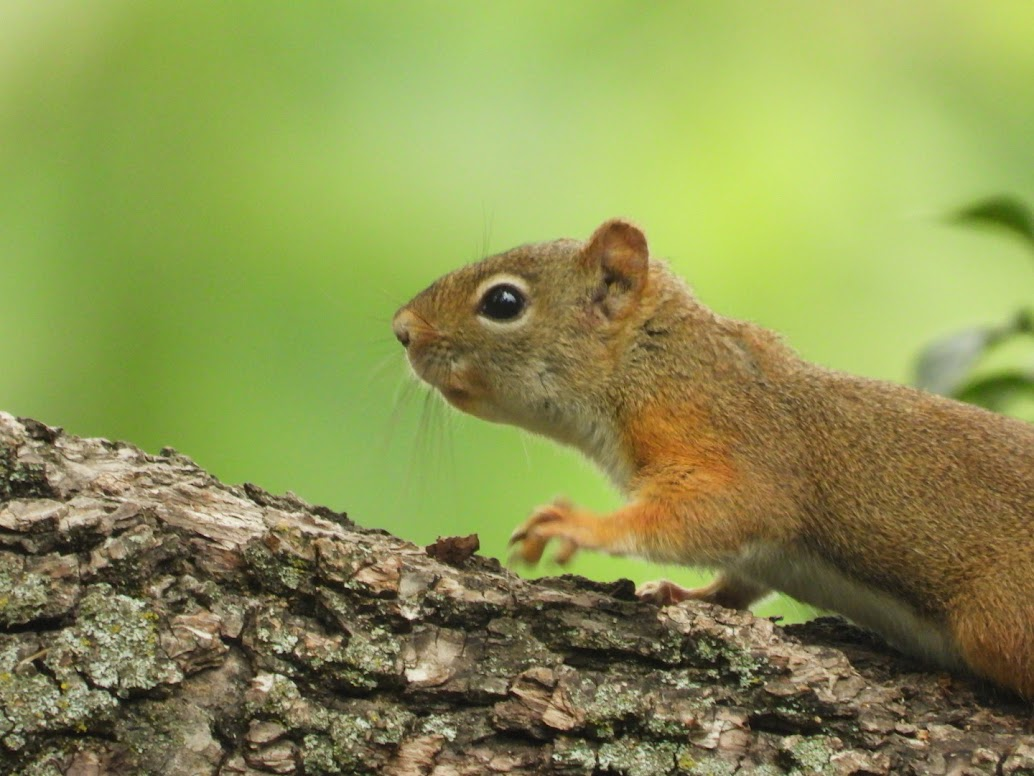 | 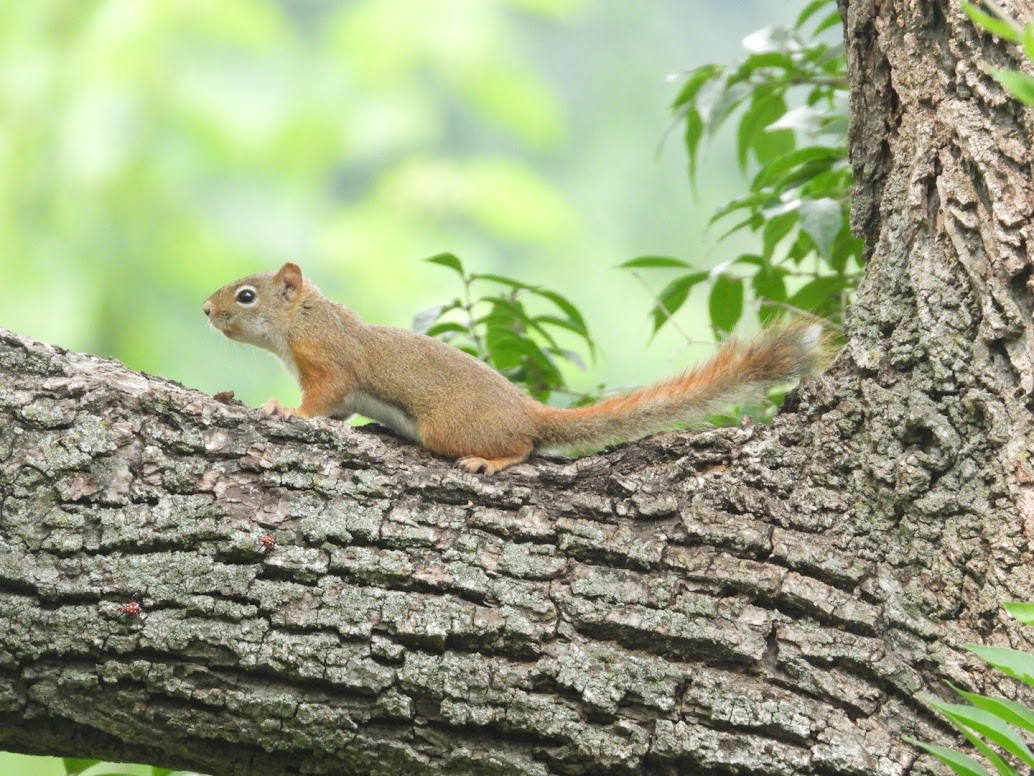 |
| ƒ/8, 1/500, ISO1100, 539mm (3000mm equiv, 125.0X) | ƒ/5.6, 1/500, ISO1100, 198mm (1102mm equiv, 45.9X) |
Blue Jay
Another common bird in these posts has been the Blue Jay, but like the Red Squirrel, I only managed to get one set of photographs where the bird was (mostly) unobstructed. The Blue Jay ranges from Canada south to the eastern and central portions of the United States. Based on the range map, I'm guessing the Rocky Mountains have prevented it from reaching the western portion of the US.
In May or June, I mentioned that I had seen a pair of these birds gathering nesting material, but I never found a nest, and during July I only saw solos - no pairs.
I don't recognize the tree branch, but with the focal length at 539mm and 503mm, this bird was at a pretty good distance. The distance and the backlighting is probably the reason why I need to adjust the tones and lighting in Google Photos.
| July 17 | July 17 |
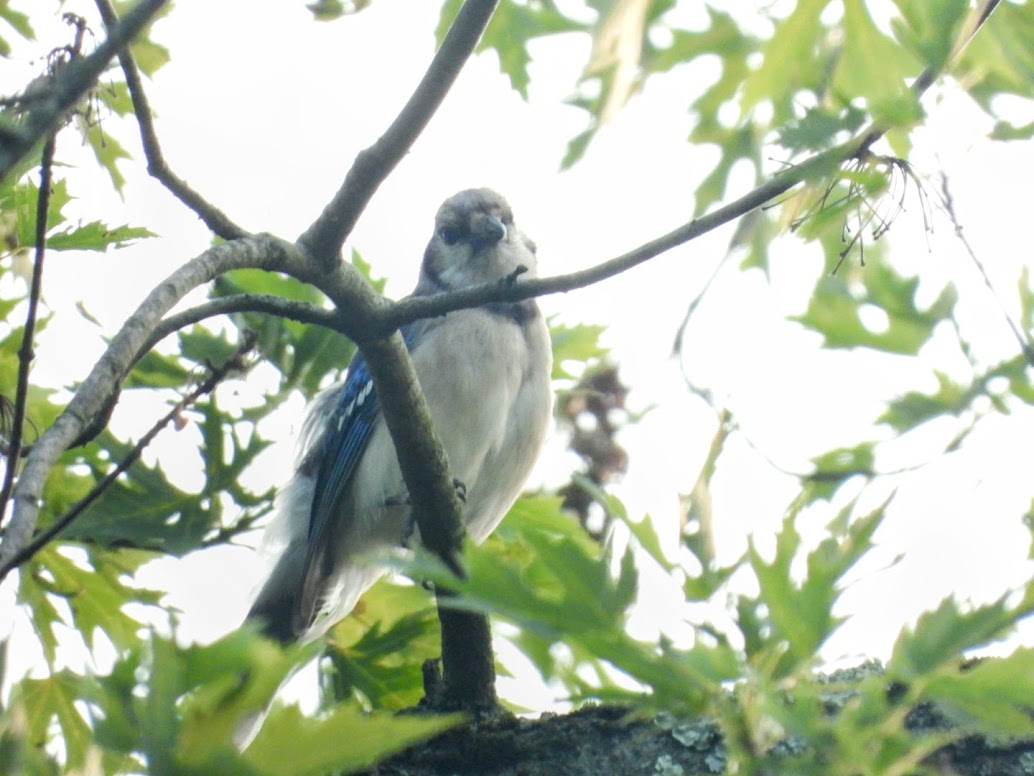 | 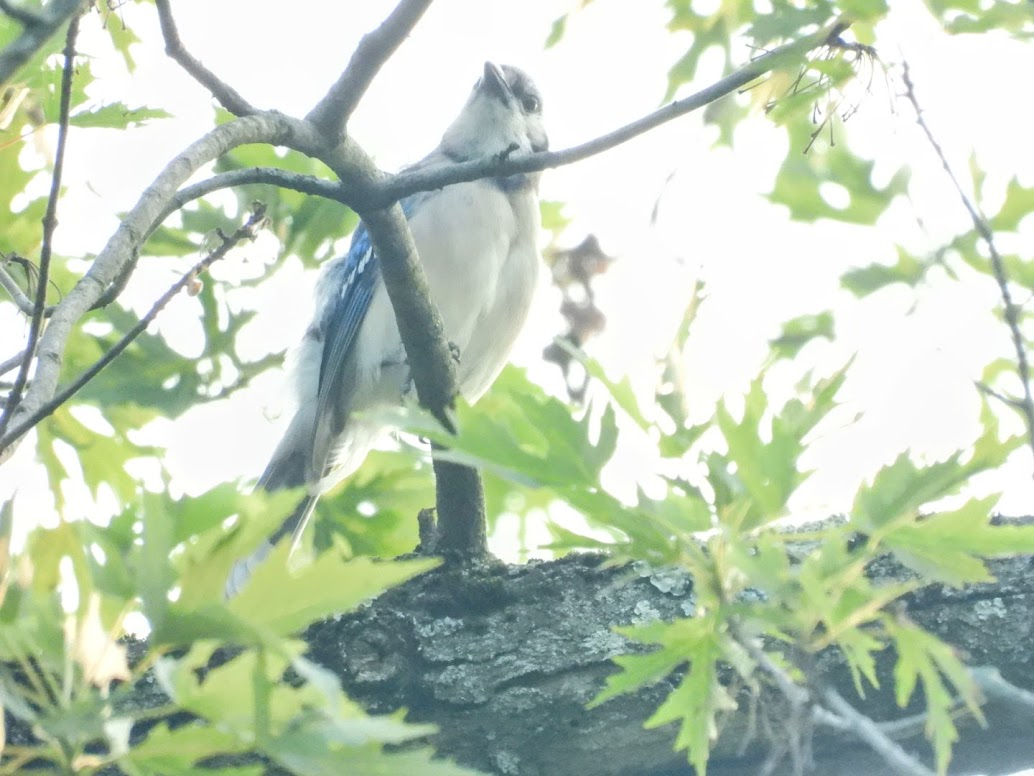 |
| ƒ/8, 1/320, ISO1000, 539mm (3000mm equiv, 125.0X). "Dynamic" adjustment in Google Photos | ƒ/8, 1/320, ISO1600, 503mm (2800mm equiv, 116.7X). "Dynamic" adjustment in Google Photos |
Eastern Cottontail
iNaturalist always suggests the Eastern Cottontail or the European Rabbit for all of these photos. Apparently, it's difficult or impossible to distinguish between them visually, and there are some scattered populations of European Rabbits in Pennsylvania that were somehow introduced from Europe - maybe from pets that were released into the wild.
One of the LLMs told me that the likelihood that these are European Rabbits is basically zero, so I should assume Eastern Cottontail. That's what I've been doing, and all of my observations have been confirmed on iNaturalist, so I guess the folks there agree.
Unlike many other animals, I was able to get many encounters with these rabbits. I'm actually not sure why I only reported them to iNaturalist once. It was probably an oversight. As with the Red Squirrel, I'm always struggling to balance between high details or capturing the full body. I mentioned in last month's post that sometimes I like to zoom in on the eye and try for an interesting reflection. I didn't have much luck with that during July, though. The in-eye reflections were all fairly lackluster.
| July 2 | July 3 |
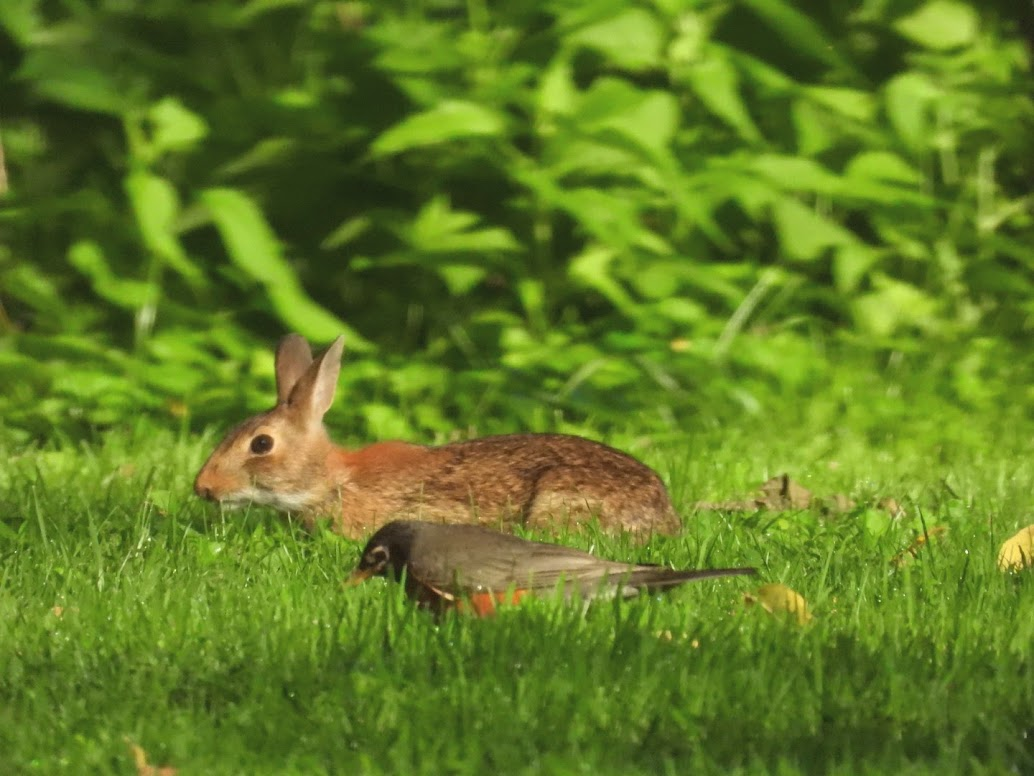 | 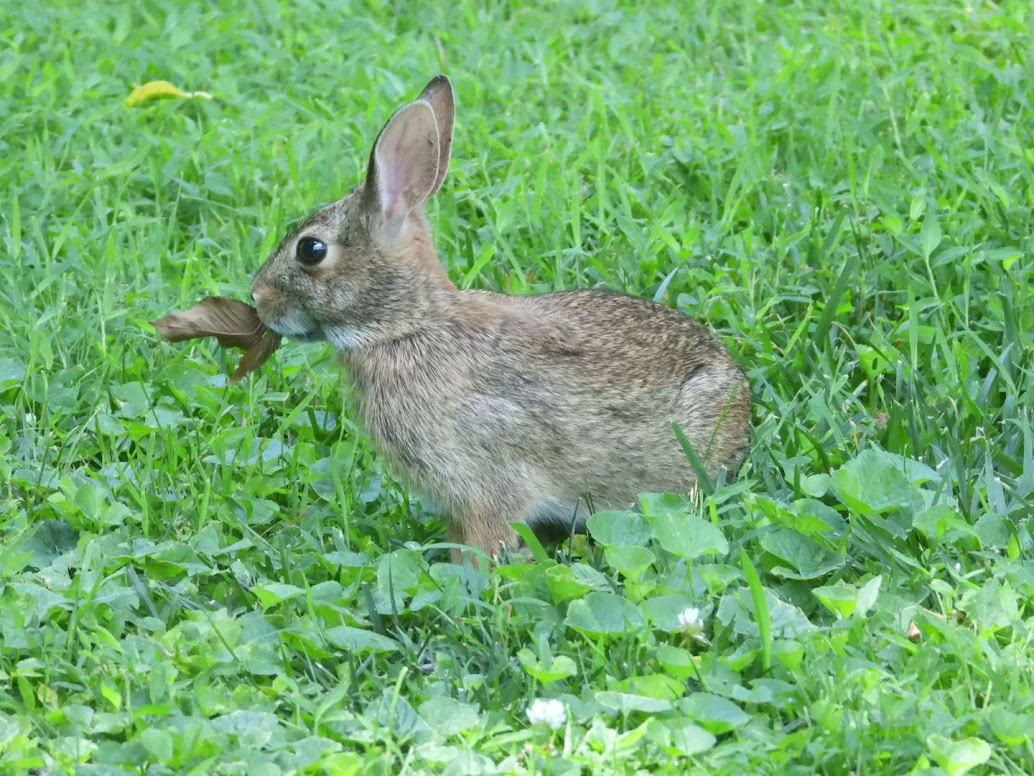 |
| ƒ/8, 1/2500, ISO1600, 432mm (2404mm equiv, 100.2X). Lighting adjusted in Google Photos | ƒ/5, 1/500, ISO1600, 95.8mm (533mm equiv, 22.2X) |
| July 16 | July 17 |
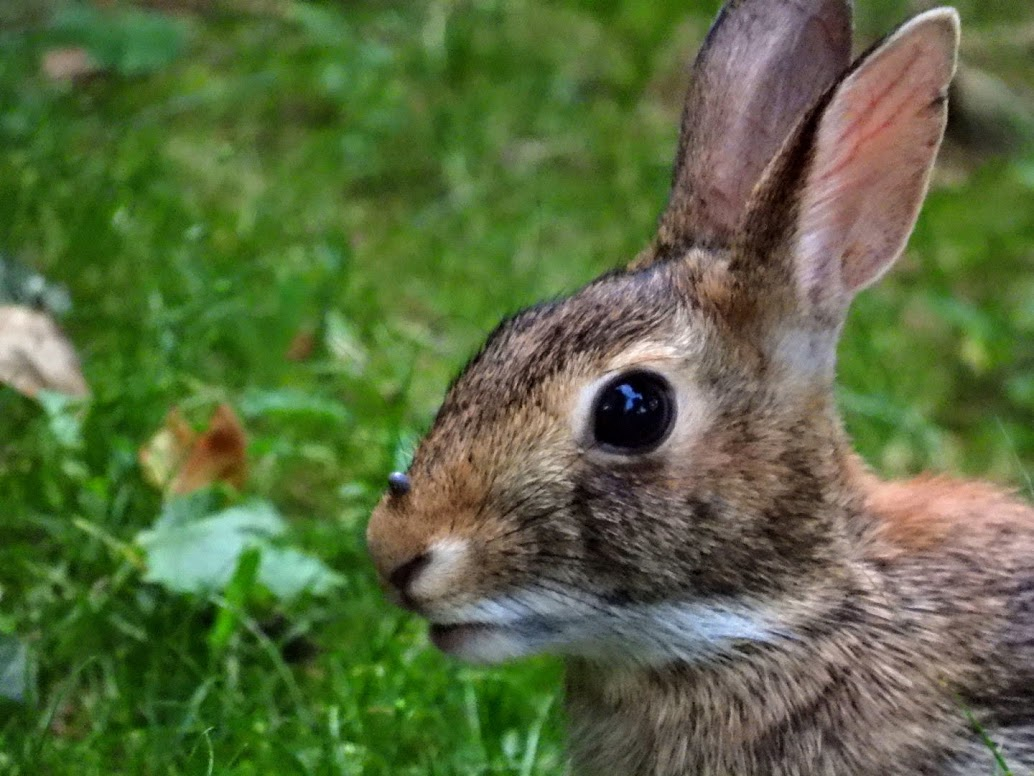 | 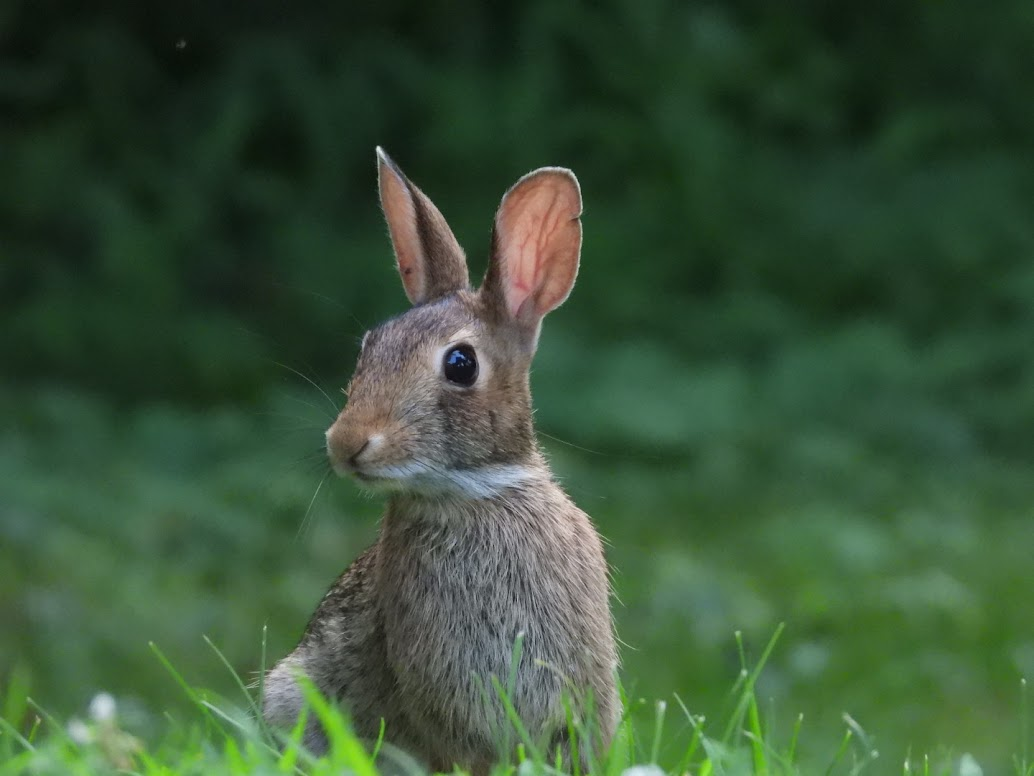 |
| ƒ/8, 1/320, ISO1600, 539mm (3000mm equiv, 125.0X). Lighting adjusted in Google Photos | ƒ/5.6, 1/320, ISO1600, 216mm (1202mm equiv, 50.1X) |
Eastern Kingbird
My first encounter with an Eastern Kingbird was when I saw it harassing a Red-tailed Hawk during the spring. After that, I only saw them a few times in May and June, and almost none in July. The only pair of photos here was captured on the very last day of the month. Surprisingly, however, I've been seeing them more frequently in August (check back in next month's series).
This species apparently travels a lot during the year. It spends the breeding season in the US, east of the Rocky Mountains, then it spends the winter months in South America, with a migration corridor through Mexico, Central America, and a small swathe of northern South America.
In this photo, I managed to get a very distant photo of one in flight (At 24mm, the field of view is wider than naked eye. The bird is actually smaller in the photo than it would have been to the naked eye because it's a wide-angle perspective.), but even with that distant shot, I was able to crop it to an identifiable bird in flight. This is one of those cases where I wasn't prepared at all, so I just had time to raise the camera, click the button, and hope for the best.
| July 31 | July 31 |
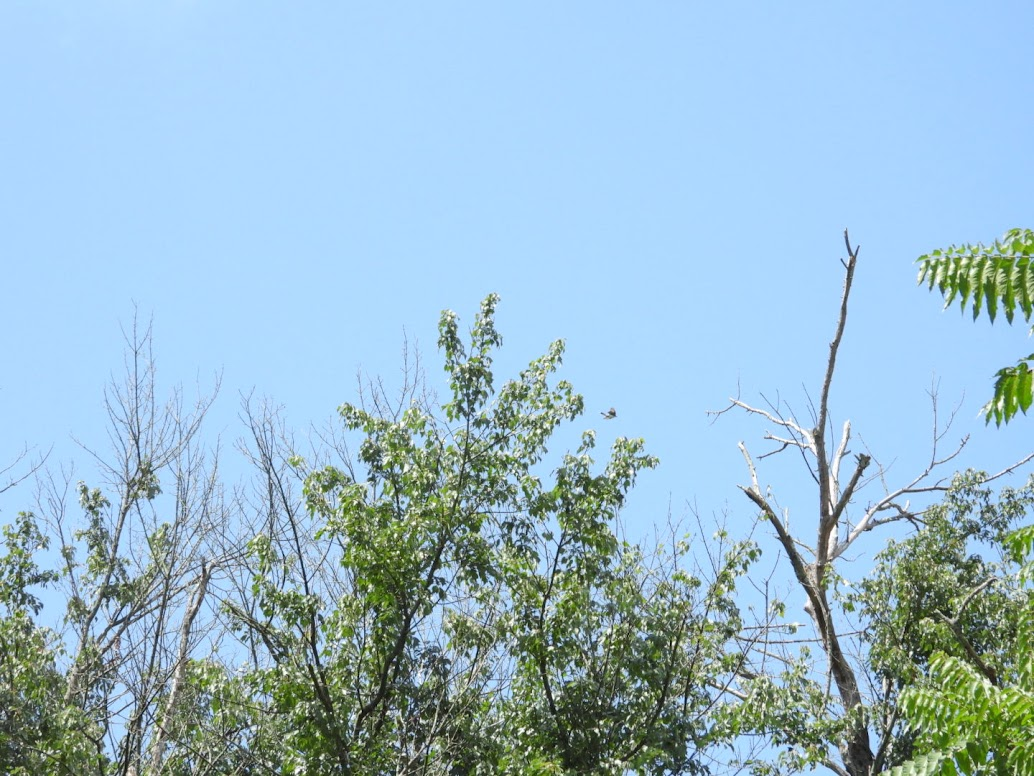 | 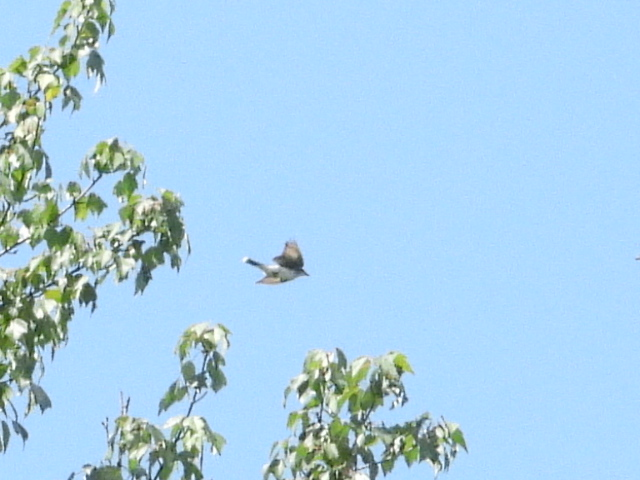 |
| ƒ/4, 1/2000, ISO500, 24.3mm (135mm equiv, 5.6X) | ƒ/4, 1/2000, ISO500, 24.3mm (135mm equiv, 5.6X) Same photo, full-resolution and cropped in LibreOffice |
European Starling
The Eastern Kingbird and the European Starling are definitely my lowest quality photos in this post. During late July and so far in August, the Starlings have been gathering in that tree near sundown almost every day.
Unfortunately, between the distance, the backlighting, and the sinking Sun, it's wicked-hard to get a decent quality shot of them. During July, the best I could do was silhouettes like these. To get closer to the tree, I would have to walk through underbrush on properties that I don't own, so this is as close as I can get to them.
| July 17 | July 17 |
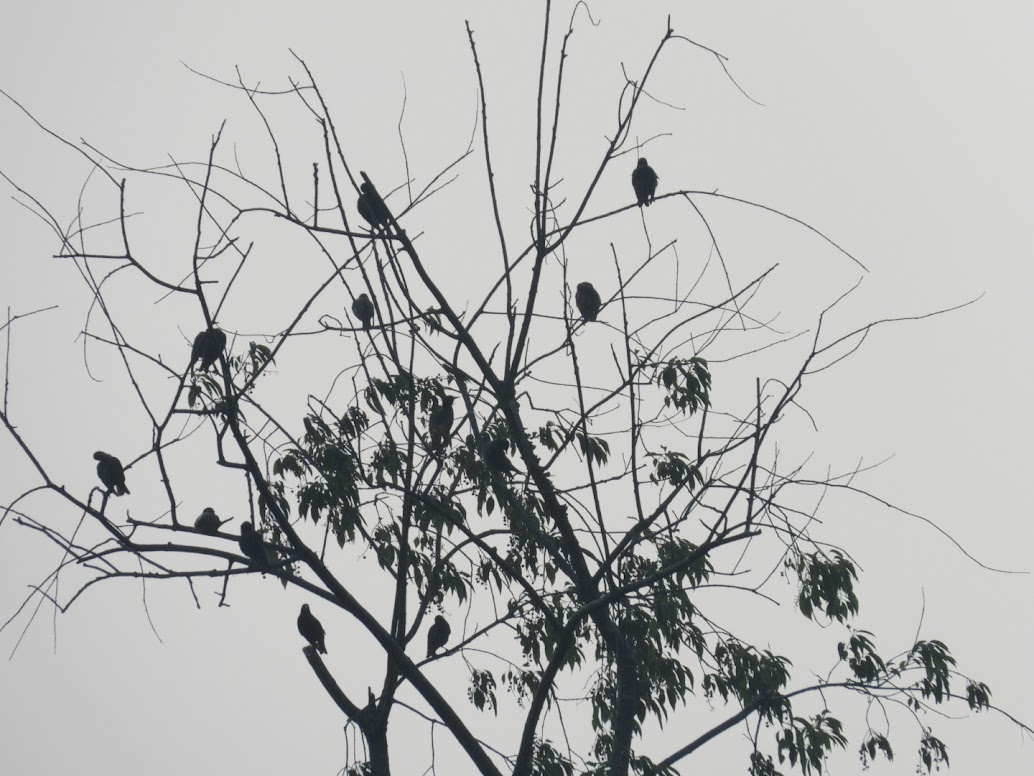 | 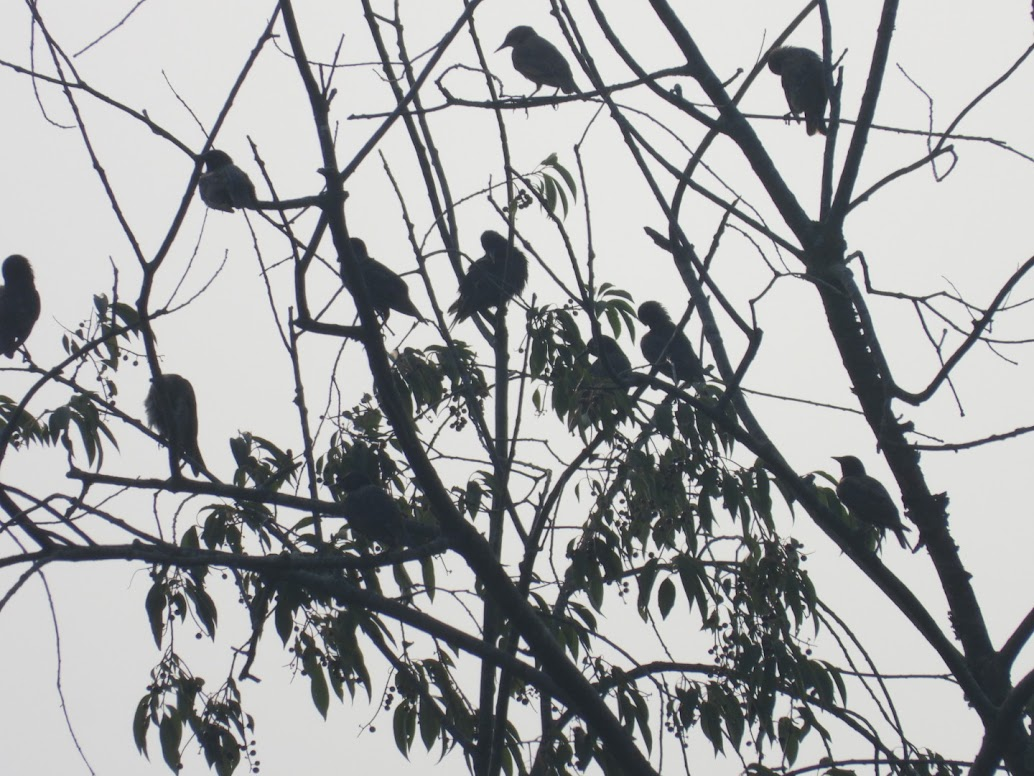 |
| ƒ/8, 1/500, ISO100, 324mm (1803mm equiv, 75.1X) | ƒ/8, 1/500, ISO125, 539mm (3000mm equiv, 125.0X) |
Northern Flicker and Red-bellied Woodpecker
The two woodpeckers in this post are the Northern Flicker and the Red-bellied Woodpecker. Both of these have been common photography subjects for me, and both of them were species that I was totally unaware of before I began this photography practice.
The Northern Flicker ranges from Canada during breeding season with a year-round presence in most of the US and small parts of Mexico. Its winter-only presence is limited to part of Texas and a small patch of the western US. In contrast, the Red-bellied Woodpecker looks like its western range is bounded by the Rockies, and it doesn't seem to have a seasonal change in territory.
For the Red-bellied Woodpecker, I had some trouble with the lighting, but was able to rescue the photo with adjustments in Google Photos. One of the things I still struggle with on the Nikon P1000 is that in suboptimal lighting, the camera's viewfinder doesn't always seem match the photo when it reaches the computer. I understand from various web pages that I should learn to read the camera's histogram, but I haven't learned how to do that yet.
Northern Flicker
| July 1 | July 1 |
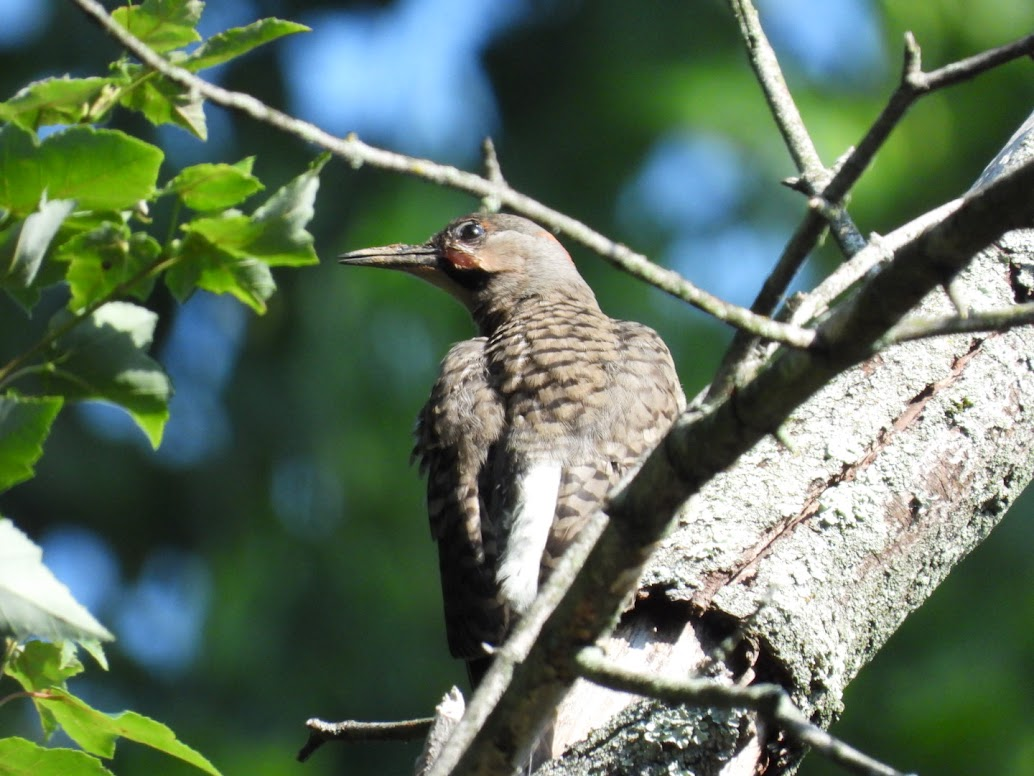 | 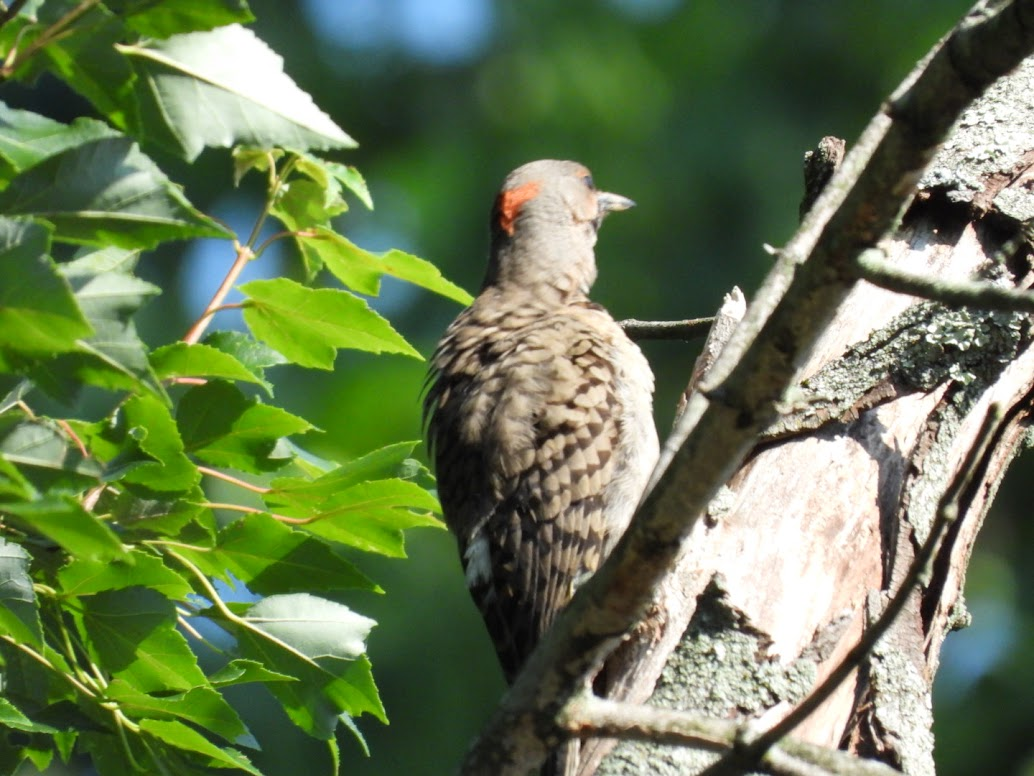 |
| ƒ/8, 1/500, ISO800, 539mm (3000mm equiv, 125.0X) | ƒ/8, 1/500, ISO800, 539mm (3000mm equiv, 125.0X) |
Red-bellied Woodpecker
| July 13 | July 13 |
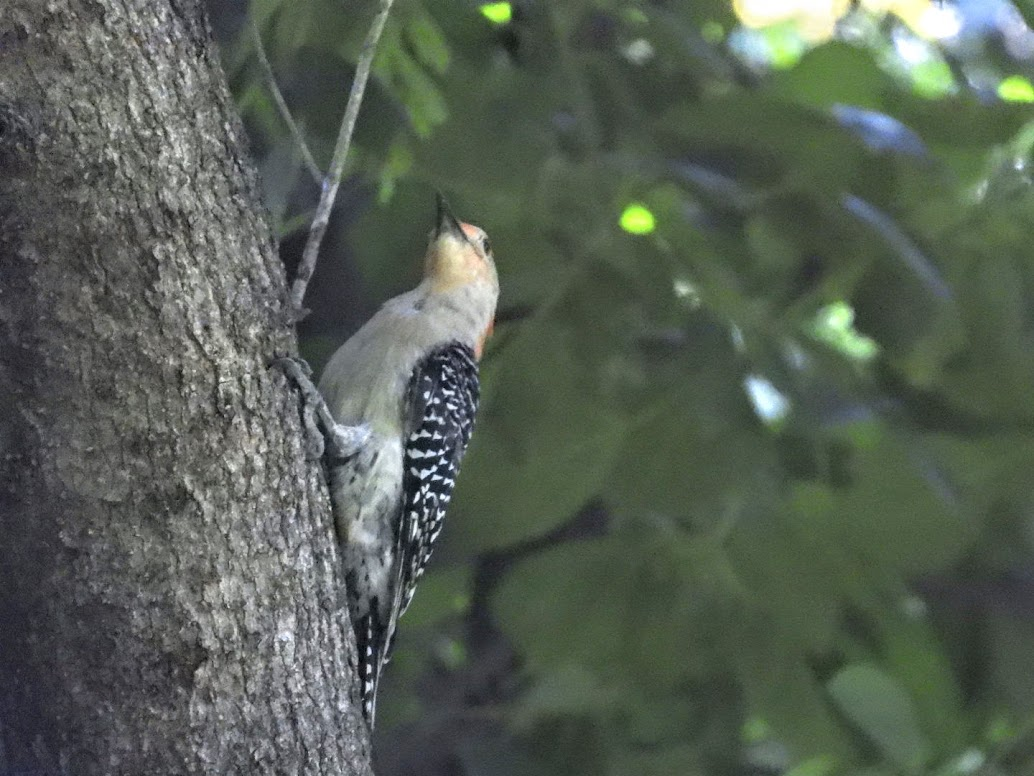 | 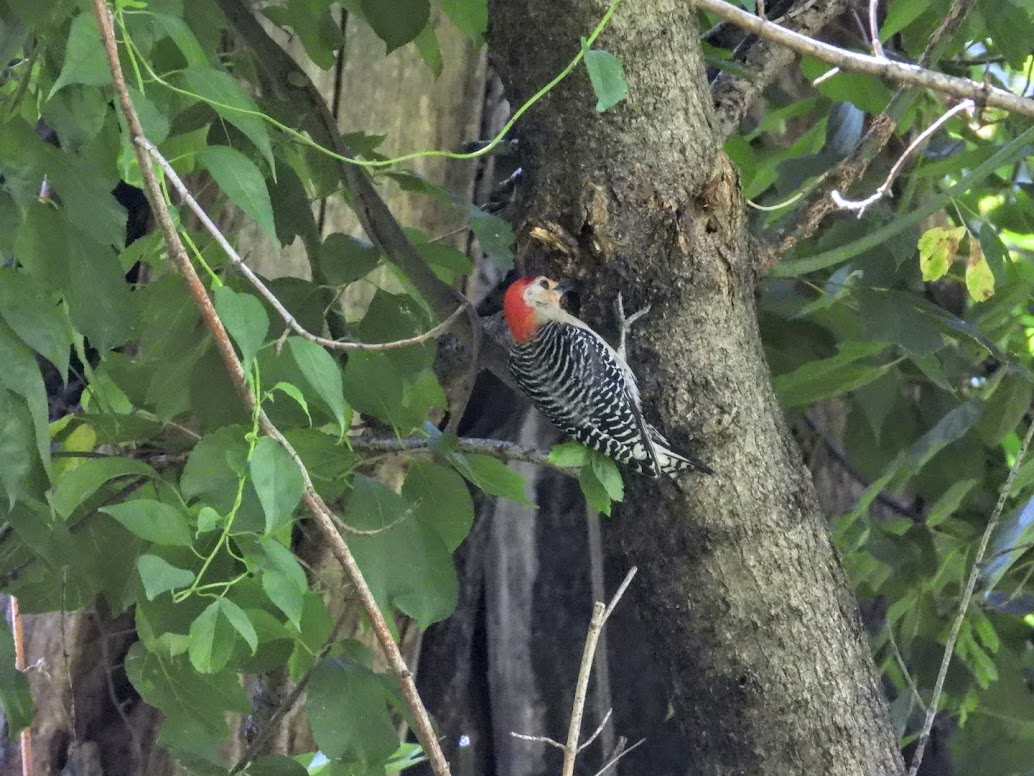 |
| ƒ/6.3, 1/500, ISO1600, 306mm (1703mm equiv, 71.0X). Lighting adjusted in Google Photos | ƒ/5.6, 1/320, ISO1600, 167mm (929mm equiv, 38.7X). Lighting adjusted in Google Photos |
Song Sparrow
The Song Sparrow is the one in this post that I was most looking forward to writing about. These have a year-round presence in much of the northeast and northwest United States. In summers, they migrate north to Canada, and in winters they extend south to Mexico.
In June, I posted photos of a Song Sparrow splashing around in the condensation puddle that accumulates by our air conditioning system. Here we see the same thing in July. The bird splashed around in the puddle for a few minutes and then flew off to a nearby tree to dry off.
In the previous post, I mentioned that later in July I had seen a Northern Cardinal eating a Spotted Lanternfly, which was the first time I knew that the invasive Lanternfly now has predators in Pennsylvania. Surprisingly, when I was putting this post together, Meta AI noticed a Lanternfly in one of these photos and reported that Song Sparrows are another species that has learned to eat Lanternflies. So, this might actually be my first photographic evidence that Lanternflies now have some predators. Although, it's not clear if the bird actually sees the Lanternfly or not, and I haven't found a web site to verify that they are among the birds that actually eat Lanternflies.
| July 2 | July 2 |
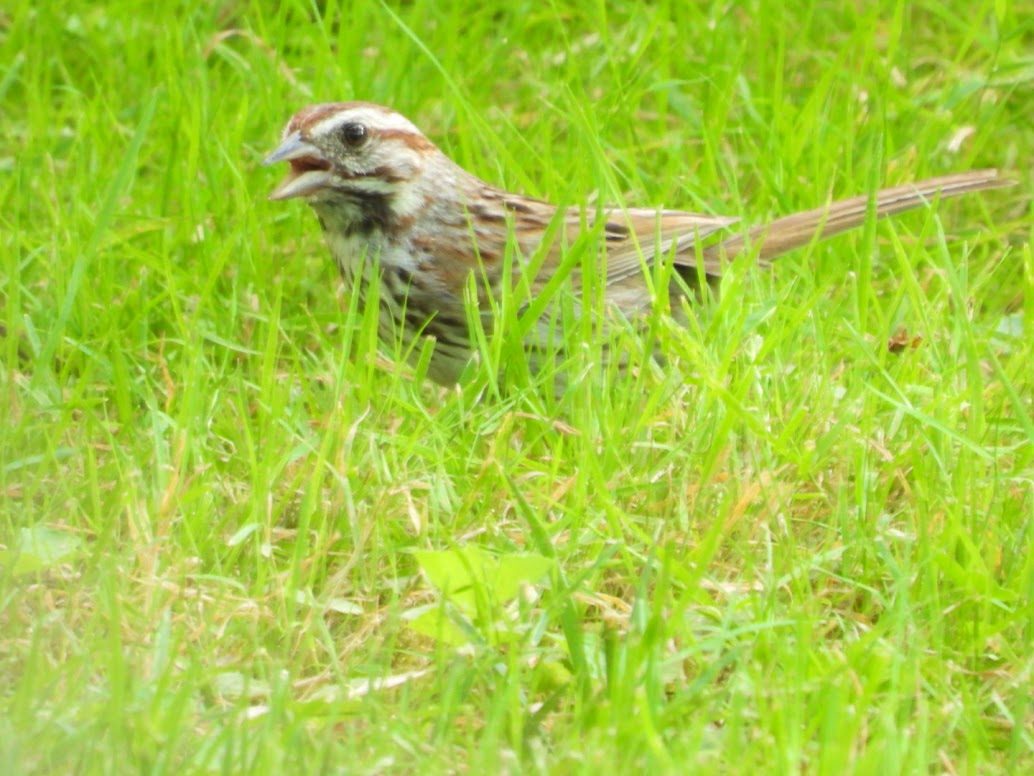 | 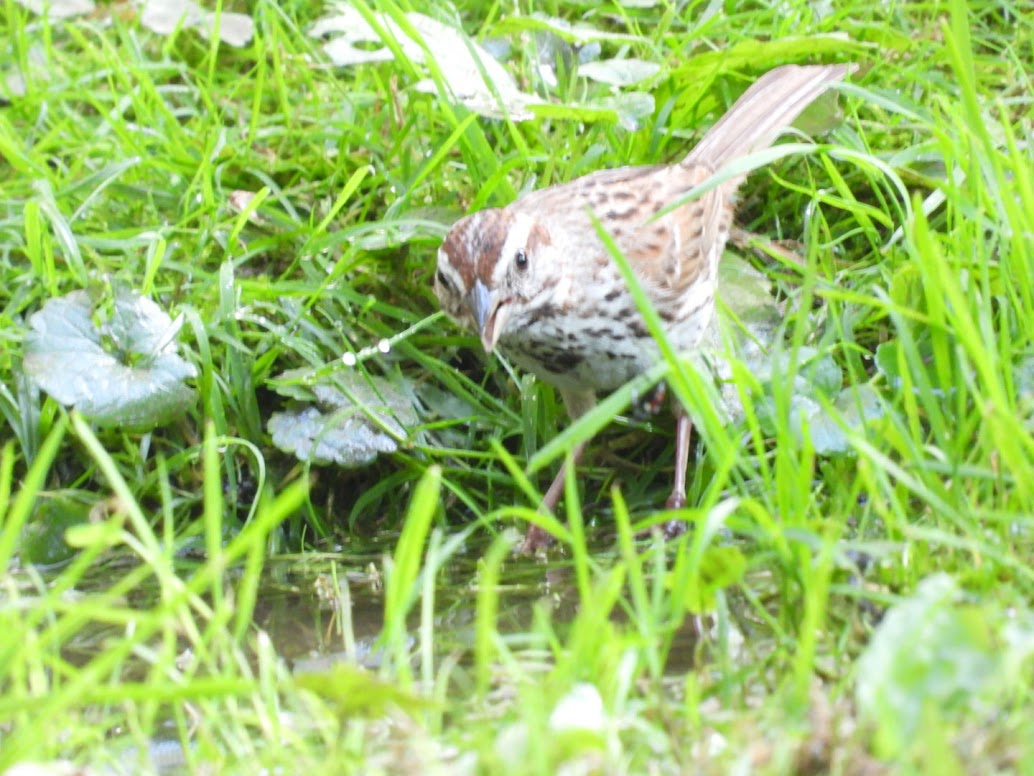 |
| ƒ/8, 1/40, ISO800, 539mm (3000mm equiv, 125.0X) | ƒ/8, 1/30, ISO900, 539mm (3000mm equiv, 125.0X) |
| July 2 | July 2 |
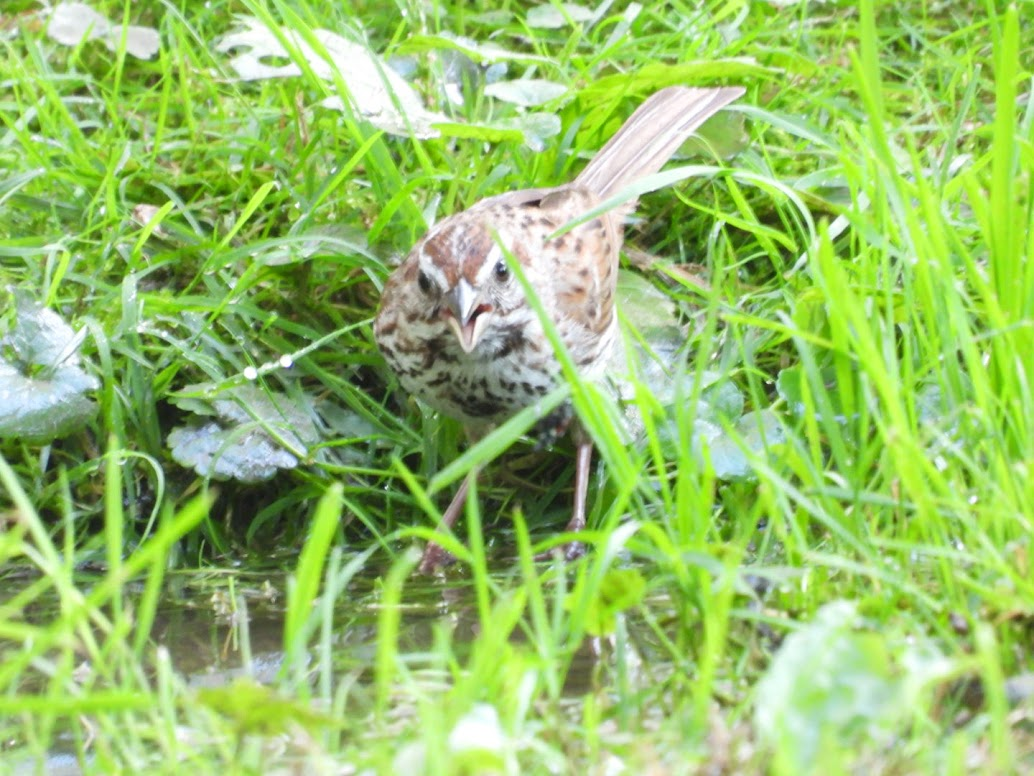 | 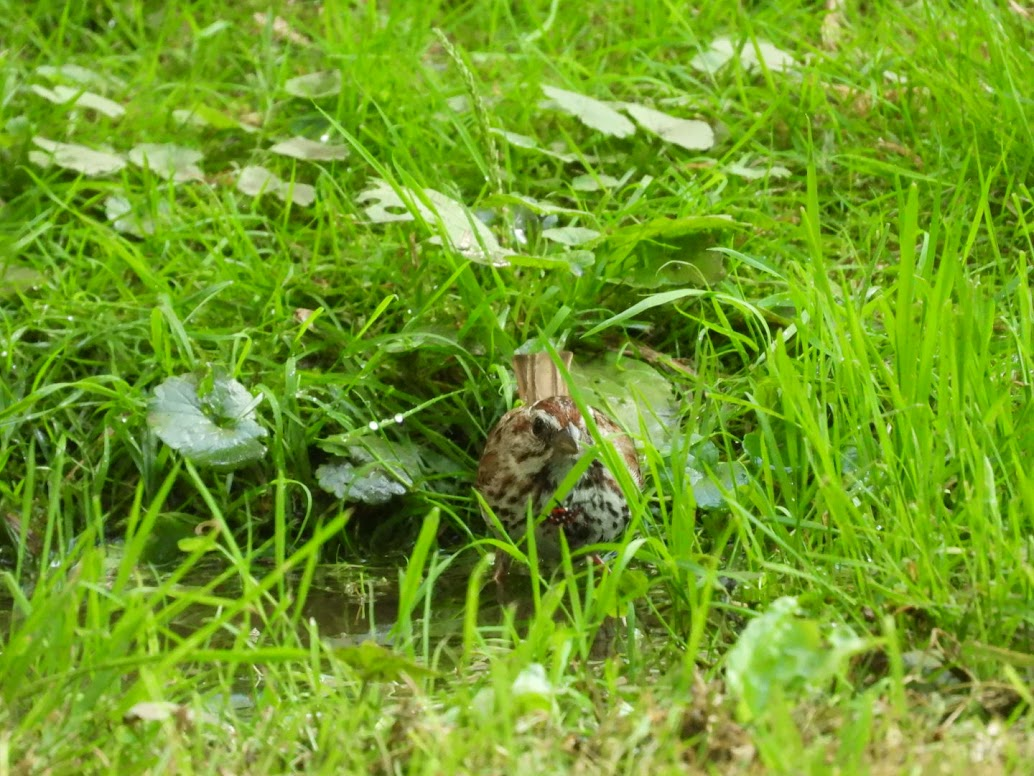 |
| ƒ/8, 1/30, ISO900, 539mm (3000mm equiv, 125.0X) | ƒ/6.3, 1/160, ISO1600, 359mm (1998mm equiv, 83.3X). Surprise: Could it be hunting a Lanternfly? |
| July 2 | July 2 |
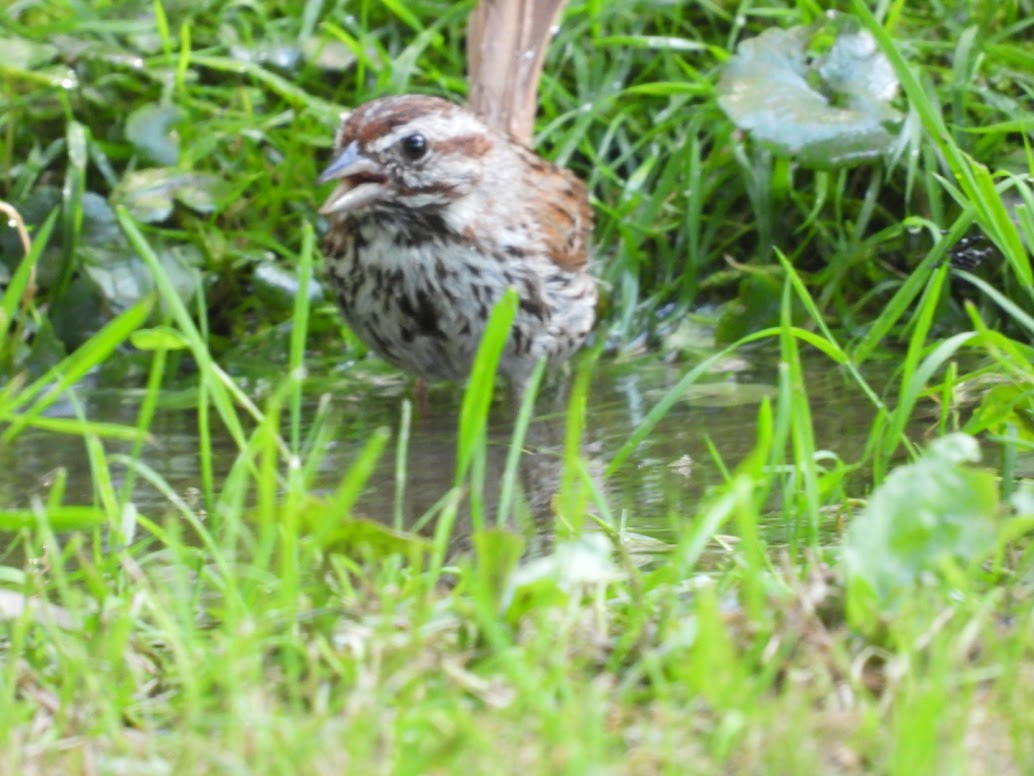 | 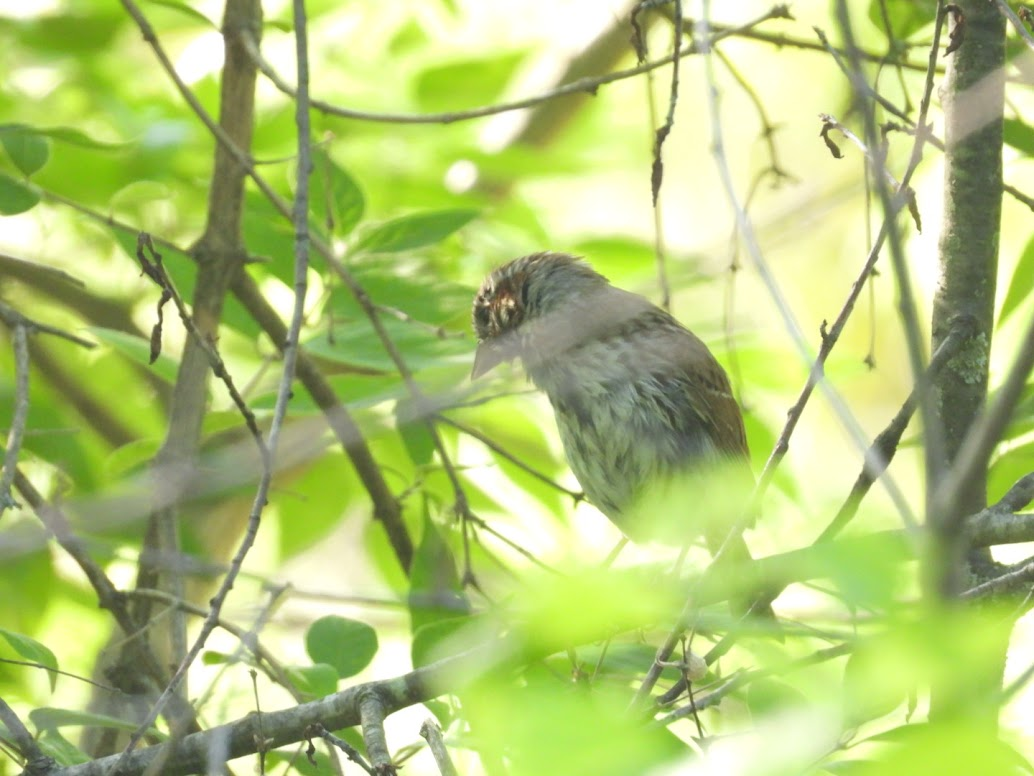 |
| ƒ/8, 1/40, ISO800, 539mm (3000mm equiv, 125.0X) | ƒ/6.3, 1/100, ISO800, 324mm (1803mm equiv, 75.1X) |
White-breasted Nuthatch
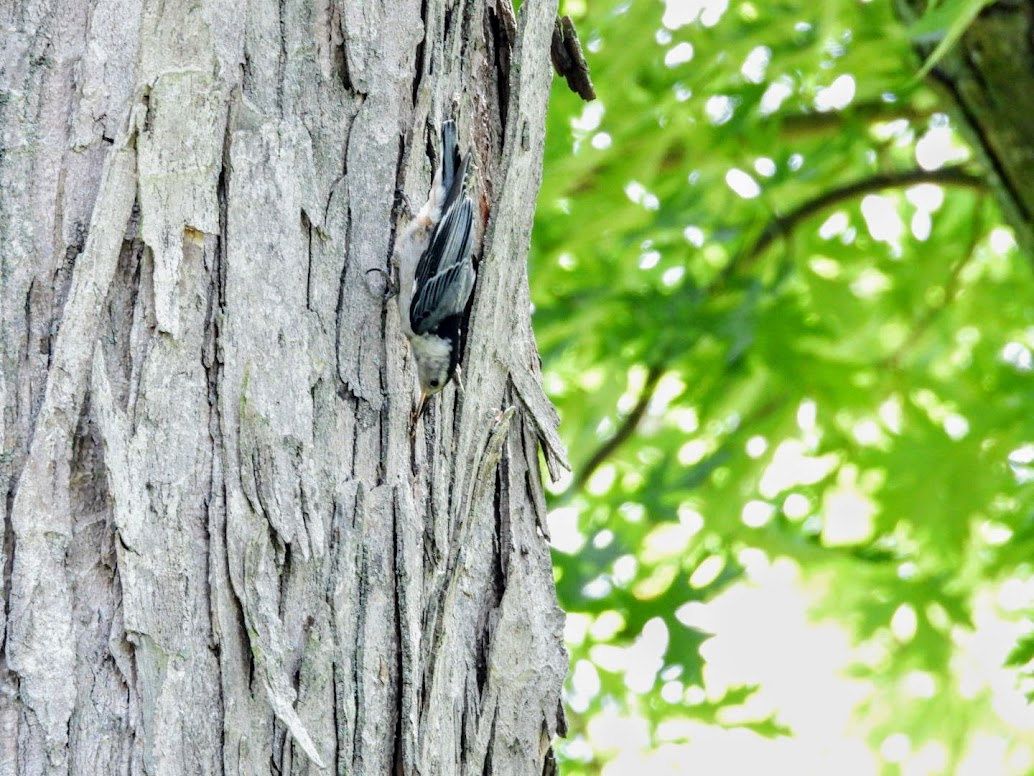
The encounter with the White-breasted Nuthatch was an interesting one. This is another year-round resident in Pennsylvania, much of the United States, and parts of Mexico. It also spends part of the year in Canada.
I happened to see it on the side of a fairly large tree, and it was definitely aware of my presence. It was chirping constantly while I was taking pictures, and as a result, I suspect that it was a juvenile.
The interesting thing was that every time I positioned myself to get a better angle for lighting and visibility, the bird circled around the tree at the same height.
Based on the pictures' timestamps, I spent almost 20 minutes photographing this bird. The camera settings vary so much because I was changing settings to deal with different lighting and shading conditions as it circled around the tree.
| July 2 | July 2 |
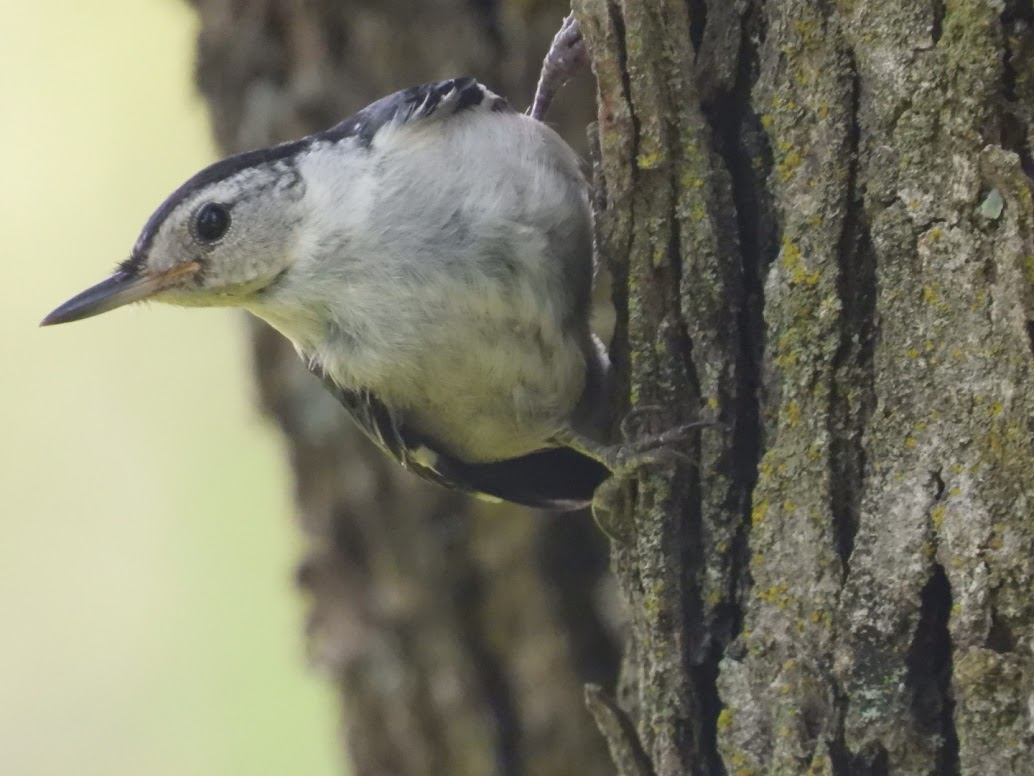 | 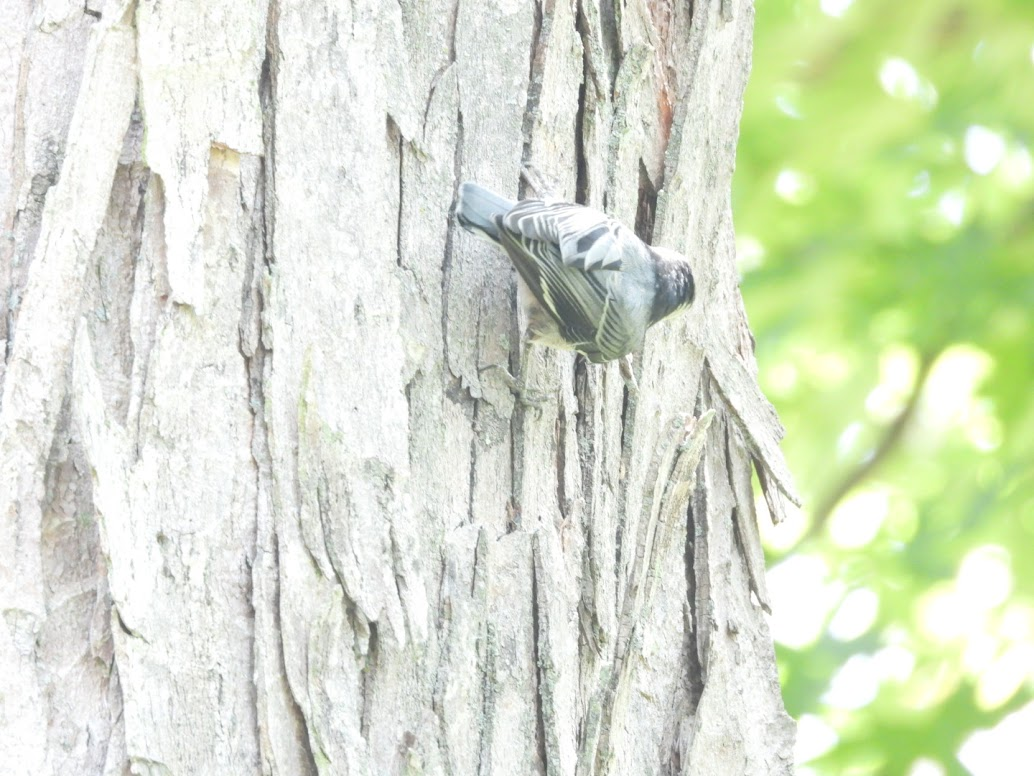 |
| ƒ/8, 1/250, ISO1600, 503mm (2800mm equiv, 116.7X) | ƒ/5.6, 1/60, ISO800, 234mm (1302mm equiv, 54.3X) |
| July 2 | July 2 |
 | 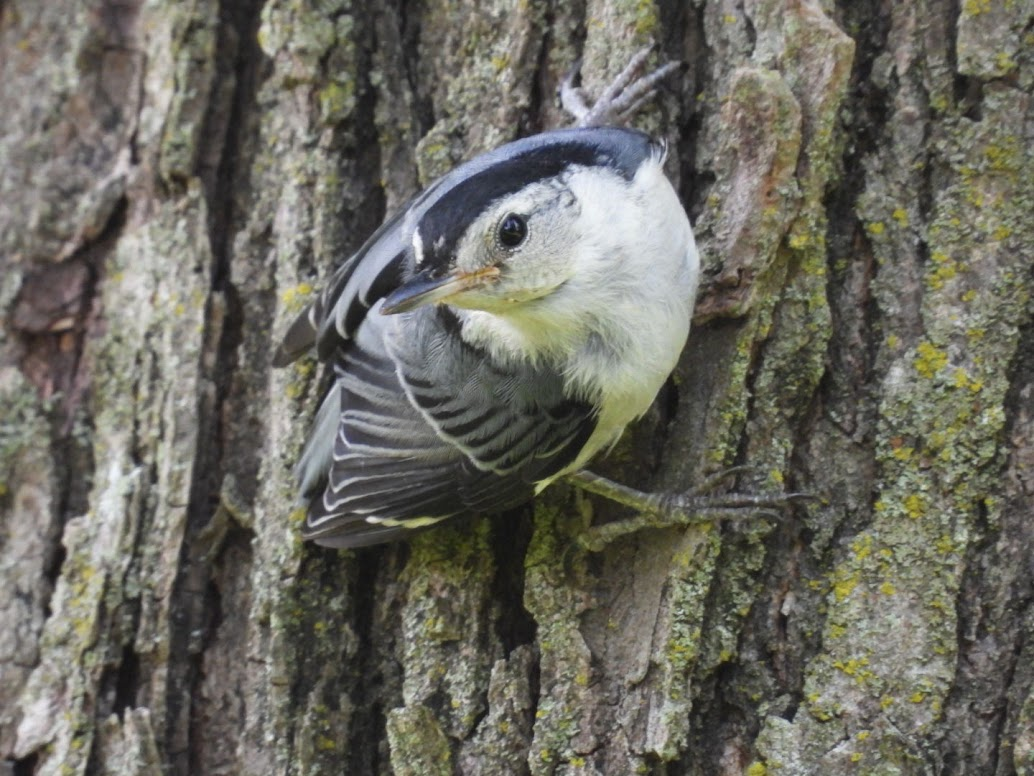 |
| ƒ/5.6, 1/100, ISO800, 144mm (801mm equiv, 33.4X). Lighting adjusted in Google Photos | ƒ/8, 1/80, ISO800, 503mm (2800mm equiv, 116.7X) |
White-tailed Deer
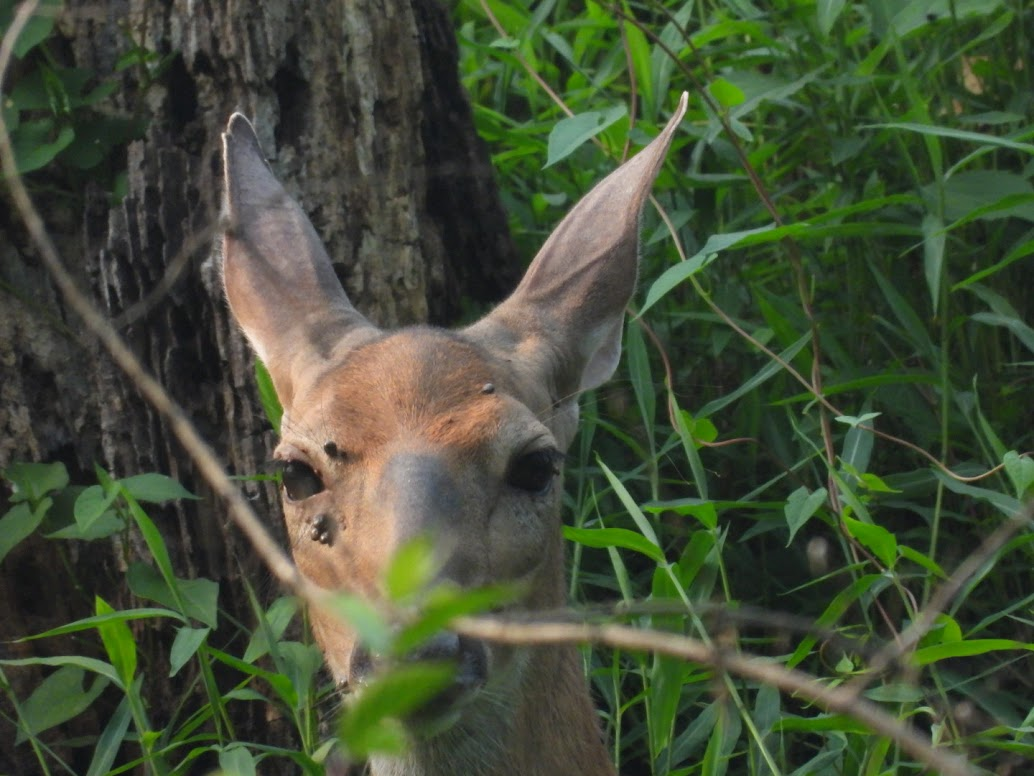
Earlier in the year, I mentioned that there had been a noticeable absence of White-tailed Deer on my property throughout the winter and spring. In summer months, however, they've been showing up a bit more frequently. I think this animal was actually the first wildlife photo that I posted on Steem, 81/2 years ago, and I've posted more photos of them a number of times over the years.
Even in the summer months, they've been less common and more reclusive than in previous years, but I'm happy that at least I'm seeing them again after they disappeared for a few months. Just yesterday, I saw a mother and a fawn in my front yard, but unfortunately I didn't have the camera with me at the moment.
| July 17 | July 17 |
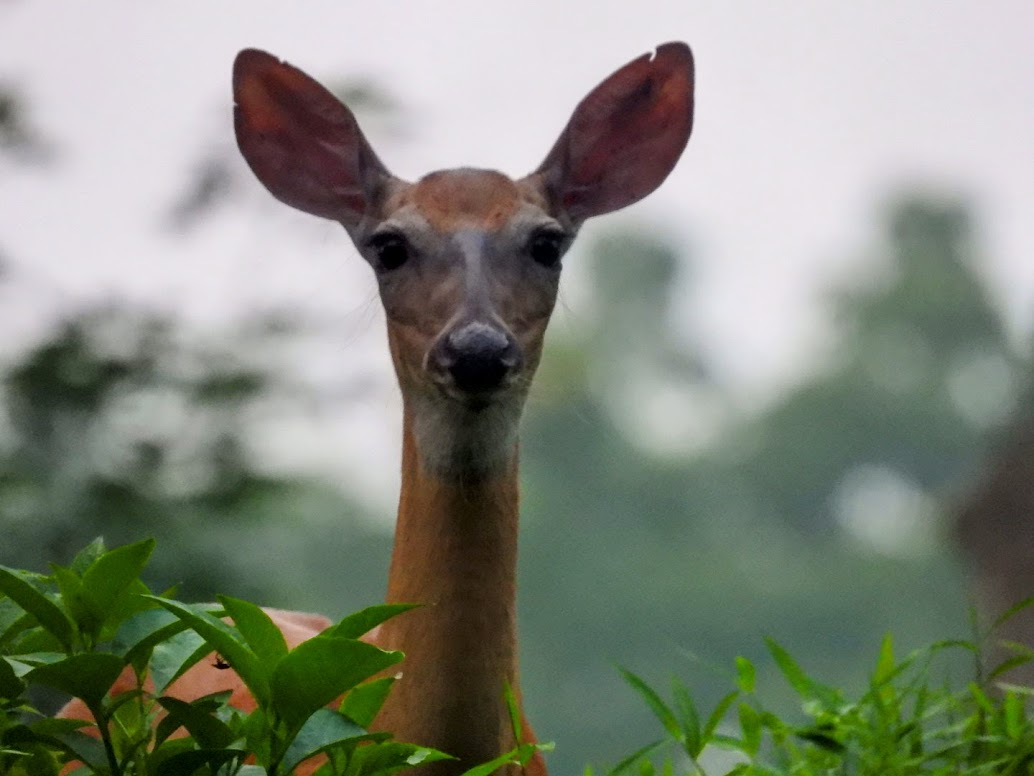 | 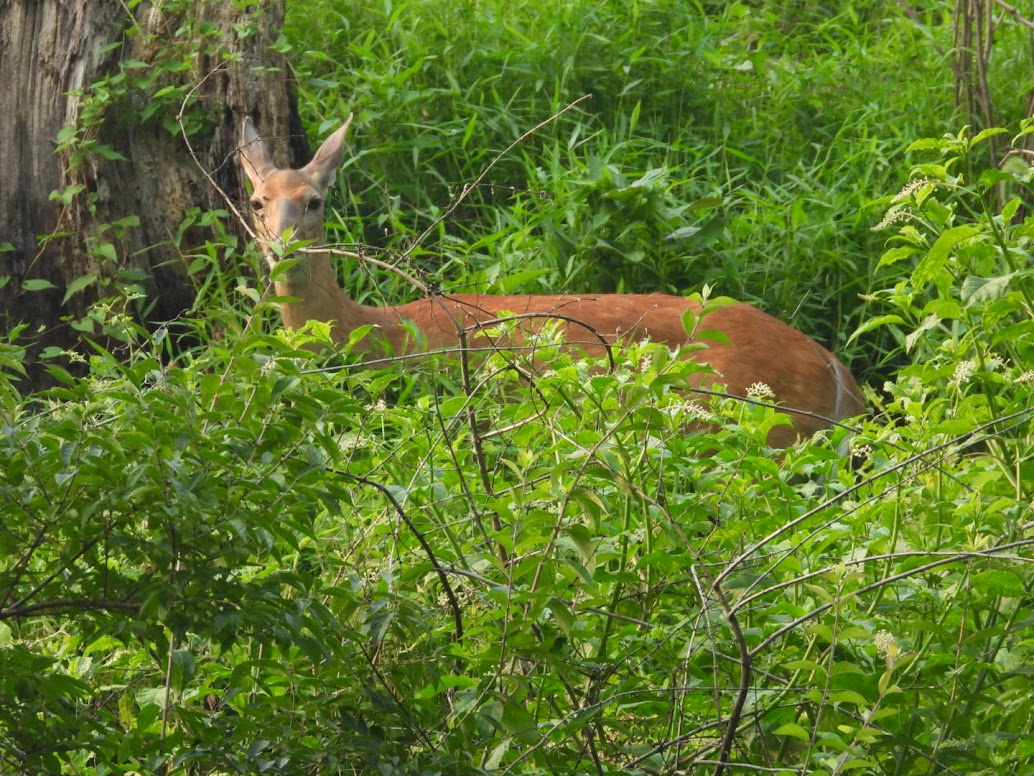 |
| ƒ/6.3, 1/100, ISO1600, 306mm (1703mm equiv, 71.0X). "Dynamic" adjustment in Google Photos | ƒ/5, 1/500, ISO560, 126mm (701mm equiv, 29.2X) |
| July 17 | |
 | |
| ƒ/8, 1/500, ISO1000, 539mm (3000mm equiv, 125.0X) | |
Wrap-up
My favorite encounter from this post was definitely the Song Sparrow. I've seen numerous species splashing around in that air conditioner's condensation puddle, and they all look like they're having fun. Behind that was the White-breasted Nuthatch, which gave me a chance to experiment with camera settings in varying light conditions.
Another thing I was happy about was the Eastern Kingbird in flight. Not a great picture, but I appreciated the practice with cropping and was surprised that the bird turned out to be identifiable.
Leading into August, the big challenge is the European Starling. As I already mentioned, those birds have been gathering in the same tree almost daily, but it's very difficult (maybe impossible?) to get a good quality photo because of the distance and lighting conditions. I think experimentation has led to some small improvements in August, though. Another thing to expect in August is an increased presence from the Eastern Kingbird.
When I started this series with February and March photos, I thought I was learning photography, but with 50 species now observed in iNaturalist, it turns out that I'm learning a lot about nature, too. It's remarkable how much you can learn by just wandering aimlessly with a camera around a small patch of lawn.
Appendix
New: A full index of my posts about wildlife photography is here: wildlife photography index
Notes on the use of AI
As previously noted, I use AI for the following purposes in creating this series:
- Wildlife identification (Merlin, iNaturalist, Meta AI, Claude, Gemini)
- Formatting iNaturalist observations, photographs, dates, and camera settings into markdown tables (Claude)
- Proof-reading and editorial advice (Claude, Gemini, Meta AI, ChatGPT, Grok)
Thank you for your attention!
Unless otherwise specified in the text, all photos above were taken by me with a (hand held) Nikon P1000 camera. I'm sharing them under the CC BY 4.0 license (share & adapt freely with attribution to the original source).
"What a fantastic and informative post! The observation table and camera specs for each photo are so well organized. The Song Sparrow splashing in the AC puddle and possibly hunting a Spotted Lanternfly is such a cool discovery. Great practice with the P1000! Looking forward to your August updates."
Hi, thanks for the reply. FYI, if you're using AI to create your posts & comments, you should probably mention it.
Hi @remlaps,
I appreciate your alertness and informing me of this. English is not my native language and therefore I had to resort to an Artificial Intelligence in order to translate and formulate my message. I’ve gone through the guidelines of the community about Artificial Intelligence usage and from now on, I will compose my messages by myself and notify in case I used AI. Thanks for your guidance!
#luckysquirrel
It would be great to see more content of this quality on Steem.
Thanks for the recognition!
I don't want to praise my own writing, but I definitely agree that it would be great to level-up Steem's article quality. IMO, it's mostly about incentives. I hope some other developers will start exploring longer-term incentive structures like the ones that Thoth users.
If authors believe that valuable content will generate longer-term reward streams, I think they'll start creating more of it.
0.00 SBD,
40.73 STEEM,
40.73 SP
Could the Community Curator accounts help with this...
Well, I feel awkward lobbying for my own project, but since you asked... Here's where I would probably start if I were directing the community curators...
(Background)
thoth.testaccount is currently seeking out posts from authors who have been active within about 950 days. I have to balance how long it takes to run vs. trying not to direct too many rewards to people who are never coming back, so the number of days changes from time to time.(Plan)
thoth.testposts or replies daily/weekly/etc..(Alternate Plan) Steemit could setup and run its own Thoth account and take full control of the filtering and the beneficiary split among
null, authors, delegators, and Steemit - itself (or even create multiple accounts doing independent reports in English, German, and Spanish). This would also have the benefit of increasing the number of authors who get reached each day.If I were running a company like Tron/Steemit, I'd actually go with the alternate plan, fork it, and make it into a professional grade product that uses hivemind instead of the public API endpoints, but I know that you may be constrained by access to development resources. Of course, you could start with the first one and switch to the second later if it works out. They're not mutually exclusive.
Exacto, eso es clave. Además, Lo de "Continuing the series providing an overview of my backyard photography practice..." está bien fundamentado.