Photography meets citizen science: July's wildlife in southeastern Pennsylvania
August is here, so it's time to start on the next monthly summary series with photos and descriptions of the animals that I saw during backyard photography practice in July.
Overall, my sense of the month is that July was relatively slow. There were a lot of repeat animals from previous months, and many cloudy days, so some of the photo quality wasn't great. However, there were some new species and other surprises, too.
In June, I had submitted 55 observations to iNaturalist with 20 species. In July, the corresponding numbers are 36 observations and 21 species.
As in previous months, I discarded many repetitive or very low-quality photos. After the discards, June was left with 1,387 photos and July had 1,419. I think July's higher photo count is misleading, though. I probably didn't clean up photo bursts as aggressively during July because other things were competing for my time.
The decline in the number of observations was likely caused by two distinct factors. First, although the picture count doesn't reflect this, I'm pretty sure I just didn't see as many animals in July. Second, I continued my practice that began in mid-June of only reporting an observation of the same species if there's something unusual about the sighting or if it's a week after the last reported observation. Reporting observations more frequently than that just feels like overkill.
Here's a summary table showing my iNaturalist observations from July (markdown by Claude)
| Common Name | Total Observations | July Observations | First Seen | Observations |
|---|---|---|---|---|
| Gray Catbird | 13 | 4 | 2026-05-01 | 2026-07-02 2026-07-14 2026-07-17 2026-07-22 |
| Red-tailed Hawk | 32 | 4 | 2026-03-19 | 2026-07-01 2026-07-08 2026-07-19 2026-07-25 |
| Turkey Vulture | 34 | 4 | 2026-03-24 | 2026-07-08 2026-07-15 2026-07-23 2026-07-30 |
| Black Vulture | 8 | 3 | 2026-05-03 | 2026-07-08 2026-07-20 2026-07-26 |
| Mourning Dove | 13 | 3 | 2026-03-21 | 2026-07-03 2026-07-14 2026-07-22 |
| Northern Cardinal | 19 | 3 | 2026-03-30 | 2026-07-17 2026-07-23 2026-07-23 |
| American Red Squirrel | 13 | 1 | 2026-03-22 | 2026-07-17 |
| Barn Swallow | 1 | 1 | 2026-07-22 | 2026-07-22 |
| Blue Jay | 15 | 1 | 2026-03-21 | 2026-07-17 |
| Chimney Swift | 1 | 1 | 2026-07-22 | 2026-07-22 |
| Cooper's Hawk | 3 | 1 | 2026-04-26 | 2026-07-14 |
| Eastern Cottontail | 6 | 1 | 2026-05-26 | 2026-07-01 |
| Eastern Kingbird | 4 | 1 | 2026-05-15 | 2026-07-31 |
| European Starling | 3 | 1 | 2026-05-12 | 2026-07-17 |
| Northern Flicker | 10 | 1 | 2026-03-25 | 2026-07-01 |
| Northern House Wren | 1 | 1 | 2026-07-01 | 2026-07-01 |
| Northern Mockingbird | 1 | 1 | 2026-07-25 | 2026-07-25 |
| Red-bellied Woodpecker | 7 | 1 | 2026-03-01 | 2026-07-13 |
| Song Sparrow | 7 | 1 | 2026-05-22 | 2026-07-02 |
| White-breasted Nuthatch | 3 | 1 | 2026-03-29 | 2026-07-02 |
| White-tailed Deer | 3 | 1 | 2026-05-29 | 2026-07-17 |
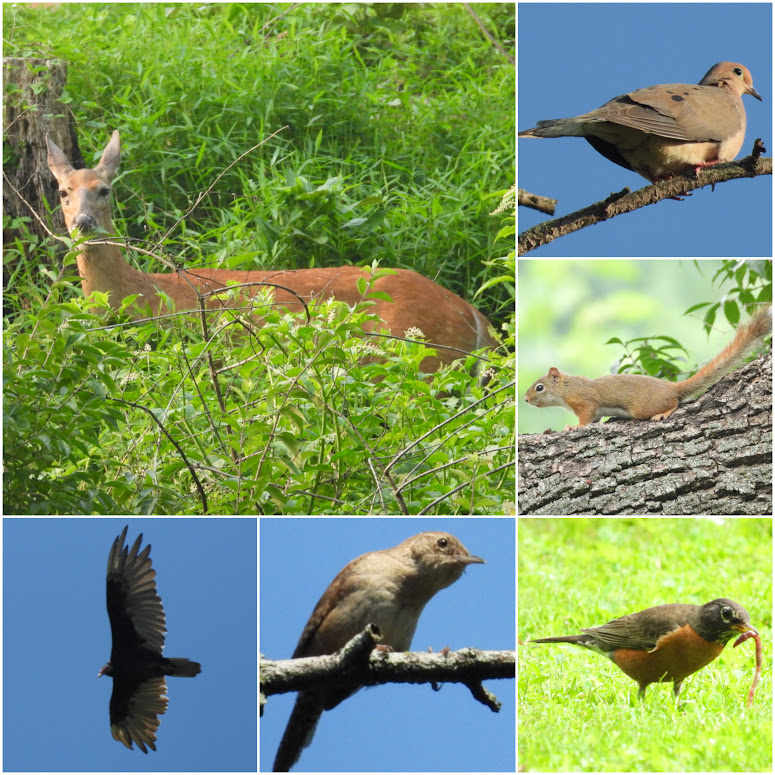
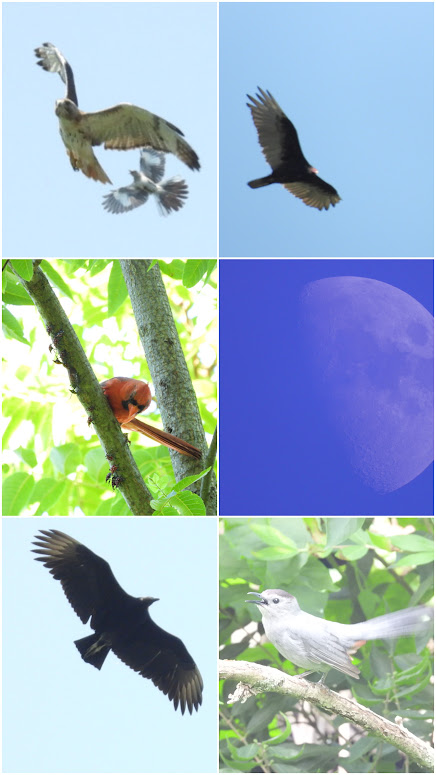
Topping the list are several animals that I have seen before, but in the single-observation portion of the list are, surprisingly, four species that I hadn't seen in previous months: Barn Swallow, Chimney Swift, Northern House Wren, and Northern Mockingbird. Three of the four are included in the Google Photos collages that are embedded in this post.
Also, because I'm reporting individual species less frequently to iNaturalist, more of this month's photos may be appearing for the first time here on Steem.
New this month
| Because July was the fourth full month of observations, we can start looking at the observation trends over time, too. | I also started capturing screenshots of the birds that Merlin heard while I was out. |
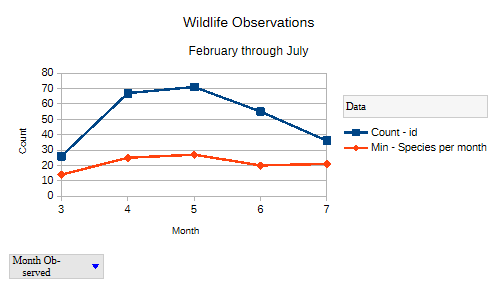 | 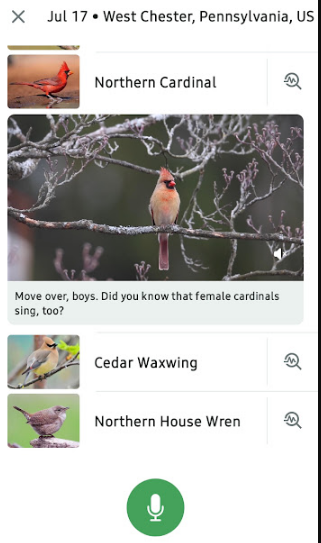 |
| The count (blue) shows the number of iNaturalist observations submitted during the month, and the "Species per month" (red) shows the number of unique species that were recorded. | Merlin normally hears many more birds than the ones I see. Finding them hiding behind the leafy tree branches has proved challenging. |
Reflections on the month
The Merlin sound-based identifications add a new dimension to these wildlife walks of mine. Merlin has identified numerous species that I haven't managed to observe visually. Some of these include: a Blue-Gray Gnatcatcher, an American Goldfinch, a Tufted Titmouse, a Marsh Wren, a Chipping Sparrow (I eventually saw one of these in August), an Eastern Towhee, an Eastern Phoebe, and probably more.
As with June, I think the mammals were more common than in the spring, and the birds were less common and harder to find. Additionally, most of the animals seemed to be harder to photograph because they were less prone to sitting still. Even the mammals were less common in July than in June, though.
A big change from June was the disappearance of the juvenile birds and mammals. The most common animals were still the American Robins and the Gray Catbirds, but even sighting those birds became less common, and the Catbirds especially hid more and moved around faster.
As far as mammals go, I should mention that I also saw a Red Fox in July (as well as previous months), but I wasn't quick enough to get a photo.
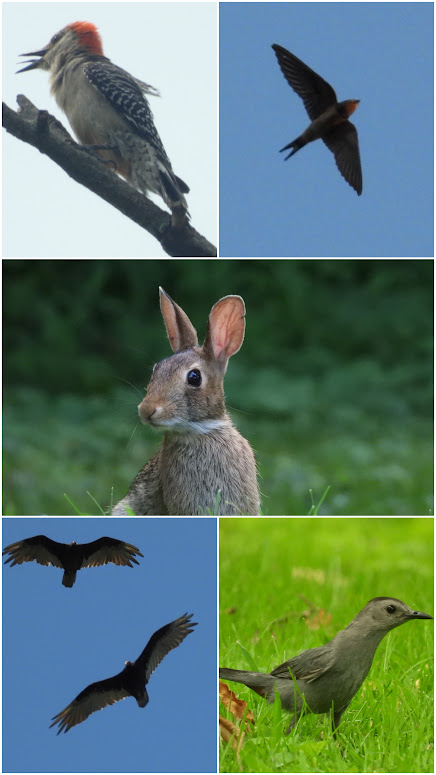
Another thing new for me this month was that I managed to get some shots of smaller birds in flight. The quality wasn't great, but several photos were at least good enough that I could get an ID on the birds.
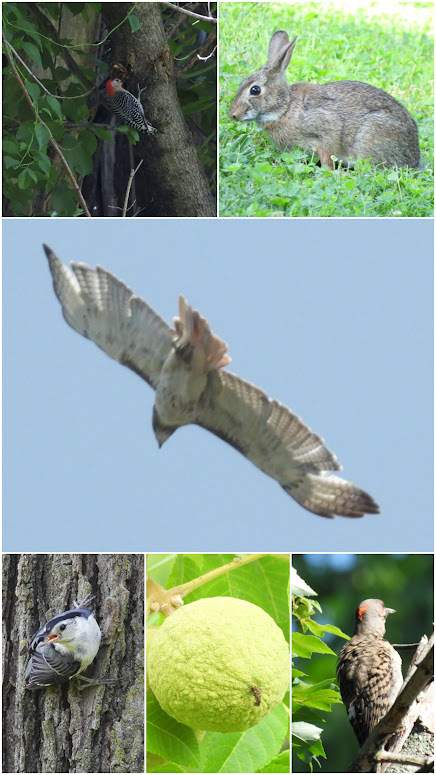
I've lived here for 20-some years and didn't know until this year that some of the trees behind my yard are Black Walnut trees, as you can see from the nut in the collage on the left.
Like the other animals, raptors were less common this month. Only the Turkey Vulture was dependable to show up every day or two. The Red-tailed Hawk and Black Vulture were seen much less frequently, and I didn't see any other raptor species at all. (I haven't seen a Bald Eagle since May.)
The month's biggest surprise
The state of Pennsylvania has quarantines in place for 56 of its 67 counties in hopes of containing an invasive species of insect, the Spotted Lanternfly. These quarantines require businesses that transport goods through the quarantined counties to obtain permits and undergo inspections, in order to prevent businesses from spreading the invader.
I first heard of the Lanternfly about 6 or 7 years ago, after it had arrived in Pennsylvania from its native habitat in China. One of the things that was worrisome was that it had no natural predators in the United States, so there were no natural constraints on how quickly it might spread. When the Lanternfly infests certain types of trees, it emits a sticky substance that attracts mold and kills the tree. The quarantines are in place because this threatens the state's agricultural industry.
However, on July 23, I was surprised to learn that the Lanternfly has now acquired some predators. Specifically, I accidentally captured some photos of a pair of Northern Cardinals, at least one of which was hunting and eating the Lanternfly. Subsequent web searches confirmed that some American birds and insects have now developed a taste for Lanternflies.
Wrap-up
As with previous months, I'll do a couple more posts this month to publish some of the photographs from July, and to offer commentary. I'm guessing maybe that'll be 3 posts, at most, but we'll see how it works out. Now that I have the Merlin screenshots, maybe I'll also do a roundup post to detail the birds that were heard and not necessarily seen.
Appendix
Notes on the use of AI
As previously noted, I use AI for the following purposes in creating this series:
- Wildlife identification (Merlin, iNaturalist, Meta AI, Claude, Gemini)
- Formatting iNaturalist observations, photographs, dates, and camera settings into markdown tables (Claude)
- Proof-reading and editorial advice (Claude, Gemini, Meta AI, ChatGPT, Grok)
Here are my previous wildlife photography posts:
July photographs
June photographs
- The Raptors of June in Southeastern Pennsylvania: Vultures and Hawks
- Backyard Wildlife Photos in Southeastern Pennsylvania: Still more small birds during June
- Backyard Wildlife Photos in Southeastern Pennsylvania: A few more small birds during June
- Backyard Wildlife Photos in Southeastern Pennsylvania: Mammals and Small Birds during June
- Photography meets citizen science: June's wildlife in south-eastern Pennsylvania
May's photographs
- Hawks and a Bald Eagle: May raptor photography practice in southeastern Pennsylvania - part 2
- Vultures and Kites: May raptor photography practice in southeastern Pennsylvania - part 1
- Wildlife photographs in southeastern Pennsylvania: Small animals with multi-month sightings in May - part 2
- Wildlife photographs in southeastern Pennsylvania: Small animals with multi-month sightings in May - part 1
- Backyard wildlife photography in southeastern Pennsylvania: First encounters during May - post 2
- Backyard wildlife photography in southeastern Pennsylvania: Something Old - Something New
- Photography meets citizen science: May's wildlife in south-eastern Pennsylvania
April's photographs
- [Citizen Science] April's Raptors in South-Eastern Pennsylvania
- Photography meets citizen science: April's wildlife in south-eastern Pennsylvania
- Learning photography with wildlife in south-eastern Pennsylvania: First encounters in the month of April
- Learning photography with wildlife in south-eastern Pennsylvania: First encounters in the month of April - part 2
- April wildlife observations in south-eastern Pennsylvania: repeated encounters with small animals
March's photographs
- Backyard Photography in Chester County, Pennsylvania during March 2026: Warm-up Shots
- [Citizen Science] Observations of Small Birds and Animals in South-eastern Pennsylvania from March of 2026
- [Citizen Science] The Raptors of March in South-Eastern Pennsylvania
Thank you for your attention!
Unless otherwise specified in the text, all photos above were taken by me with a (hand held) Nikon P1000 camera. I'm sharing them under the CC BY 4.0 license (share & adapt freely with attribution to the original source).